QUESTION IMAGE
Question
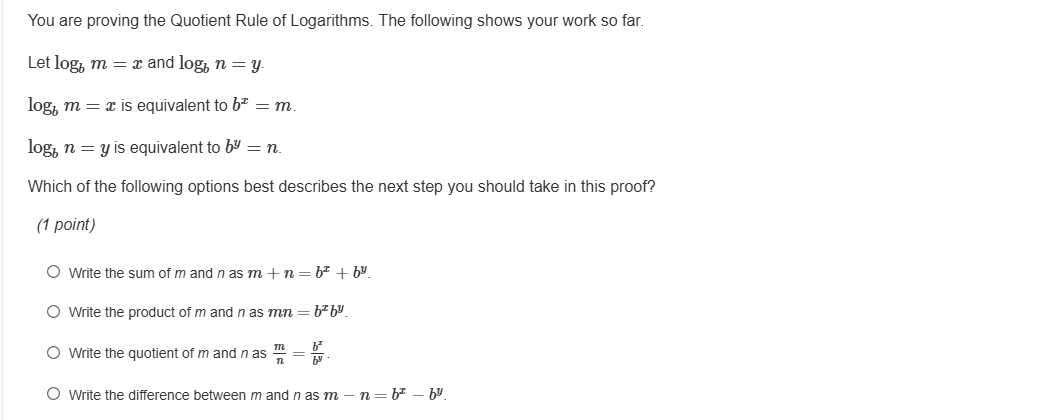
you are proving the quotient rule of logarithms. the following shows your work so far.
let \\(\log_b m = x\\) and \\(\log_b n = y\\).
\\(\log_b m = x\\) is equivalent to \\(b^x = m\\).
\\(\log_b n = y\\) is equivalent to \\(b^y = n\\).
which of the following options best describes the next step you should take in this proof?
(1 point)
\\(\circ\\) write the sum of \\(m\\) and \\(n\\) as \\(m + n = b^x + b^y\\).
\\(\circ\\) write the product of \\(m\\) and \\(n\\) as \\(mn = b^x b^y\\).
\\(\circ\\) write the quotient of \\(m\\) and \\(n\\) as \\(\frac{m}{n} = \frac{b^x}{b^y}\\).
\\(\circ\\) write the difference between \\(m\\) and \\(n\\) as \\(m - n = b^x - b^y\\).
To prove the Quotient Rule of Logarithms (\(\log_b \frac{m}{n}=\log_b m - \log_b n\)), we start with \(\log_b m=x\) (so \(b^x = m\)) and \(\log_b n = y\) (so \(b^y=n\)). The quotient of \(m\) and \(n\) is \(\frac{m}{n}\), and substituting \(m = b^x\) and \(n = b^y\) gives \(\frac{m}{n}=\frac{b^x}{b^y}\). This is the logical next step as the Quotient Rule involves the quotient of two numbers, not their sum, product, or difference.

Snap & solve any problem in the app
Get step-by-step solutions on Sovi AI
Photo-based solutions with guided steps
Explore more problems and detailed explanations
C. Write the quotient of \(m\) and \(n\) as \(\frac{m}{n}=\frac{b^x}{b^y}\)