QUESTION IMAGE
Question
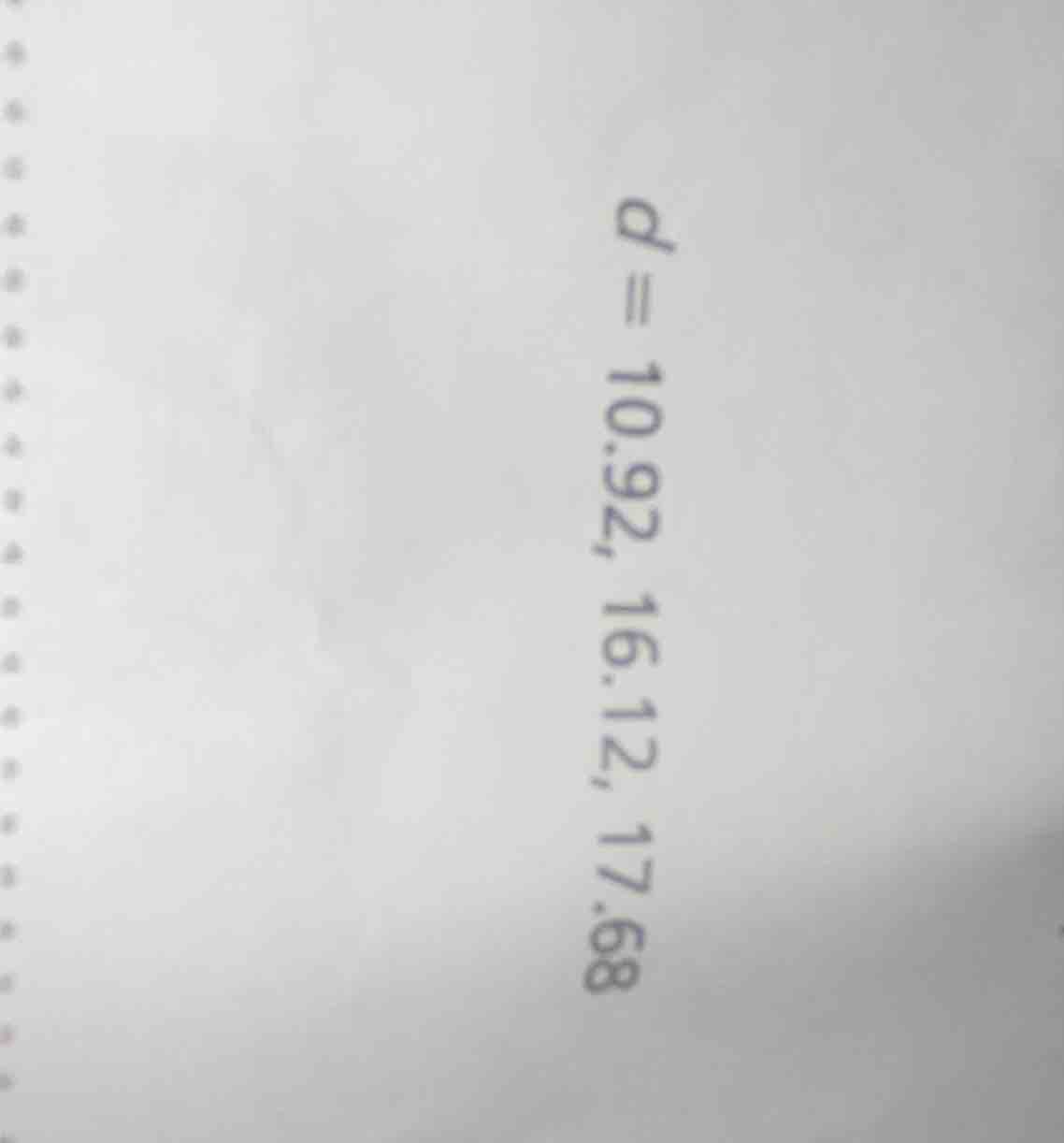
d = 10.92, 16.12, 17.68
Step1: Identify the sequence type
The given sequence is \( 10.92, 16.12, 17.68 \)? Wait, maybe it's an arithmetic sequence? Wait, let's check the difference between consecutive terms. Wait, maybe the first term is \( a_1 = 10.92 \), second \( a_2 = 16.12 \), third \( a_3 = 17.68 \)? Wait, no, maybe the common difference \( d \) is to be found? Wait, maybe the sequence is arithmetic. Let's calculate the difference between the second and first term: \( 16.12 - 10.92 = 5.2 \). Then between third and second: \( 17.68 - 16.12 = 1.56 \). Wait, that's not consistent. Wait, maybe the numbers are \( 10.92, 16.12, 17.68 \) with a typo? Or maybe it's a different sequence. Wait, maybe the user wants to find the common difference \( d \) for an arithmetic sequence. Wait, maybe the first two terms are \( 10.92 \) and \( 16.12 \), so \( d = 16.12 - 10.92 = 5.2 \). Wait, but the third term is \( 17.68 \), which would make \( d = 17.68 - 16.12 = 1.56 \), which is inconsistent. Maybe the sequence is \( 10.92, 16.12, 21.32 \)? Then \( d = 5.2 \). Wait, maybe the original problem is to find \( d \) for an arithmetic sequence with terms \( 10.92, 16.12, 21.32, \dots \). Then:
Step1: Calculate the common difference
For an arithmetic sequence, the common difference \( d \) is \( a_{n+1} - a_n \). Taking the first two terms: \( a_1 = 10.92 \), \( a_2 = 16.12 \). Then \( d = a_2 - a_1 = 16.12 - 10.92 = 5.2 \).
Step2: Verify with next term (if applicable)
If the next term is \( a_3 = a_2 + d = 16.12 + 5.2 = 21.32 \), but the given third term is \( 17.68 \), which is different. Maybe there's a mistake, but assuming the first two terms are correct for an arithmetic sequence, \( d = 5.2 \).

Snap & solve any problem in the app
Get step-by-step solutions on Sovi AI
Photo-based solutions with guided steps
Explore more problems and detailed explanations
The common difference \( d \) (assuming arithmetic sequence with first two terms) is \( \boldsymbol{5.2} \).