QUESTION IMAGE
Question
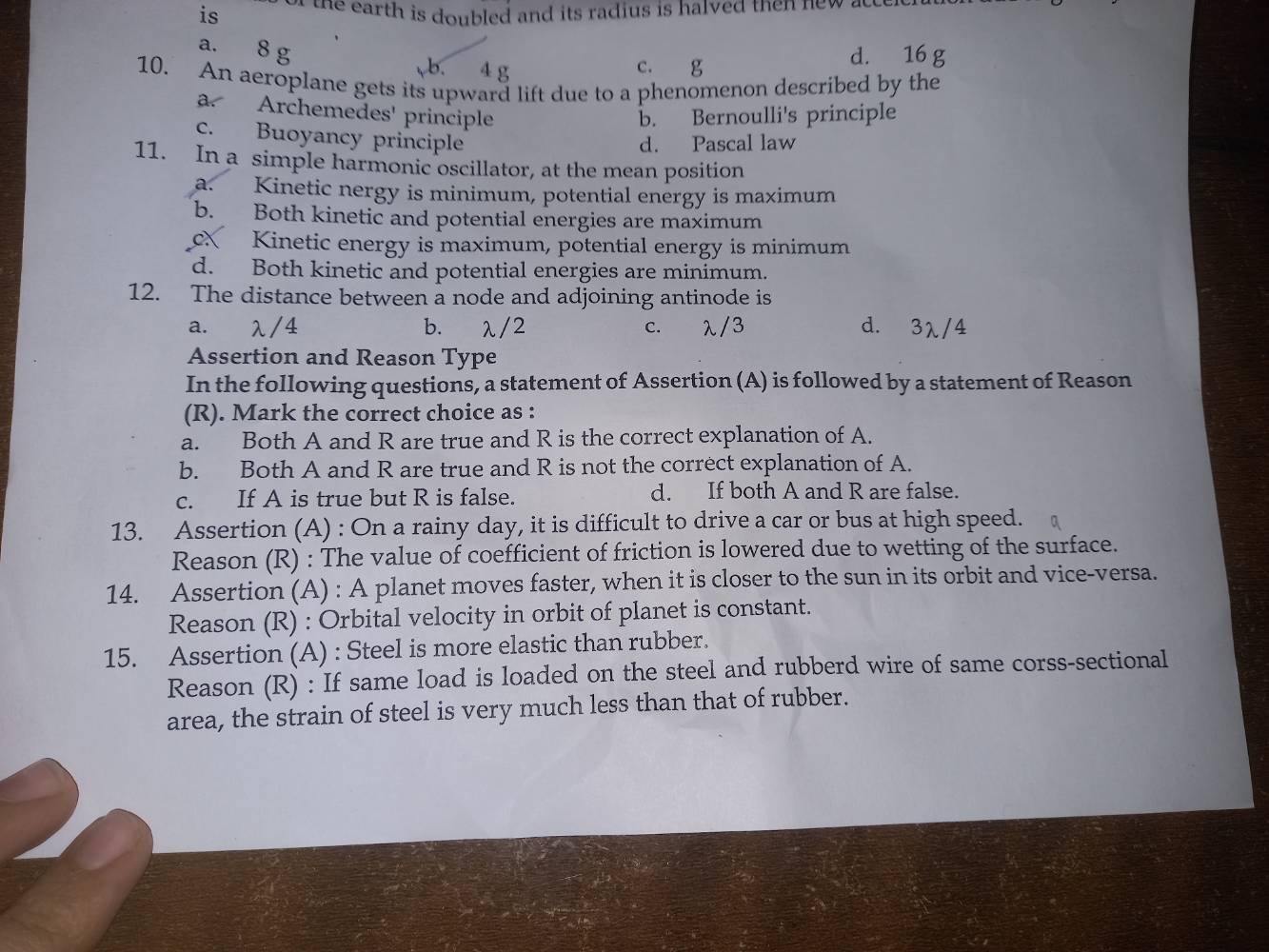
is
a. $8g$ b. $4g$ c. $g$ d. $16g$
- an aeroplane gets its upward lift due to a phenomenon described by the
a. archemedes principle b. bernoullis principle
c. buoyancy principle d. pascal law
- in a simple harmonic oscillator, at the mean position
a. kinetic energy is minimum, potential energy is maximum
b. both kinetic and potential energies are maximum
c. kinetic energy is maximum, potential energy is minimum
d. both kinetic and potential energies are minimum.
- the distance between a node and adjoining antinode is
a. $\lambda/4$ b. $\lambda/2$ c. $\lambda/3$ d. $3\lambda/4$
assertion and reason type
in the following questions, a statement of assertion (a) is followed by a statement of reason (r). mark the correct choice as :
a. both a and r are true and r is the correct explanation of a.
b. both a and r are true and r is not the correct explanation of a.
c. if a is true but r is false. d. if both a and r are false.
- assertion (a) : on a rainy day, it is difficult to drive a car or bus at high speed.
reason (r) : the value of coefficient of friction is lowered due to wetting of the surface.
- assertion (a) : a planet moves faster, when it is closer to the sun in its orbit and vice-versa.
reason (r) : orbital velocity in orbit of planet is constant.
- assertion (a) : steel is more elastic than rubber.
reason (r) : if same load is loaded on the steel and rubber wire of same corss-sectional area, the strain of steel is very much less than that of rubber.
- Upward lift of airplanes relies on pressure differences from fluid speed, explained by Bernoulli's principle.
- In simple harmonic motion, mean position has zero displacement (minimum potential energy) and maximum velocity (maximum kinetic energy).
- By wave properties, the distance between a node and adjacent antinode is one-fourth the wavelength.
- Rain wets roads, reducing friction (makes high-speed driving hard); both A and R are true, R explains A.
- Planets move faster closer to the sun (Kepler's 2nd law), but orbital velocity is not constant; A is true, R is false.
- Elasticity depends on strain under load; steel has less strain than rubber under same load, so it's more elastic; both A and R are true, R explains A.

Snap & solve any problem in the app
Get step-by-step solutions on Sovi AI
Photo-based solutions with guided steps
Explore more problems and detailed explanations
- b. Bernoulli's principle
- c. Kinetic energy is maximum, potential energy is minimum
- a. $\lambda/4$
- a. Both A and R are true and R is the correct explanation of A.
- c. If A is true but R is false.
- a. Both A and R are true and R is the correct explanation of A.