QUESTION IMAGE
Question
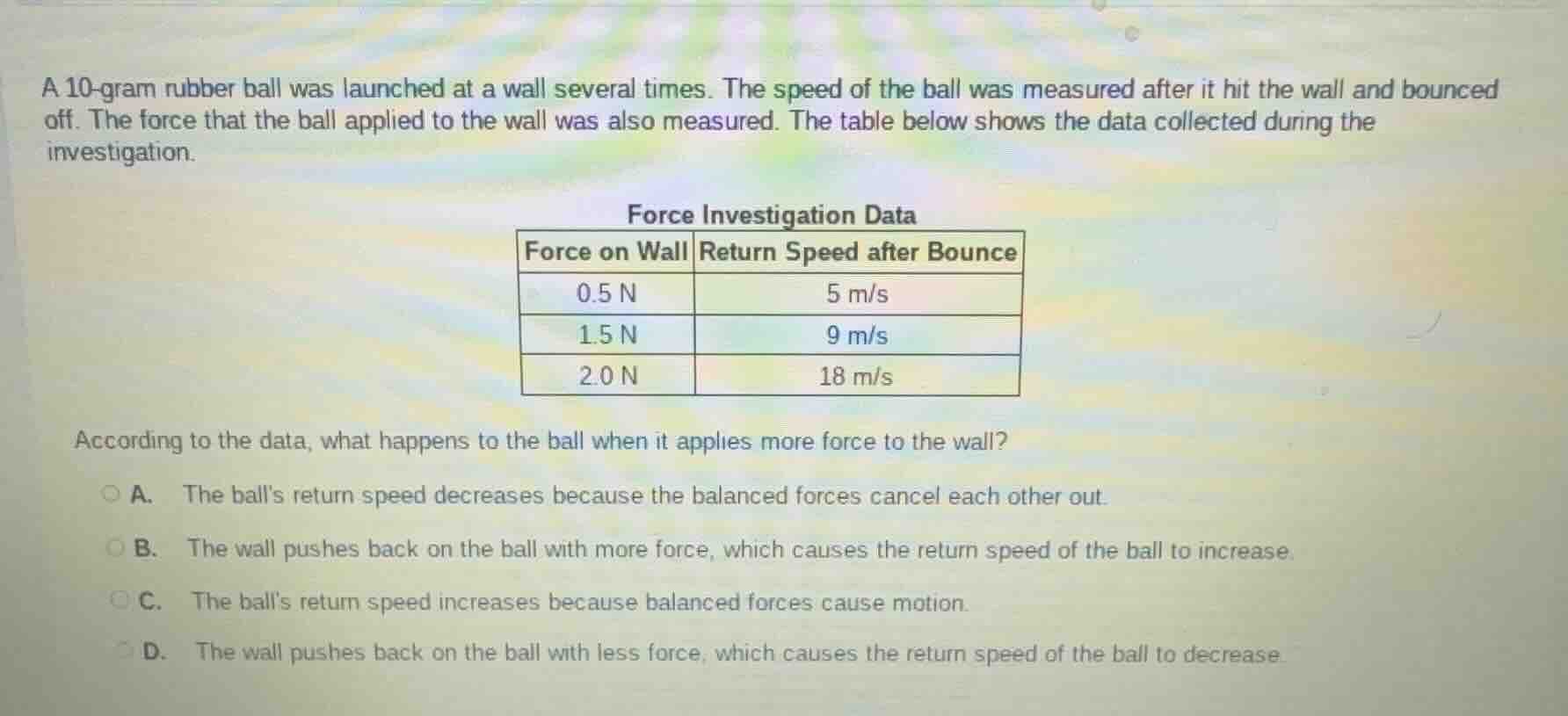
a 10-gram rubber ball was launched at a wall several times. the speed of the ball was measured after it hit the wall and bounced off. the force that the ball applied to the wall was also measured. the table below shows the data collected during the investigation.
force investigation data
| force on wall | return speed after bounce |
|---|---|
| 1.5 n | 9 m/s |
| 2.0 n | 18 m/s |
according to the data, what happens to the ball when it applies more force to the wall?
a. the balls return speed decreases because the balanced forces cancel each other out.
b. the wall pushes back on the ball with more force, which causes the return speed of the ball to increase.
c. the balls return speed increases because balanced forces cause motion.
d. the wall pushes back on the ball with less force, which causes the return speed of the ball to decrease.
- Observe the data: as the force the ball applies to the wall increases (0.5 N → 1.5 N → 2.0 N), the ball's return speed also increases (5 m/s → 9 m/s → 18 m/s).
- Newton's Third Law states that for every force applied by the ball to the wall, the wall exerts an equal and opposite force back on the ball. A larger reaction force from the wall accelerates the ball more, increasing its return speed.
- Eliminate incorrect options: A and D claim speed decreases, which contradicts the data. C incorrectly cites balanced forces; the forces here are action-reaction pairs, not balanced, and balanced forces do not cause acceleration/change in speed.

Snap & solve any problem in the app
Get step-by-step solutions on Sovi AI
Photo-based solutions with guided steps
Explore more problems and detailed explanations
B. The wall pushes back on the ball with more force, which causes the return speed of the ball to increase.