QUESTION IMAGE
Question
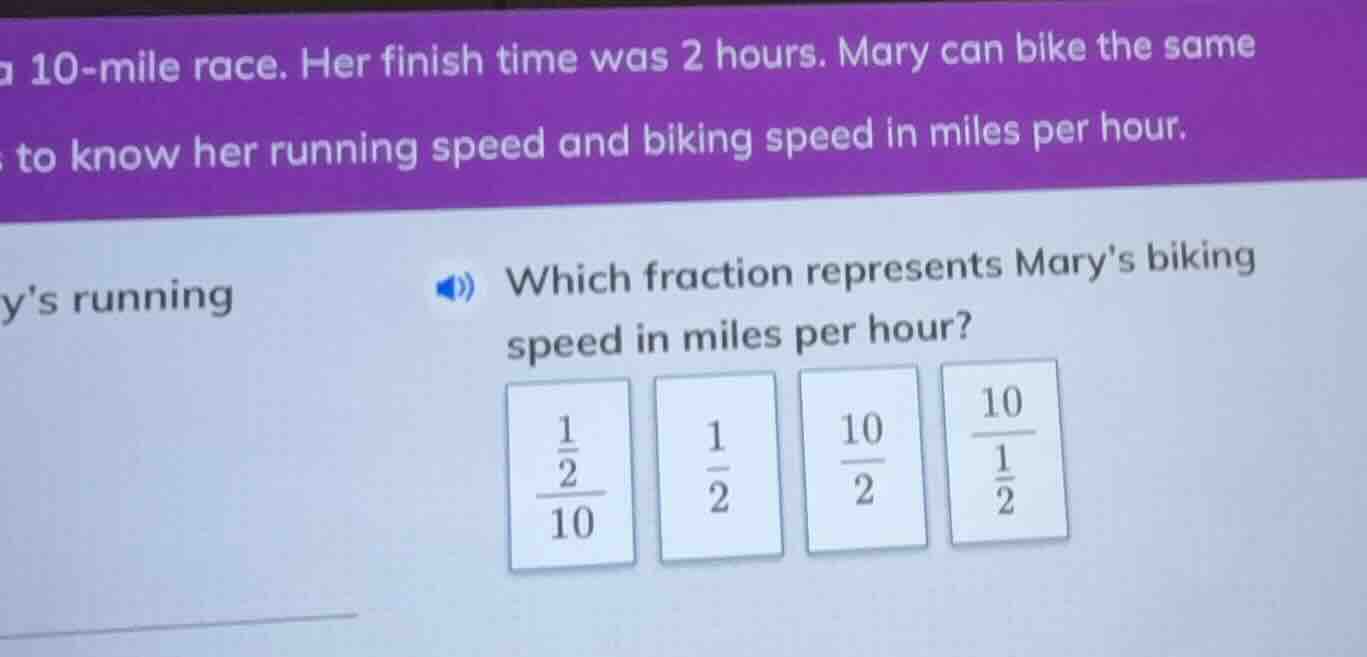
a 10-mile race. her finish time was 2 hours. mary can bike the same to know her running speed and biking speed in miles per hour. ys running which fraction represents marys biking speed in miles per hour? \\(\frac{\frac{1}{2}}{10}\\) \\(\frac{1}{2}\\) \\(\frac{10}{2}\\) \\(\frac{10}{\frac{1}{2}}\\)
Step1: Recall the speed formula
Speed is calculated as distance divided by time, so the formula is \( \text{Speed} = \frac{\text{Distance}}{\text{Time}} \).
Step2: Identify distance and time for biking
The distance for biking is the same as the running race, which is 10 miles. The time taken for biking (assuming it's the same context, maybe a typo but from the running info, time is 2 hours? Wait, the problem says "Mary can bike the same" (probably same distance) and we need biking speed. So distance \( d = 10 \) miles, time \( t = \frac{1}{2} \) hours? Wait no, wait the running race: 10 - mile race, finish time 2 hours. Wait the question is about biking speed. Wait maybe the biking time is \( \frac{1}{2} \) hour? Wait no, looking at the options. Wait the options: let's re - read. The question is "Which fraction represents Mary's biking speed in miles per hour?". Let's assume that the distance for biking is 10 miles (same as running) and the time for biking is \( \frac{1}{2} \) hour? Wait no, maybe I misread. Wait the running: 10 - mile, 2 hours. But for biking, maybe the time is \( \frac{1}{2} \) hour? Wait no, the options: let's check the formula \( \text{Speed}=\frac{\text{Distance}}{\text{Time}} \). If distance is 10 miles and time is \( \frac{1}{2} \) hour, then speed is \( \frac{10}{\frac{1}{2}} \). Wait but let's check the options. The fourth option is \( \frac{10}{\frac{1}{2}} \), the third is \( \frac{10}{2} \), second is \( \frac{1}{2} \), first is \( \frac{\frac{1}{2}}{10} \). Wait maybe the biking time is \( \frac{1}{2} \) hour? Wait no, maybe the problem is that when running, 10 miles in 2 hours, but for biking, maybe the time is \( \frac{1}{2} \) hour? Wait no, let's think again. Wait the formula for speed is distance over time. So if Mary bikes 10 miles (same as running) and the time taken for biking is \( \frac{1}{2} \) hour, then speed is \( \frac{10}{\frac{1}{2}} \). But let's check the options. Wait maybe I made a mistake. Wait the running: 10 miles, 2 hours. But the question is about biking. Wait maybe the biking time is \( \frac{1}{2} \) hour. So using \( \text{Speed}=\frac{\text{Distance}}{\text{Time}} \), with distance = 10 miles and time=\( \frac{1}{2} \) hour, the speed is \( \frac{10}{\frac{1}{2}} \), which is the fourth option. Wait but let's confirm. The formula for speed is \( v=\frac{d}{t} \), where \( d \) is distance and \( t \) is time. If \( d = 10 \) miles and \( t=\frac{1}{2} \) hour, then \( v=\frac{10}{\frac{1}{2}} \). So the fraction representing her biking speed is \( \frac{10}{\frac{1}{2}} \), which is the fourth option.

Snap & solve any problem in the app
Get step-by-step solutions on Sovi AI
Photo-based solutions with guided steps
Explore more problems and detailed explanations
\(\boldsymbol{\frac{10}{\frac{1}{2}}}\) (the fourth option among the given options)