QUESTION IMAGE
Question
- political cartoon – identify the major symbols in the cartoon and meaning of the caption.
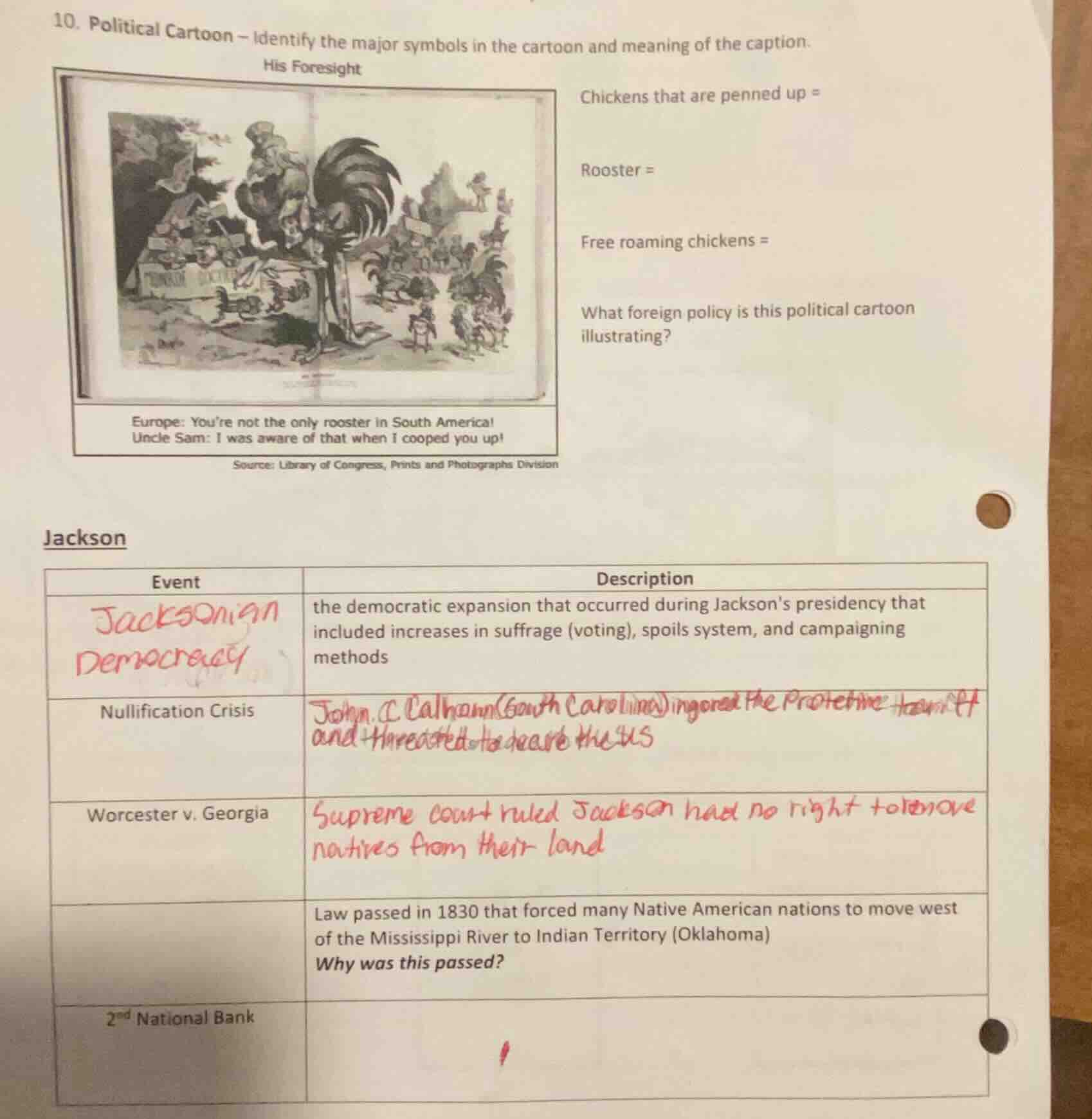
his foresight
chickens that are penned up =
rooster =
free roaming chickens =
what foreign policy is this political cartoon
illustrating?
europe: youre not the only rooster in south america!
uncle sam: i was aware of that when i cooped you up!
source: library of congress, prints and photographs division
jackson
event description
jacksonian democracy the democratic expansion that occurred during jacksons presidency that
included increases in suffrage (voting), spoils system, and campaigning
methods
nullification crisis
worcester v. georgia
law passed in 1830 that forced many native american nations to move west
of the mississippi river to indian territory (oklahoma)
why was this passed?
2nd national bank
Political Cartoon Symbolism and Foreign Policy
1. Symbols in the Cartoon:
- Chickens that are penned up: European nations (restricted by U.S. foreign policy in the Americas).
- Rooster: Uncle Sam (representing the United States, asserting influence in the Americas).
- Free - roaming chickens: Independent or U.S. - influenced nations in South America (free from direct European control in the region).
2. Foreign Policy Illustrated:
The cartoon illustrates the Monroe Doctrine. The Monroe Doctrine (1823) stated that the Americas were no longer open to European colonization or interference, and the U.S. would act to protect this sphere of influence. The dialogue (“You’re not the only rooster in South America!” and “I was aware of that when I cooped you up!”) shows the U.S. (Uncle Sam as the rooster) asserting control over European influence (penned - up chickens) in the Americas, with South American nations as the free - roaming chickens under U.S. - led regional dominance.
Jackson - Era Events (Table Completion)
1. Nullification Crisis:
- Description: John C. Calhoun (of South Carolina) argued that states could nullify (declare void) federal laws they deemed unconstitutional. The crisis centered around a protective tariff; South Carolina threatened nullification, and Jackson responded by preparing for military action while also seeking a compromise tariff to resolve the dispute.
2. Worcester v. Georgia:
- Description: The Supreme Court ruled that the state of Georgia had no right to enforce laws on Cherokee tribal land, as the Cherokee were a sovereign nation. Jackson is often noted for his refusal to enforce this ruling (“John Marshall has made his decision; now let him enforce it”), leading to continued pressure on Native Americans.
3. Indian Removal Act (the law described in the table row):
- Description: Law passed in 1830 that forced many Native American nations to move west of the Mississippi River to Indian Territory (Oklahoma).
- Why was this passed?: To make land in the Southeast (where Native Americans lived) available for white settlement (especially for cotton plantations) and to remove Native American tribes from areas of perceived “white” expansion.
4. 2nd National Bank:
- Description: Jackson opposed the Second Bank of the United States, viewing it as an undemocratic institution that favored the wealthy. He vetoed its re - charter, and the bank’s power declined, leading to economic instability in the years following (the “Bank War” was a major political conflict of his presidency).

Snap & solve any problem in the app
Get step-by-step solutions on Sovi AI
Photo-based solutions with guided steps
Explore more problems and detailed explanations
Political Cartoon Symbolism and Foreign Policy
1. Symbols in the Cartoon:
- Chickens that are penned up: European nations (restricted by U.S. foreign policy in the Americas).
- Rooster: Uncle Sam (representing the United States, asserting influence in the Americas).
- Free - roaming chickens: Independent or U.S. - influenced nations in South America (free from direct European control in the region).
2. Foreign Policy Illustrated:
The cartoon illustrates the Monroe Doctrine. The Monroe Doctrine (1823) stated that the Americas were no longer open to European colonization or interference, and the U.S. would act to protect this sphere of influence. The dialogue (“You’re not the only rooster in South America!” and “I was aware of that when I cooped you up!”) shows the U.S. (Uncle Sam as the rooster) asserting control over European influence (penned - up chickens) in the Americas, with South American nations as the free - roaming chickens under U.S. - led regional dominance.
Jackson - Era Events (Table Completion)
1. Nullification Crisis:
- Description: John C. Calhoun (of South Carolina) argued that states could nullify (declare void) federal laws they deemed unconstitutional. The crisis centered around a protective tariff; South Carolina threatened nullification, and Jackson responded by preparing for military action while also seeking a compromise tariff to resolve the dispute.
2. Worcester v. Georgia:
- Description: The Supreme Court ruled that the state of Georgia had no right to enforce laws on Cherokee tribal land, as the Cherokee were a sovereign nation. Jackson is often noted for his refusal to enforce this ruling (“John Marshall has made his decision; now let him enforce it”), leading to continued pressure on Native Americans.
3. Indian Removal Act (the law described in the table row):
- Description: Law passed in 1830 that forced many Native American nations to move west of the Mississippi River to Indian Territory (Oklahoma).
- Why was this passed?: To make land in the Southeast (where Native Americans lived) available for white settlement (especially for cotton plantations) and to remove Native American tribes from areas of perceived “white” expansion.
4. 2nd National Bank:
- Description: Jackson opposed the Second Bank of the United States, viewing it as an undemocratic institution that favored the wealthy. He vetoed its re - charter, and the bank’s power declined, leading to economic instability in the years following (the “Bank War” was a major political conflict of his presidency).