QUESTION IMAGE
Question
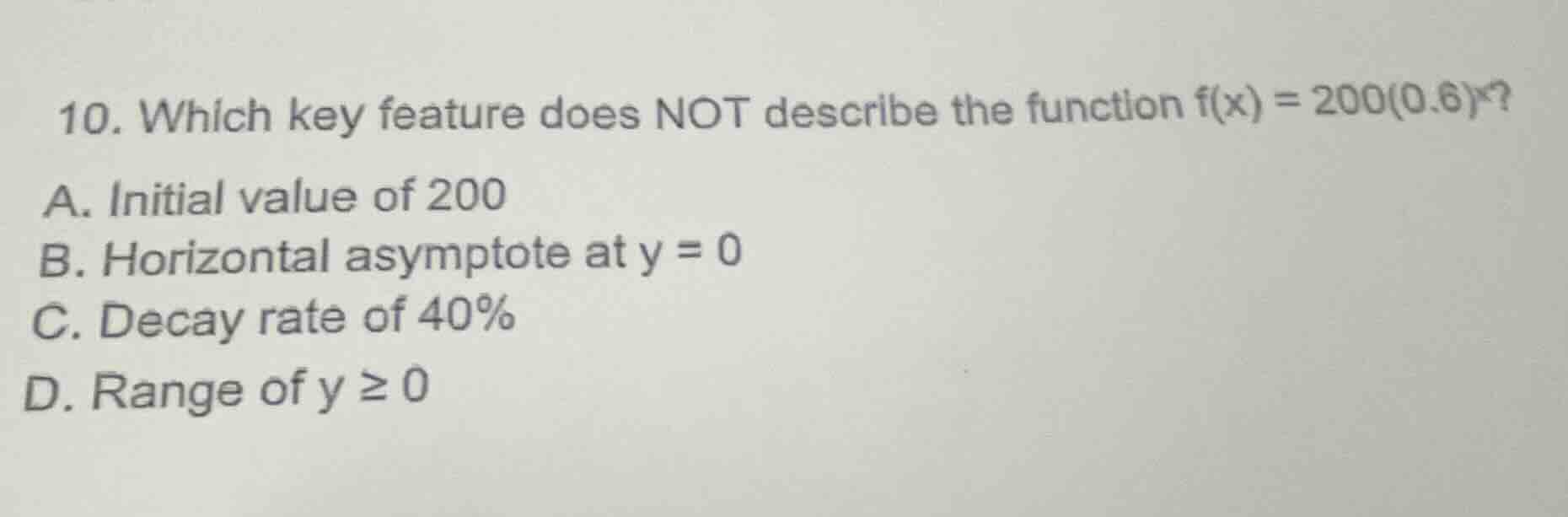
- which key feature does not describe the function $f(x) = 200(0.6)^x$?
a. initial value of 200
b. horizontal asymptote at $y = 0$
c. decay rate of 40%
d. range of $y \geq 0$
Brief Explanations
- Analyze Option A: For an exponential function \( f(x)=a(b)^x \), the initial value (when \( x = 0 \)) is \( a \). Here, \( a = 200 \), so \( f(0)=200(0.6)^0 = 200(1)=200 \). So the initial value is 200, A is correct.
- Analyze Option B: For exponential functions of the form \( f(x)=a(b)^x \) where \( a>0 \) and \( 0 < b< 1 \) (decay), the horizontal asymptote is \( y = 0 \) because as \( x
ightarrow\pm\infty \) (for \( b\in(0,1) \), as \( x
ightarrow+\infty \), \( b^x
ightarrow0 \); as \( x
ightarrow-\infty \), \( b^x
ightarrow+\infty \), but the horizontal asymptote for the end - behavior as \( x
ightarrow+\infty \) is \( y = 0 \)). So B is correct.
- Analyze Option C: The general form of an exponential decay function is \( f(x)=a(1 - r)^x \), where \( r \) is the decay rate. Given \( f(x)=200(0.6)^x=200(1 - 0.4)^x \), so the decay rate \( r = 0.4=40\% \). So C is correct.
- Analyze Option D: For the function \( f(x)=200(0.6)^x \), since \( 0.6^x>0 \) for all real \( x \) and \( 200>0 \), then \( f(x)=200(0.6)^x>0 \) for all real \( x \). The range of the function is \( y>0 \), not \( y\geq0 \). So D does not describe the function.

Snap & solve any problem in the app
Get step-by-step solutions on Sovi AI
Photo-based solutions with guided steps
Explore more problems and detailed explanations
D. Range of \( y\geq0 \)