QUESTION IMAGE
Question
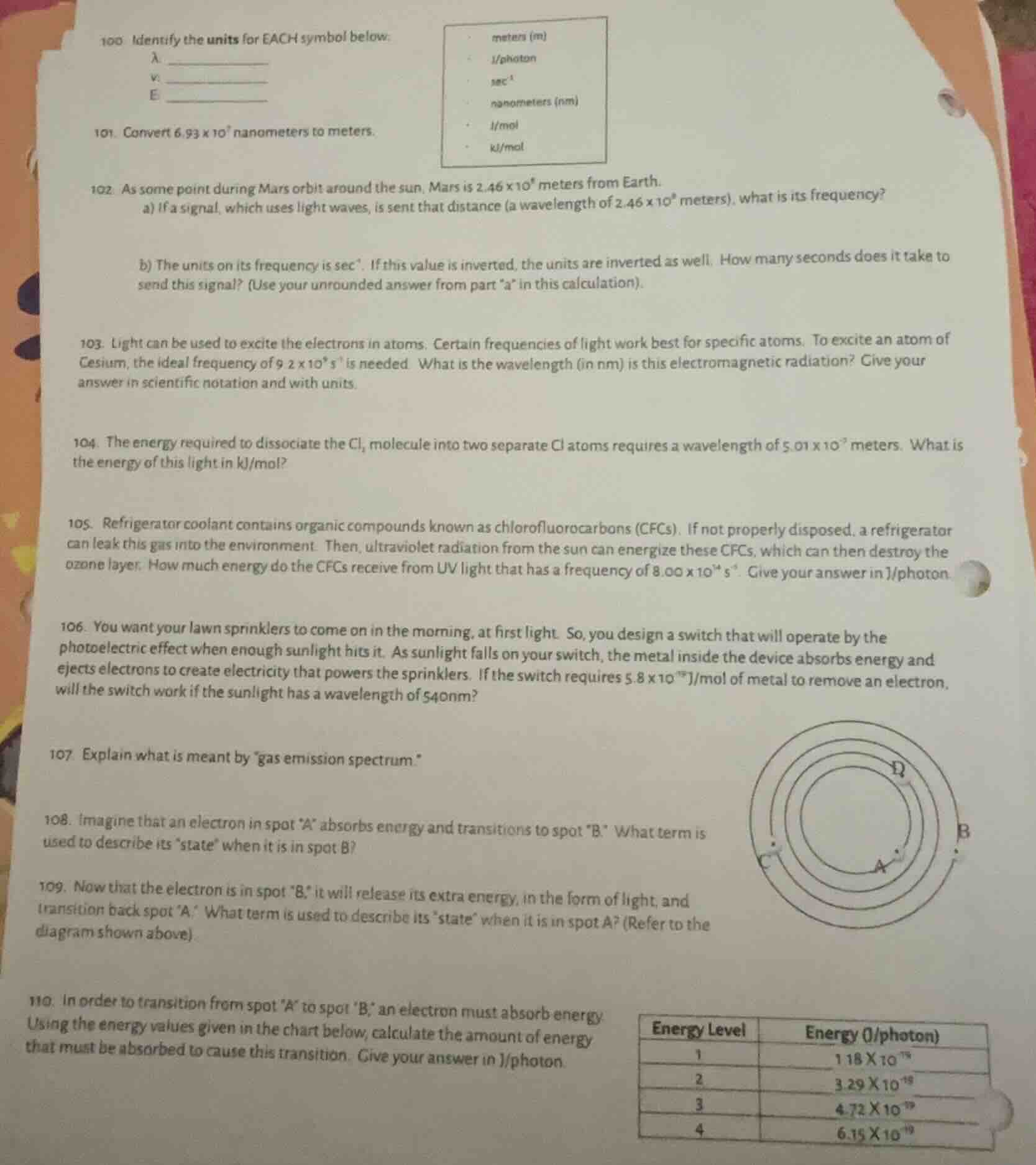
- identify the units for each symbol below:λ _______ν _____e _______options:meters (m)j/photonsec⁻¹nanometers (nm)j/molkj/mol101. convert $6.93 \times 10^7$ nanometers to meters.102. as some point during mars orbit around the sun, mars is $2.46 \times 10^8$ meters from earth.a) if a signal, which uses light waves, is sent that distance (a wavelength of $2.46 \times 10^8$ meters), what is its frequency?b) the units on its frequency is $sec^{-1}$. if this value is inverted, the units are inverted as well. how many seconds does it take to send this signal? (use your unrounded answer from part \a\ in this calculation).103. light can be used to excite the electrons in atoms. certain frequencies of light work best for specific atoms. to excite an atom of cesium, the ideal frequency of $9.2 \times 10^{14} s^{-1}$ is needed. what is the wavelength (in nm) is this electromagnetic radiation? give your answer in scientific notation and with units.104. the energy required to dissociate the $cl_2$ molecule into two separate cl atoms requires a wavelength of $5.01 \times 10^{-7}$ meters. what is the energy of this light in kj/mol?105. refrigerator coolant contains organic compounds known as chlorofluorocarbons (cfcs). if not properly disposed, a refrigerator can leak this gas into the environment. then, ultraviolet radiation from the sun can energize these cfcs, which can then destroy the ozone layer. how much energy do the cfcs receive from uv light that has a frequency of $8.00 \times 10^{14} s^{-1}$. give your answer in j/photon.106. you want your lawn sprinklers to come on in the morning, at first light. so, you design a switch that will operate by the photoelectric effect when enough sunlight hits it. as sunlight falls on your switch, the metal inside the device absorbs energy and ejects electrons to create electricity that powers the sprinklers. if the switch requires $5.8 \times 10^{-19}$ j/mol of metal to remove an electron, will the switch work if the sunlight has a wavelength of 540nm?107. explain what is meant by \gas emission spectrum\.108. imagine that an electron in spot \a\ absorbs energy and transitions to spot \b\. what term is used to describe its \state\ when it is in spot b?109. now that the electron is in spot \b,\ it will release its extra energy, in the form of light, and transition back spot \a.\ what term is used to describe its \state\ when it is in spot a? (refer to the diagram shown above).110. in order to transition from spot \a\ to spot \b,\ an electron must absorb energy. using the energy values given in the chart below, calculate the amount of energy that must be absorbed to cause this transition. give your answer in j/photon.| energy level | energy (j/photon) || ---- | ---- || 1 | $1.18 \times 10^{-19}$ || 2 | $3.29 \times 10^{-19}$ || 3 | $4.72 \times 10^{-19}$ || 4 | $6.15 \times 10^{-19}$ |
Step1: Match symbols to units
$\lambda$: nanometers (nm) or meters (m)
$
u$: $\text{sec}^{-1}$
$E$: J/photon or kJ/mol
Step2: Convert nm to meters
Use $1\ \text{nm}=10^{-9}\ \text{m}$:
$6.93 \times 10^7\ \text{nm} = 6.93 \times 10^7 \times 10^{-9}\ \text{m} = 6.93 \times 10^{-2}\ \text{m}$
Step3a: Calculate frequency (102a)
Use $c=\lambda
u$, $c=3.00\times10^8\ \text{m/s}$:
$
u=\frac{c}{\lambda}=\frac{3.00\times10^8\ \text{m/s}}{2.46\times10^8\ \text{m}} \approx 1.22\ \text{sec}^{-1}$
Step3b: Calculate signal time (102b)
Invert frequency:
$t=\frac{1}{
u}=\frac{1}{1.22\ \text{sec}^{-1}} \approx 0.820\ \text{seconds}$
Step4: Find wavelength (103)
Use $\lambda=\frac{c}{
u}$, convert to nm:
$\lambda=\frac{3.00\times10^8\ \text{m/s}}{9.2\times10^{14}\ \text{sec}^{-1}} = 3.26\times10^{-7}\ \text{m} = 3.26\times10^{2}\ \text{nm}$
Step5: Calculate energy (104)
Use $E=\frac{hcN_A}{\lambda}$, $h=6.626\times10^{-34}\ \text{J·s}$, $N_A=6.022\times10^{23}\ \text{mol}^{-1}$:
$E=\frac{(6.626\times10^{-34}\ \text{J·s})(3.00\times10^8\ \text{m/s})(6.022\times10^{23}\ \text{mol}^{-1})}{5.01\times10^{-7}\ \text{m}} \approx 2.39\times10^5\ \text{J/mol} = 239\ \text{kJ/mol}$
Step6: Calculate photon energy (105)
Use $E=h
u$:
$E=(6.626\times10^{-34}\ \text{J·s})(8.00\times10^{14}\ \text{sec}^{-1}) = 5.30\times10^{-19}\ \text{J/photon}$
Step7: Evaluate photoelectric switch (106)
First convert $\lambda=540\ \text{nm}=5.40\times10^{-7}\ \text{m}$, calculate energy per mole:
$E=\frac{hcN_A}{\lambda}=\frac{(6.626\times10^{-34})(3.00\times10^8)(6.022\times10^{23})}{5.40\times10^{-7}} \approx 2.22\times10^5\ \text{J/mol}=222\ \text{kJ/mol}$
Compare to required $5.8\times10^2\ \text{kJ/mol}$: $222 < 580$, so no.
Step8: Define gas emission spectrum (107)
A gas emission spectrum is a pattern of discrete bright lines produced when excited gas atoms emit photons of specific energies (wavelengths) as their electrons return to lower energy levels.
Step9: Identify electron state (108)
When an electron is in spot B (higher energy), it is in an excited state.
Step10: Identify electron state (109)
When an electron is in spot A (lower, stable energy), it is in the ground state.
Step11: Calculate transition energy (110)
Assume A = level 1, B = level 4:
$\Delta E = E_4 - E_1 = 6.15\times10^{-19}\ \text{J/photon} - 1.18\times10^{-19}\ \text{J/photon} = 4.97\times10^{-19}\ \text{J/photon}$

Snap & solve any problem in the app
Get step-by-step solutions on Sovi AI
Photo-based solutions with guided steps
Explore more problems and detailed explanations
- $\lambda$: nanometers (nm) or meters (m); $
u$: $\text{sec}^{-1}$; $E$: J/photon or kJ/mol
- $6.93 \times 10^{-2}\ \text{m}$
102a. $1.22\ \text{sec}^{-1}$
102b. $0.820\ \text{seconds}$
- $3.3 \times 10^{2}\ \text{nm}$ (rounded to 2 sig figs)
- $239\ \text{kJ/mol}$
- $5.30 \times 10^{-19}\ \text{J/photon}$
- No, the sunlight does not provide enough energy.
- A discrete spectrum of bright lines formed when excited gas atoms emit specific wavelengths of light as electrons drop to lower energy levels.
- Excited state
- Ground state
- $4.97 \times 10^{-19}\ \text{J/photon}$