QUESTION IMAGE
Question
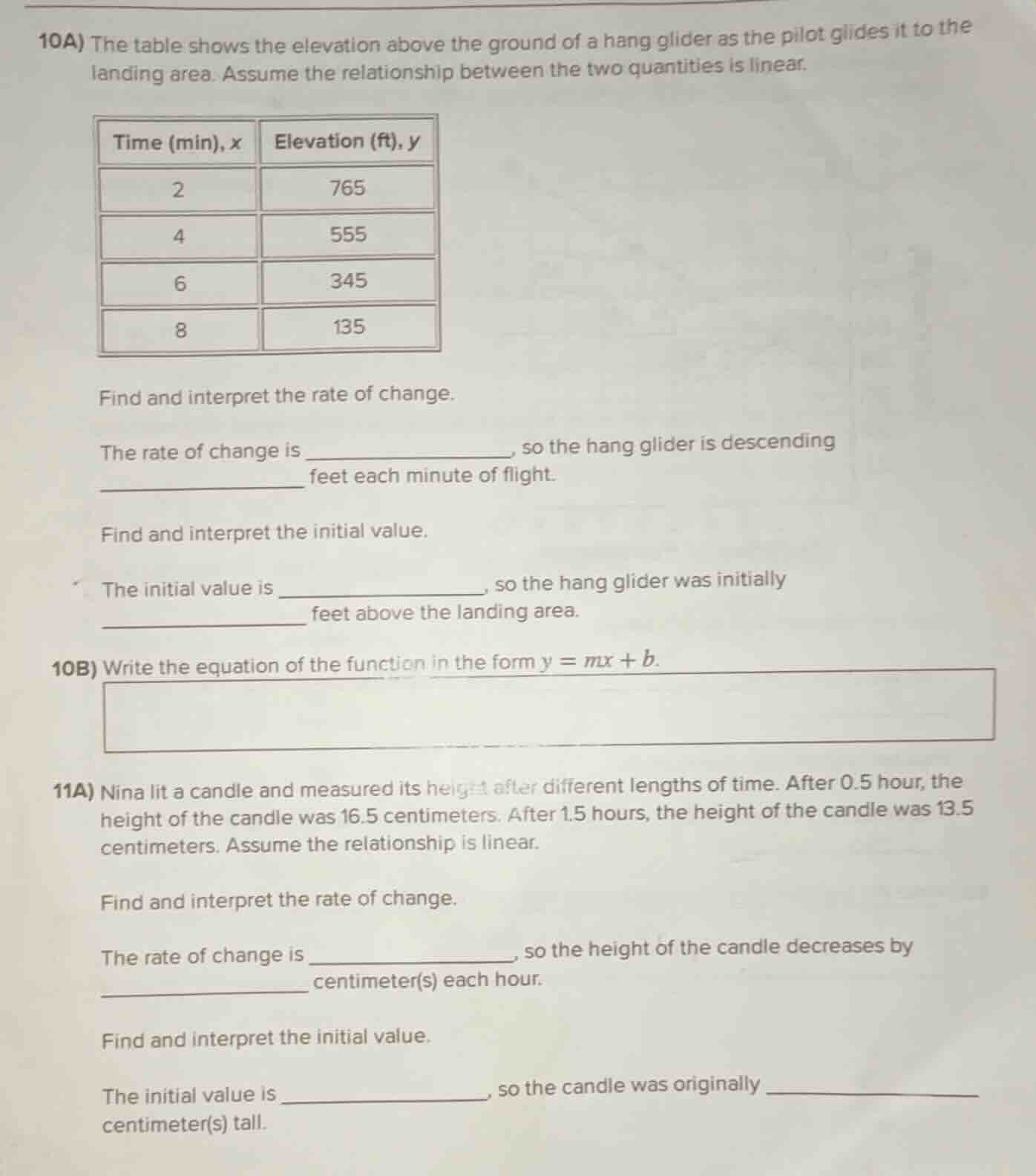
10a) the table shows the elevation above the ground of a hang glider as the pilot glides it to the landing area. assume the relationship between the two quantities is linear.
| time (min), x | elevation (ft), y |
|---|---|
| 4 | 555 |
| 6 | 345 |
| 8 | 135 |
find and interpret the rate of change.
the rate of change is __________, so the hang glider is descending __________ feet each minute of flight.
find and interpret the initial value.
the initial value is __________, so the hang glider was initially __________ feet above the landing area.
10b) write the equation of the function in the form $y = mx + b$.
11a) nina lit a candle and measured its height after different lengths of time. after 0.5 hour, the height of the candle was 16.5 centimeters. after 1.5 hours, the height of the candle was 13.5 centimeters. assume the relationship is linear.
find and interpret the rate of change.
the rate of change is __________, so the height of the candle decreases by __________ centimeter(s) each hour.
find and interpret the initial value.
the initial value is __________, so the candle was originally __________ centimeter(s) tall.
10A)
Rate of Change
Step1: Recall rate of change formula
The rate of change (slope \( m \)) for a linear relationship is given by \( m=\frac{y_2 - y_1}{x_2 - x_1} \). Let's take two points, say \( (2, 765) \) and \( (4, 555) \).
Step2: Calculate the slope
\( m=\frac{555 - 765}{4 - 2}=\frac{-210}{2}=- 105 \)
The negative sign indicates a decrease (descending). So the rate of change is \(-105\), meaning the hang glider is descending \( 105 \) feet each minute.
Initial Value (y-intercept \( b \))
Step1: Use the linear equation \( y = mx + b \)
We know \( m=-105 \) and can use a point, e.g., \( (2, 765) \). Substitute into \( y=mx + b \): \( 765=-105(2)+b \)
Step2: Solve for \( b \)
\( 765=-210 + b \), so \( b = 765 + 210=975 \)
The initial value (when \( x = 0 \), time \( 0 \) minutes) is \( 975 \), meaning the hang glider was initially \( 975 \) feet above the landing area.
Equation of the Function
Step1: Use \( y=mx + b \)
We have \( m=-105 \) and \( b = 975 \), so the equation is \( y=-105x + 975 \)
11A)
Rate of Change

Snap & solve any problem in the app
Get step-by-step solutions on Sovi AI
Photo-based solutions with guided steps
Explore more problems and detailed explanations
Step1: Use \( y=mx + b \)
From 10A, \( m=-105 \) and \( b = 975 \), so the equation is \( y=-105x + 975 \)
Final Answers
10A - Rate of Change:
The rate of change is \(\boldsymbol{-105}\), so the hang glider is descending \(\boldsymbol{105}\) feet each minute of flight.
10A - Initial Value:
The initial value is \(\boldsymbol{975}\), so the hang glider was initially \(\boldsymbol{975}\) feet above the landing area.
10B - Equation:
The equation is \(\boldsymbol{y=-105x + 975}\)
11A - Rate of Change:
The rate of change is \(\boldsymbol{-3}\), so the height of the candle decreases by \(\boldsymbol{3}\) centimeter(s) each hour.
11A - Initial Value:
The initial value is \(\boldsymbol{18}\), so the candle was originally \(\boldsymbol{18}\) centimeter(s) tall.