QUESTION IMAGE
Question
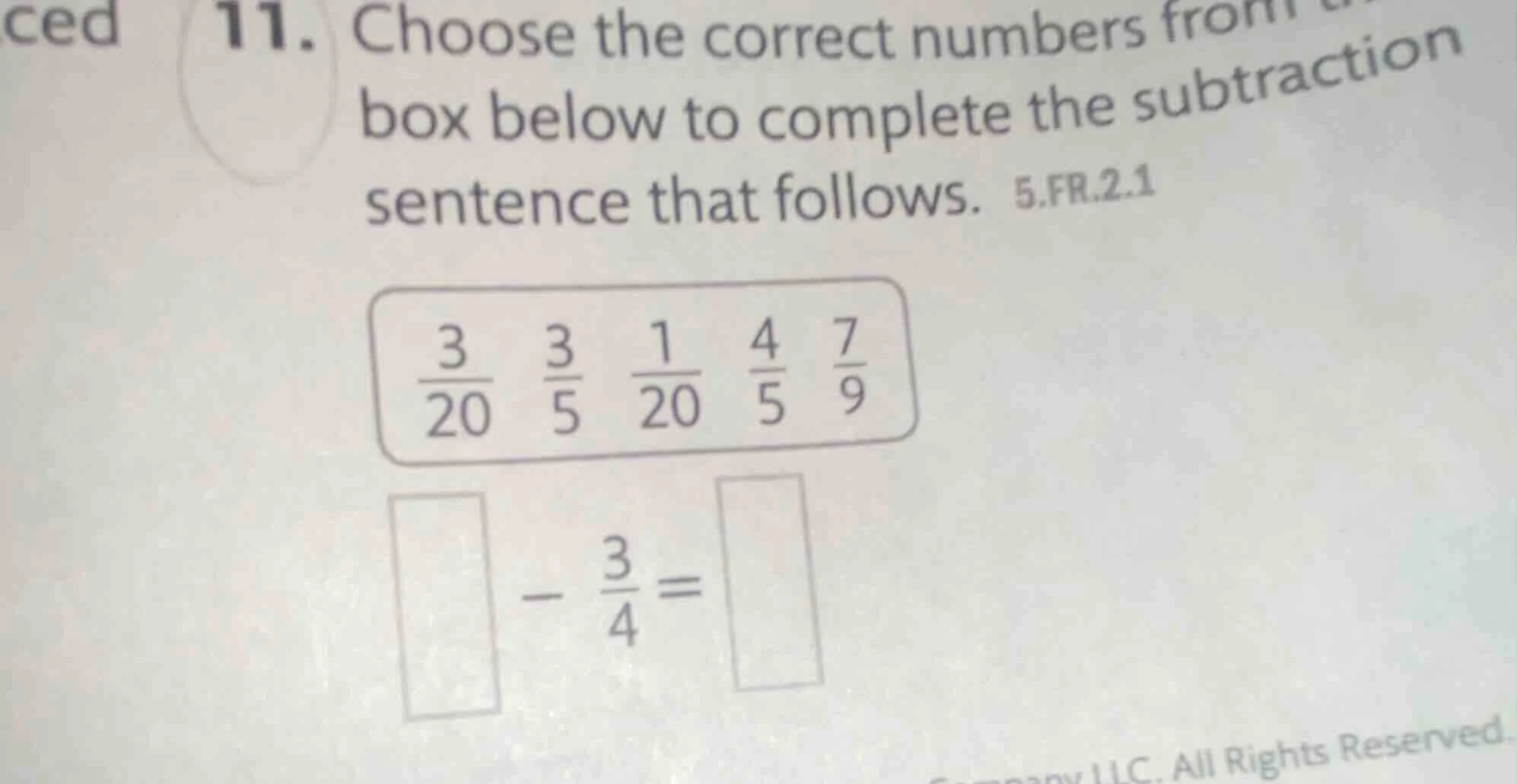
- choose the correct numbers from the box below to complete the subtraction sentence that follows. 5.fr.2.1
\\(\boldsymbol{\frac{3}{20}}) \\(\boldsymbol{\frac{3}{5}}) \\(\boldsymbol{\frac{1}{20}}) \\(\boldsymbol{\frac{4}{5}}) \\(\boldsymbol{\frac{7}{9}})
\\(square - \frac{3}{4} = square\\)
Step1: Convert fractions to have denominator 20 (since 4 and 20 are related, and we can check which numerator - 15 (since 3/4 = 15/20) gives a numerator from the box fractions' numerators when denominator is 20).
First, convert \( \frac{3}{4} \) to twentieths: \( \frac{3}{4}=\frac{3\times5}{4\times5}=\frac{15}{20} \).
Now, let's convert the given fractions in the box to twentieths:
- \( \frac{3}{5}=\frac{3\times4}{5\times4}=\frac{12}{20} \) (not helpful as we need a fraction where numerator - 15 is valid, but 12 < 15, so this fraction can't be the minuend)
- \( \frac{4}{5}=\frac{4\times4}{5\times4}=\frac{16}{20} \) (wait, no, wait: Wait, the minuend minus \( \frac{3}{4} \) (15/20) should equal one of the box fractions. Let's list box fractions as twentieths:
- \( \frac{3}{20} \): numerator 3
- \( \frac{3}{5}=\frac{12}{20} \): numerator 12
- \( \frac{1}{20} \): numerator 1
- \( \frac{4}{5}=\frac{16}{20} \): numerator 16
- \( \frac{7}{9} \): not twentieths, so we can ignore it as the result or minuend with denominator 20 is needed.
Wait, maybe better: Let the minuend be \( x \), so \( x - \frac{3}{4}=y \), where \( x \) and \( y \) are in the box. So \( x = y + \frac{3}{4} \). Let's check each fraction in the box as \( y \) and see if \( y + \frac{3}{4} \) is also in the box.
Check \( y=\frac{3}{20} \): \( \frac{3}{20}+\frac{3}{4}=\frac{3}{20}+\frac{15}{20}=\frac{18}{20}=\frac{9}{10} \) (not in box)
Check \( y=\frac{1}{20} \): \( \frac{1}{20}+\frac{3}{4}=\frac{1}{20}+\frac{15}{20}=\frac{16}{20}=\frac{4}{5} \) (which is in the box! So \( x = \frac{4}{5} \), \( y=\frac{1}{20} \))
Check \( y=\frac{3}{5} \): \( \frac{3}{5}+\frac{3}{4}=\frac{12}{20}+\frac{15}{20}=\frac{27}{20}=1\frac{7}{20} \) (not in box)
Check \( y=\frac{7}{9} \): \( \frac{7}{9}+\frac{3}{4}=\frac{28 + 27}{36}=\frac{55}{36} \) (not in box)
Check \( y=\frac{4}{5} \): \( \frac{4}{5}+\frac{3}{4}=\frac{16}{20}+\frac{15}{20}=\frac{31}{20} \) (not in box)
Wait, so when \( y = \frac{1}{20} \), \( x=\frac{4}{5} \), because \( \frac{4}{5}-\frac{3}{4}=\frac{16}{20}-\frac{15}{20}=\frac{1}{20} \). Let's verify:
\( \frac{4}{5}-\frac{3}{4}=\frac{16 - 15}{20}=\frac{1}{20} \), and both \( \frac{4}{5} \) and \( \frac{1}{20} \) are in the box.
Step2: Confirm the subtraction.
Subtract \( \frac{3}{4} \) from \( \frac{4}{5} \):
Convert to common denominator (20):
\( \frac{4}{5}=\frac{16}{20} \), \( \frac{3}{4}=\frac{15}{20} \)
\( \frac{16}{20}-\frac{15}{20}=\frac{1}{20} \), which is in the box.

Snap & solve any problem in the app
Get step-by-step solutions on Sovi AI
Photo-based solutions with guided steps
Explore more problems and detailed explanations
The minuend is \( \boldsymbol{\frac{4}{5}} \) and the result is \( \boldsymbol{\frac{1}{20}} \), so the subtraction sentence is \( \frac{4}{5}-\frac{3}{4}=\frac{1}{20} \)