QUESTION IMAGE
Question
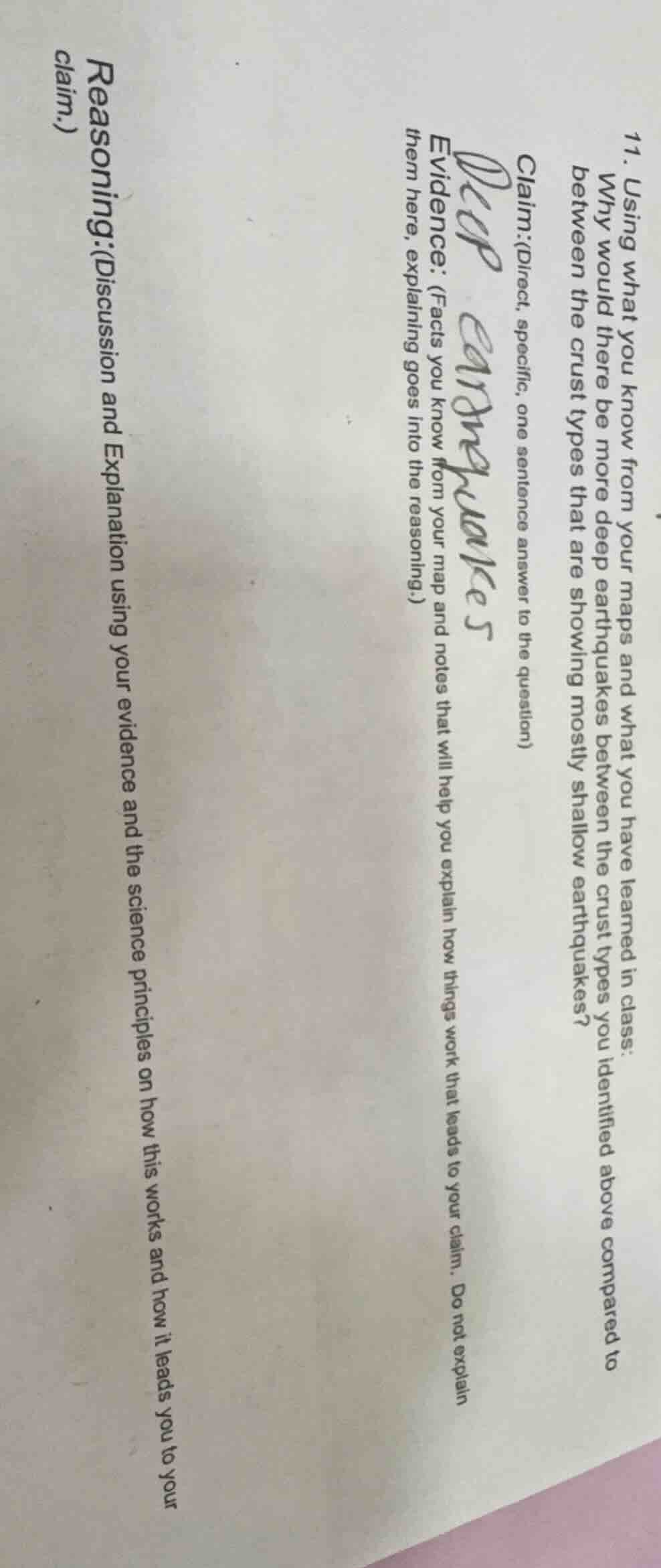
- using what you know from your maps and what you have learned in class:why would there be more deep earthquakes between the crust types that are showing mostly shallow earthquakes?claim:(direct, specific, one sentence answer to the question)deep earthquakesevidence: (facts you know from your map and notes that will help you explain how things work that leads to your claim. do not explain them here, explaining goes into the reasoning.)reasoning:(discussion and explanation using your evidence and the science principles on how this works and how it leads you to your claim.)
Deep earthquakes form when a dense oceanic crust plate subducts under a less dense crust plate (continental or another oceanic plate), and the descending plate breaks and shifts as it sinks deep into the mantle. In contrast, shallow earthquakes occur at transform boundaries (where plates slide past each other) or divergent boundaries (where plates pull apart), which only involve the upper, shallow portion of the crust with no deep subduction. The subduction zone process drives deep quakes, while the shallower crust interactions create mostly shallow quakes.

Snap & solve any problem in the app
Get step-by-step solutions on Sovi AI
Photo-based solutions with guided steps
Explore more problems and detailed explanations
Claim:
Deep earthquakes form at subduction zones between oceanic and other crust types, while shallow earthquakes dominate at transform/divergent crust boundaries.
Evidence:
- Subduction zones (e.g., Pacific Ring of Fire) have deep earthquake clusters mapped at 300-670 km depth.
- Transform boundaries (e.g., San Andreas Fault) and divergent boundaries (e.g., Mid-Atlantic Ridge) only have earthquakes mapped at 0-70 km depth.
- Oceanic crust is denser than continental crust, causing subduction.
Reasoning:
When dense oceanic crust subducts under less dense crust, the descending plate is pushed deep into the mantle. As the plate sinks, it experiences increasing pressure, temperature changes, and friction with the mantle, leading to fractures and shifts that create deep earthquakes. At transform or divergent boundaries, plates only interact in the shallow upper crust, so any resulting earthquakes are limited to this shallow layer, resulting in mostly shallow earthquakes in these areas. This matches the pattern seen in seismic maps and plate tectonics principles.