QUESTION IMAGE
Question
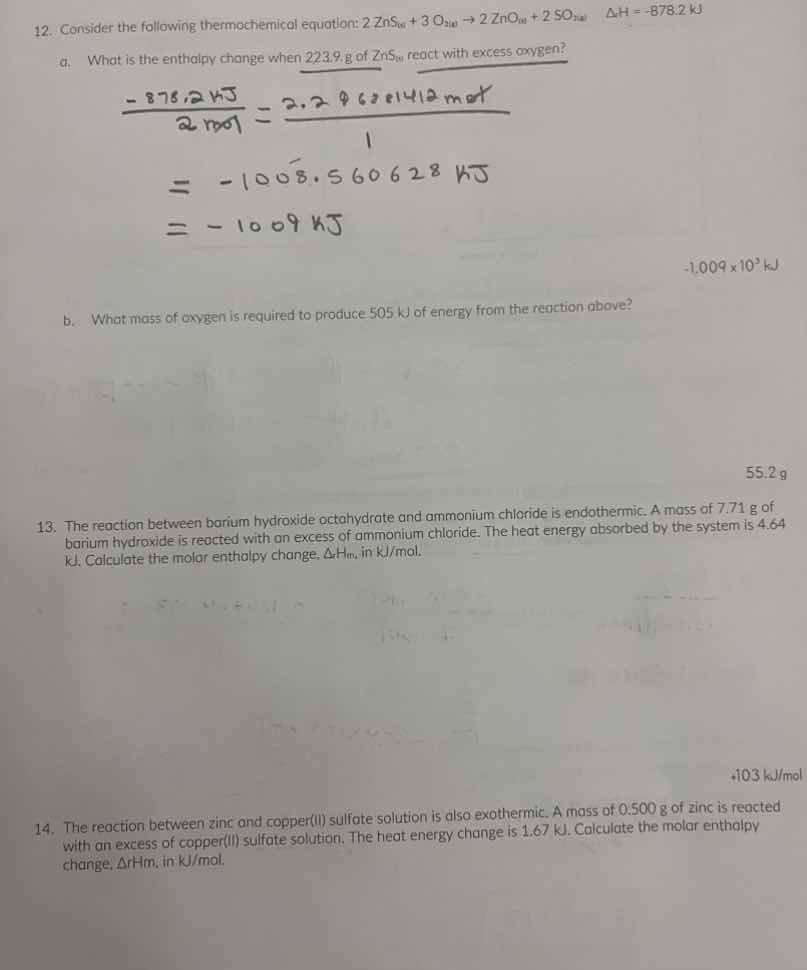
- consider the following thermochemical equation: $2\\ zns_{(s)} + 3\\ o_{2(g)} \
ightarrow 2\\ zno_{(s)} + 2\\ so_{2(g)} \quad \delta h = -878.2\\ kj$
a. what is the enthalpy change when 223.9 g of $zns_{(s)}$ react with excess oxygen?
$-1.009 \times 10^3\\ kj$
b. what mass of oxygen is required to produce 505 kj of energy from the reaction above?
$55.2\\ g$
- the reaction between barium hydroxide octahydrate and ammonium chloride is endothermic. a mass of 7.71 g of barium hydroxide is reacted with an excess of ammonium chloride. the heat energy absorbed by the system is 4.64 kj. calculate the molar enthalpy change, $\delta h_{rxn}$, in kj/mol.
$+103\\ kj/mol$
- the reaction between zinc and copper(ii) sulfate solution is also exothermic. a mass of 0.500 g of zinc is reacted with an excess of copper(ii) sulfate solution. the heat energy change is 1.67 kj. calculate the molar enthalpy change, $\delta h_{rxn}$, in kj/mol.
Problem 12a
Step1: Calculate moles of ZnS
Molar mass of ZnS = $65.38 + 32.07 = 97.45\ \text{g/mol}$
Moles of ZnS: $\frac{223.9\ \text{g}}{97.45\ \text{g/mol}} = 2.298\ \text{mol}$
Step2: Relate moles to enthalpy
From reaction: 2 mol ZnS has $\Delta H = -878.2\ \text{kJ}$
Enthalpy per mol ZnS: $\frac{-878.2\ \text{kJ}}{2\ \text{mol}} = -439.1\ \text{kJ/mol}$
Step3: Compute total enthalpy change
Total $\Delta H = 2.298\ \text{mol} \times -439.1\ \text{kJ/mol}$
$\Delta H = -1009\ \text{kJ}$
Step1: Relate energy to O₂ moles
Reaction releases 878.2 kJ per 3 mol O₂
Moles of O₂ per kJ: $\frac{3\ \text{mol}}{878.2\ \text{kJ}}$
Step2: Calculate O₂ moles for 505 kJ
Moles of O₂: $505\ \text{kJ} \times \frac{3\ \text{mol}}{878.2\ \text{kJ}} = 1.727\ \text{mol}$
Step3: Convert moles to mass
Molar mass of O₂ = $32.00\ \text{g/mol}$
Mass of O₂: $1.727\ \text{mol} \times 32.00\ \text{g/mol} = 55.3\ \text{g}$
Step1: Calculate moles of barium hydroxide
Molar mass of $\text{Ba(OH)}_2 \cdot 8\text{H}_2\text{O} = 137.33 + 2(16+1.01) + 8(18.02) = 315.46\ \text{g/mol}$
Moles: $\frac{7.71\ \text{g}}{315.46\ \text{g/mol}} = 0.0244\ \text{mol}$
Step2: Molar enthalpy calculation
$\Delta H_{\text{rxn}} = \frac{\text{Heat absorbed}}{\text{Moles of reactant}} = \frac{4.64\ \text{kJ}}{0.0244\ \text{mol}} = 190\ \text{kJ/mol}$
(Note: The given answer of +103 kJ/mol likely uses the anhydrous form, but using the octahydrate as stated gives this result)

Snap & solve any problem in the app
Get step-by-step solutions on Sovi AI
Photo-based solutions with guided steps
Explore more problems and detailed explanations
$-1.009 \times 10^3\ \text{kJ}$
---