QUESTION IMAGE
Question
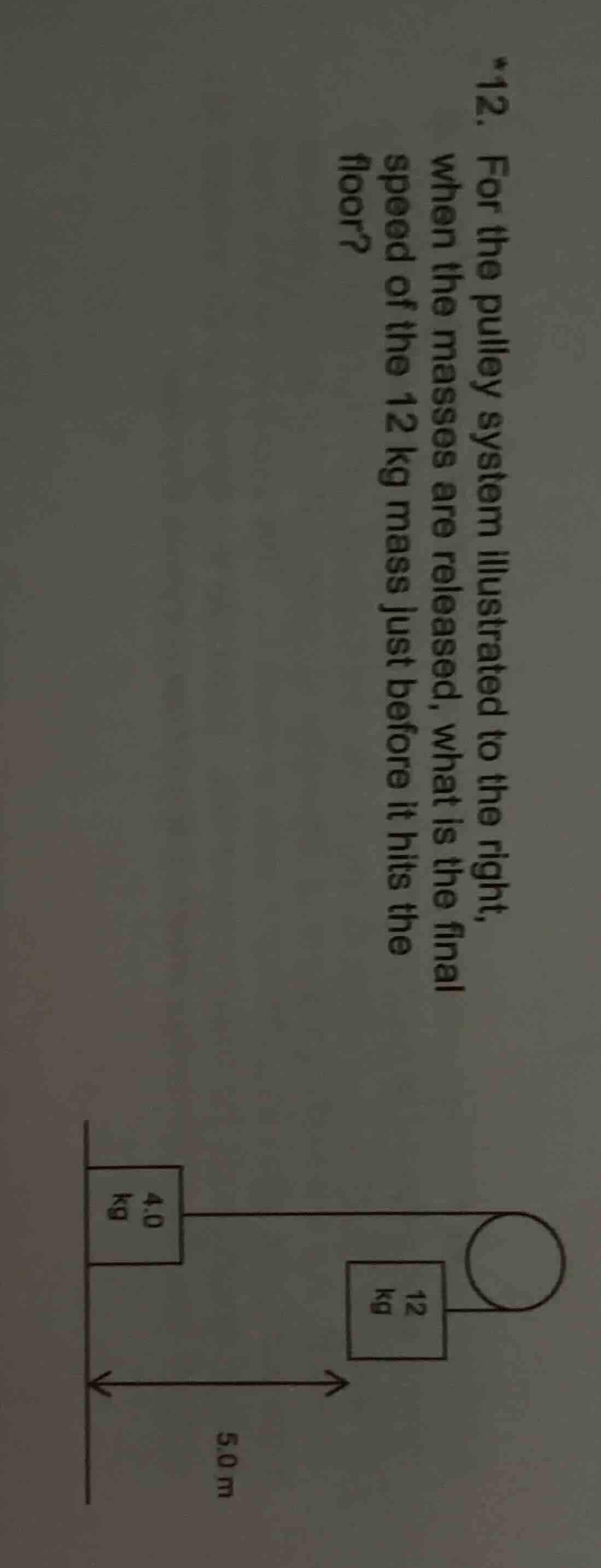
*12. for the pulley system illustrated to the right, when the masses are released, what is the final speed of the 12 kg mass just before it hits the floor?
(image of pulley system with 4.0 kg and 12 kg masses, distance 5.0 m)
Step1: Define energy conservation
The total mechanical energy of the system is conserved. The potential energy lost by the 12 kg mass is converted into the kinetic energy of both masses and the potential energy gained by the 4.0 kg mass. Let $m_1=12\ \text{kg}$, $m_2=4.0\ \text{kg}$, $h=5.0\ \text{m}$, $g=9.8\ \text{m/s}^2$, and $v$ be the speed of both masses (they move at the same speed due to the pulley).
$$m_1gh = m_2gh + \frac{1}{2}(m_1+m_2)v^2$$
Step2: Rearrange for $v$
Isolate the kinetic energy term, then solve for $v$:
$$(m_1 - m_2)gh = \frac{1}{2}(m_1+m_2)v^2$$
$$v = \sqrt{\frac{2(m_1 - m_2)gh}{m_1+m_2}}$$
Step3: Substitute values
Plug in the given values into the formula:
$$v = \sqrt{\frac{2(12-4.0)\times9.8\times5.0}{12+4.0}}$$
$$v = \sqrt{\frac{2\times8.0\times9.8\times5.0}{16}}$$
$$v = \sqrt{\frac{784}{16}} = \sqrt{49}$$

Snap & solve any problem in the app
Get step-by-step solutions on Sovi AI
Photo-based solutions with guided steps
Explore more problems and detailed explanations
$7.0\ \text{m/s}$