QUESTION IMAGE
Question
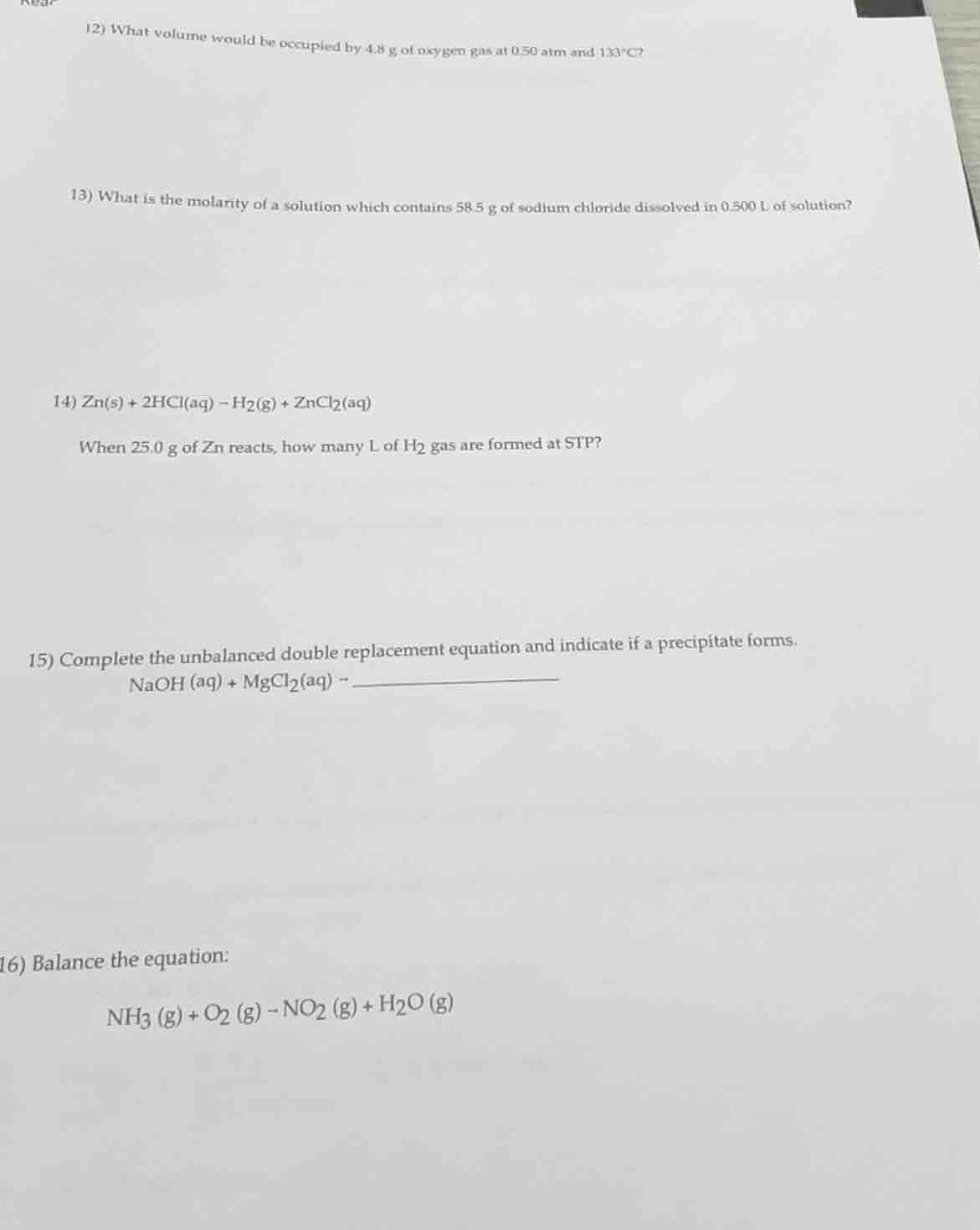
- what volume would be occupied by 4.8 g of oxygen gas at 0.50 atm and 133°c?
- what is the molarity of a solution which contains 58.5 g of sodium chloride dissolved in 0.500 l of solution?
- zn(s) + 2hcl(aq) → h₂(g) + zncl₂(aq)
when 25.0 g of zn reacts, how many l of h₂ gas are formed at stp?
- complete the unbalanced double replacement equation and indicate if a precipitate forms.
naoh (aq) + mgcl₂(aq) →
- balance the equation:
nh₃ (g) + o₂ (g) → no₂ (g) + h₂o (g)
Step1: Calculate moles of O₂
Molar mass of $\text{O}_2$ is $32\ \text{g/mol}$.
$n_{\text{O}_2} = \frac{4.8\ \text{g}}{32\ \text{g/mol}} = 0.15\ \text{mol}$
Step2: Convert temperature to Kelvin
$T = 133^\circ\text{C} + 273.15 = 406.15\ \text{K}$
Step3: Use ideal gas law $V=\frac{nRT}{P}$
$R = 0.0821\ \frac{\text{L·atm}}{\text{mol·K}}$, $P=0.50\ \text{atm}$
$V = \frac{0.15\ \text{mol} \times 0.0821\ \frac{\text{L·atm}}{\text{mol·K}} \times 406.15\ \text{K}}{0.50\ \text{atm}} \approx 10.0\ \text{L}$
---
Step1: Calculate moles of NaCl
Molar mass of $\text{NaCl}$ is $58.5\ \text{g/mol}$.
$n_{\text{NaCl}} = \frac{58.5\ \text{g}}{58.5\ \text{g/mol}} = 1.00\ \text{mol}$
Step2: Calculate molarity $M=\frac{n}{V}$
$V=0.500\ \text{L}$
$M = \frac{1.00\ \text{mol}}{0.500\ \text{L}} = 2.00\ \text{M}$
---
Step1: Calculate moles of Zn
Molar mass of $\text{Zn}$ is $65.38\ \text{g/mol}$.
$n_{\text{Zn}} = \frac{25.0\ \text{g}}{65.38\ \text{g/mol}} \approx 0.382\ \text{mol}$
Step2: Mole ratio of Zn:H₂ is 1:1
$n_{\text{H}_2} = 0.382\ \text{mol}$
Step3: Volume at STP ($22.4\ \text{L/mol}$)
$V_{\text{H}_2} = 0.382\ \text{mol} \times 22.4\ \frac{\text{L}}{\text{mol}} \approx 8.56\ \text{L}$
---
Step1: Complete double replacement
Swap cations/anions: $\text{NaOH(aq)} + \text{MgCl}_2\text{(aq)}
ightarrow \text{Mg(OH)}_2 + \text{NaCl}$
Step2: Balance the equation
$2\text{NaOH(aq)} + \text{MgCl}_2\text{(aq)}
ightarrow \text{Mg(OH)}_2\text{(s)} + 2\text{NaCl(aq)}$
Step3: Identify precipitate
$\text{Mg(OH)}_2$ is insoluble in water, so it forms a precipitate.
---
Step1: Balance N atoms
$4\text{NH}_3\text{(g)} + \text{O}_2\text{(g)}
ightarrow 4\text{NO}_2\text{(g)} + \text{H}_2\text{O(g)}$
Step2: Balance H atoms
$4\text{NH}_3\text{(g)} + \text{O}_2\text{(g)}
ightarrow 4\text{NO}_2\text{(g)} + 6\text{H}_2\text{O(g)}$
Step3: Balance O atoms
$4\text{NH}_3\text{(g)} + 7\text{O}_2\text{(g)}
ightarrow 4\text{NO}_2\text{(g)} + 6\text{H}_2\text{O(g)}$

Snap & solve any problem in the app
Get step-by-step solutions on Sovi AI
Photo-based solutions with guided steps
Explore more problems and detailed explanations
- $\approx 10.0\ \text{L}$
- $2.00\ \text{M}$
- $\approx 8.56\ \text{L}$
- $2\text{NaOH(aq)} + \text{MgCl}_2\text{(aq)}
ightarrow \text{Mg(OH)}_2\text{(s)} + 2\text{NaCl(aq)}$; A precipitate of $\text{Mg(OH)}_2$ forms.
- $4\text{NH}_3\text{(g)} + 7\text{O}_2\text{(g)}
ightarrow 4\text{NO}_2\text{(g)} + 6\text{H}_2\text{O(g)}$