QUESTION IMAGE
Question
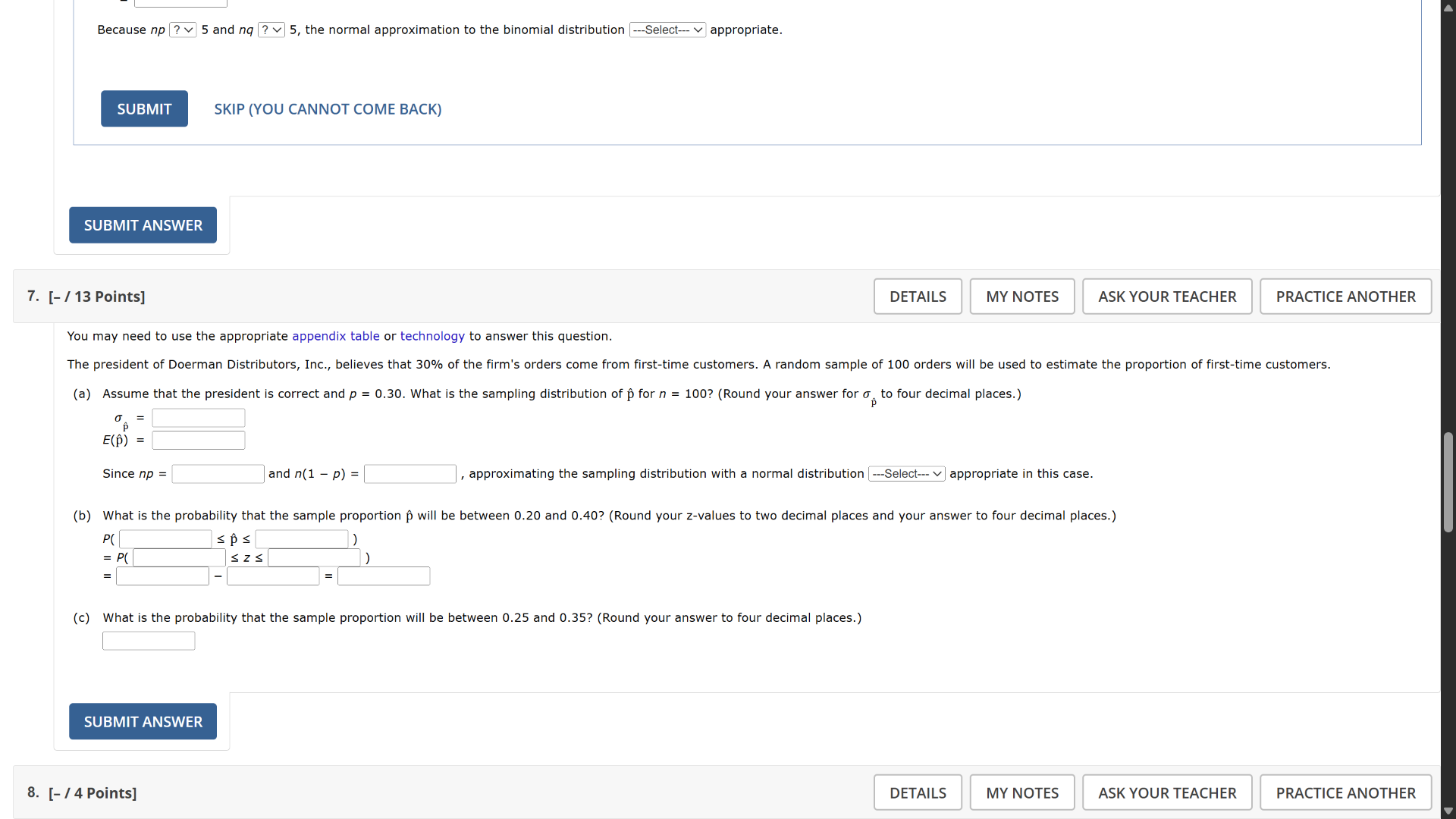
- - / 13 points you may need to use the appropriate appendix table or technology to answer this question. the president of doerman distributors, inc., believes that 30% of the firms orders come from first - time customers. a random sample of 100 orders will be used to estimate the proportion of first - time customers. (a) assume that the president is correct and p = 0.30. what is the sampling distribution of \\(\hat{p}\\) for n = 100? (round your answer for \\(\sigma_{\hat{p}}\\) to four decimal places.) \\(\sigma_{\hat{p}} = \\) \\(e(\hat{p}) = \\) since np = and n(1 - p) =, approximating the sampling distribution with a normal distribution appropriate in this case. (b) what is the probability that the sample proportion \\(\hat{p}\\) will be between 0.20 and 0.40? (round your z - values to two decimal places and your answer to four decimal places.) \\(p(\leq \hat{p} \leq ) = p(\leq z \leq ) = - = \\) (c) what is the probability that the sample proportion will be between 0.25 and 0.35? (round your answer to four decimal places.)
Part (a)
Step 1: Find the mean of the sampling distribution of $\hat{p}$
The mean of the sampling distribution of the sample proportion $\hat{p}$ (denoted as $E(\hat{p})$) is equal to the population proportion $p$. Given $p = 0.30$, we have $E(\hat{p})=p = 0.30$.
Step 2: Find the standard deviation of the sampling distribution of $\hat{p}$
The formula for the standard deviation of the sampling distribution of $\hat{p}$ (denoted as $\sigma_{\hat{p}}$) is $\sigma_{\hat{p}}=\sqrt{\frac{p(1 - p)}{n}}$. Substituting $p = 0.30$, $1-p=0.70$, and $n = 100$:
$$\sigma_{\hat{p}}=\sqrt{\frac{0.30\times0.70}{100}}=\sqrt{\frac{0.21}{100}}=\sqrt{0.0021}\approx0.0458$$
Step 3: Calculate $np$ and $n(1 - p)$
For $np$: Substitute $n = 100$ and $p = 0.30$: $np=100\times0.30 = 30$.
For $n(1 - p)$: Substitute $n = 100$ and $1 - p=0.70$: $n(1 - p)=100\times0.70 = 70$.
Since $np = 30\geq5$ and $n(1 - p)=70\geq5$, the normal approximation is appropriate.
Step 1: Standardize the bounds
The z - score formula for a sample proportion is $z=\frac{\hat{p}-p}{\sigma_{\hat{p}}}$.
For $\hat{p}=0.20$: $z_1=\frac{0.20 - 0.30}{0.0458}\approx\frac{- 0.10}{0.0458}\approx - 2.18$ (rounded to two decimal places).
For $\hat{p}=0.40$: $z_2=\frac{0.40 - 0.30}{0.0458}\approx\frac{0.10}{0.0458}\approx2.18$ (rounded to two decimal places).
So we want $P(0.20\leq\hat{p}\leq0.40)=P(-2.18\leq z\leq2.18)$.
Step 2: Use the standard normal table
We know that $P(-2.18\leq z\leq2.18)=\Phi(2.18)-\Phi(-2.18)$, where $\Phi(z)$ is the cumulative distribution function of the standard normal distribution.
From the standard normal table, $\Phi(2.18) = 0.9854$ and $\Phi(-2.18)=1 - 0.9854 = 0.0146$.
Then $P(-2.18\leq z\leq2.18)=0.9854 - 0.0146 = 0.9708$.
Step 1: Standardize the bounds
For $\hat{p}=0.25$: $z_1=\frac{0.25 - 0.30}{0.0458}\approx\frac{-0.05}{0.0458}\approx - 1.09$ (rounded to two decimal places).
For $\hat{p}=0.35$: $z_2=\frac{0.35 - 0.30}{0.0458}\approx\frac{0.05}{0.0458}\approx1.09$ (rounded to two decimal places).
We want $P(0.25\leq\hat{p}\leq0.35)=P(-1.09\leq z\leq1.09)$.
Step 2: Use the standard normal table
From the standard normal table, $\Phi(1.09)=0.8621$ and $\Phi(-1.09)=1 - 0.8621 = 0.1379$.
Then $P(-1.09\leq z\leq1.09)=\Phi(1.09)-\Phi(-1.09)=0.8621 - 0.1379 = 0.7242$.

Snap & solve any problem in the app
Get step-by-step solutions on Sovi AI
Photo-based solutions with guided steps
Explore more problems and detailed explanations
(Part a):
$\sigma_{\hat{p}}\approx\boldsymbol{0.0458}$, $E(\hat{p})=\boldsymbol{0.30}$, $np=\boldsymbol{30}$, $n(1 - p)=\boldsymbol{70}$, and the normal approximation is $\boldsymbol{\text{is}}$ appropriate.