QUESTION IMAGE
Question
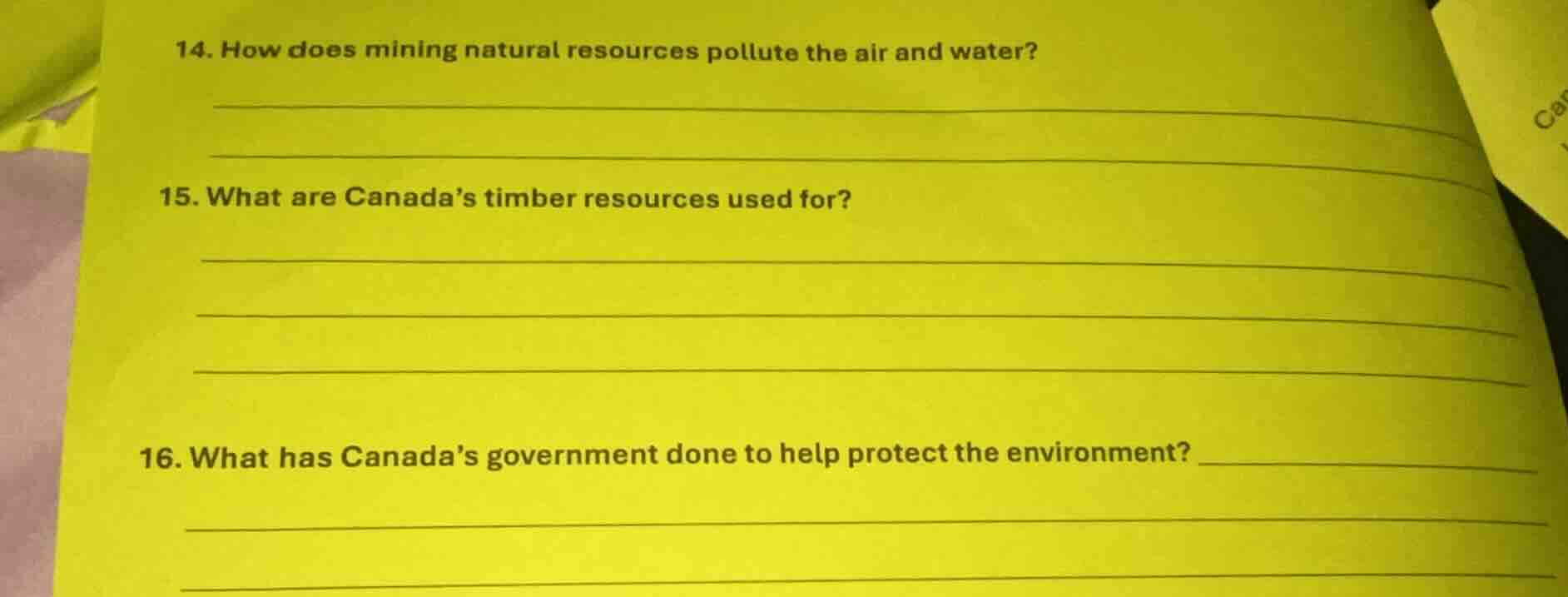
- how does mining natural resources pollute the air and water?
- what are canada’s timber resources used for?
- what has canada’s government done to help protect the environment?
Question 14
Mining pollutes air via dust, emissions (e.g., from diesel engines, smelting releasing sulfur dioxide). Water pollution occurs from runoff with heavy metals, chemicals (like cyanide in gold mining), and sedimentation from disturbed soil.
Canada’s timber is used for lumber (housing, furniture), pulp and paper (newspapers, packaging), bioenergy (fuel), and exports (supporting the forestry industry and trade).
Canada’s government has established protected areas (e.g., national parks), regulated industrial emissions (e.g., from mining, logging), promoted renewable energy, and implemented sustainable resource management (e.g., forestry practices) to protect the environment.

Snap & solve any problem in the app
Get step-by-step solutions on Sovi AI
Photo-based solutions with guided steps
Explore more problems and detailed explanations
Mining pollutes air through dust, diesel emissions, and smelting - related gas releases (e.g., sulfur dioxide). For water, mining runoff carries heavy metals (e.g., mercury, lead), chemicals (e.g., cyanide in gold mining), and sediment, contaminating water sources.