QUESTION IMAGE
9,124 Learners found this answer helpful
Question
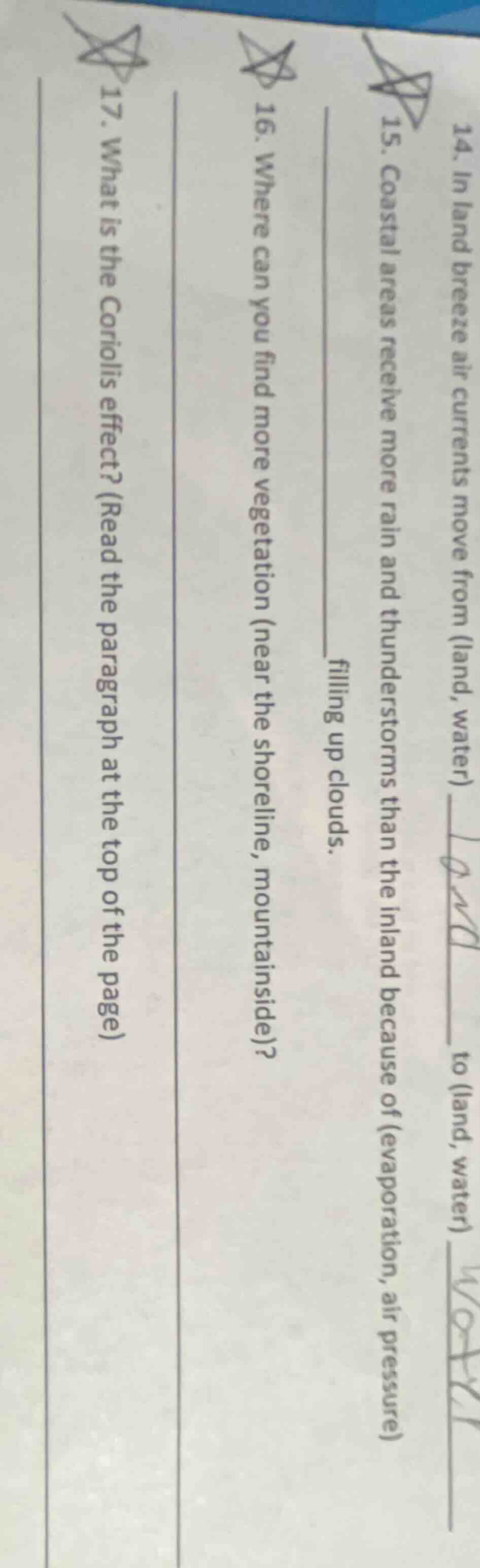
- in land breeze air currents move from (land, water) to (land, water)
- coastal areas receive more rain and thunderstorms than the inland because of (evaporation, air pressure) filling up clouds.
- where can you find more vegetation (near the shoreline, mountainside)?
- what is the coriolis effect? (read the paragraph at the top of the page)
Brief Explanations
- Land breezes occur at night when land cools faster than water, creating higher pressure over land, so air moves from land to water.
- Coastal areas have more evaporation from nearby water, which adds moisture to air, forming clouds that produce rain/thunderstorms.
- Mountainsides (windward slopes) receive more precipitation, supporting more vegetation than shorelines which have drier, salt-exposed conditions.
- The Coriolis effect is a phenomenon caused by Earth's rotation that deflects moving air and water currents; it occurs globally, affecting large-scale winds and ocean currents, with a stronger effect near the poles and no effect at the equator.

Snap & solve any problem in the app
Get step-by-step solutions on Sovi AI
Photo-based solutions with guided steps
Explore more problems and detailed explanations
- land; water
- evaporation
- Mountainside
- The Coriolis effect is a deflection of moving air and water currents caused by the Earth's rotation, occurring across the globe (stronger near the poles, absent at the equator) that impacts large-scale atmospheric and oceanic motion.