QUESTION IMAGE
Question
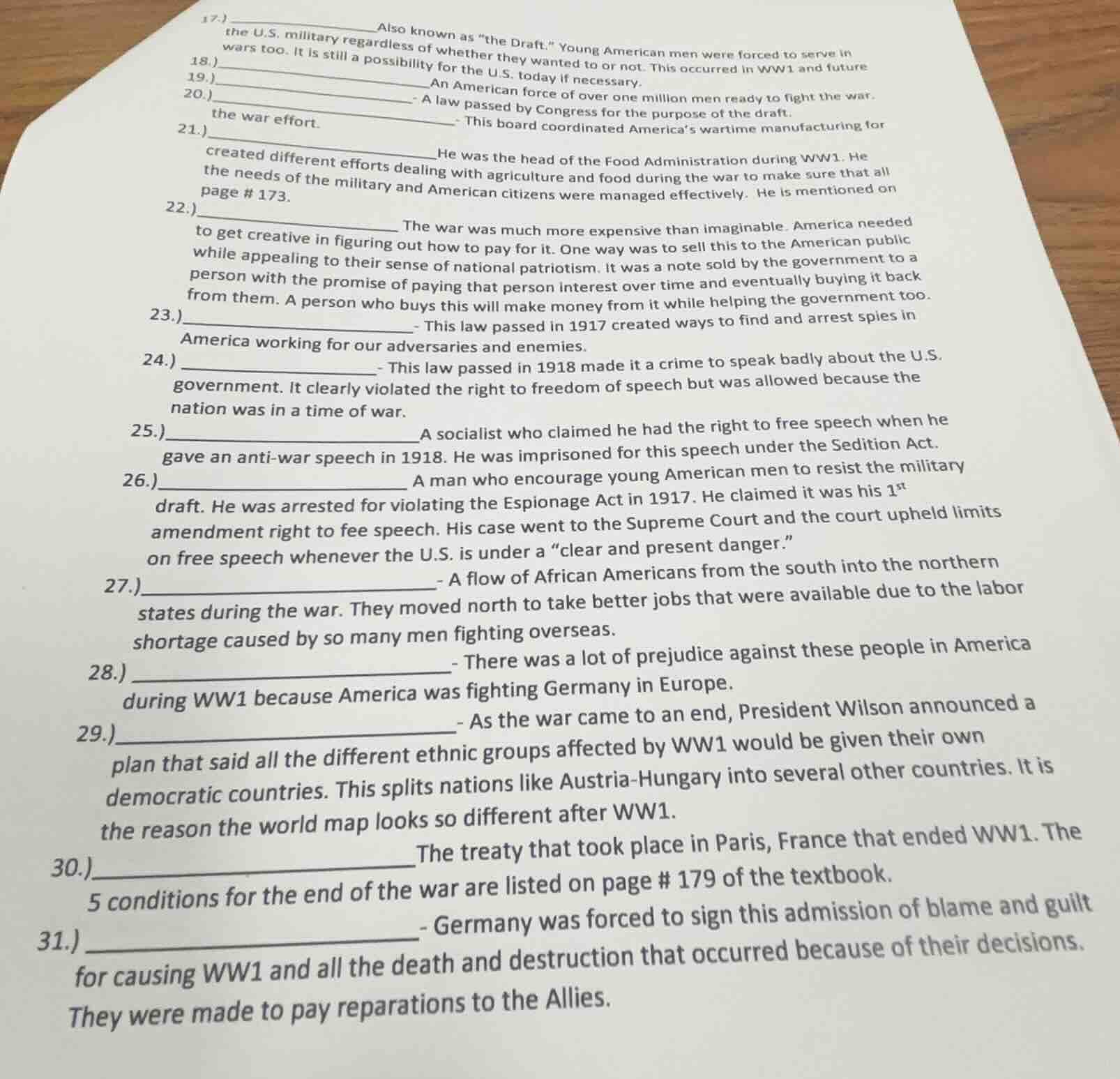
17.) ____________ also known as \the draft.\ young american men were forced to serve in the u.s. military regardless of whether they wanted to or not. this occurred in ww1 and future wars too. it is still a possibility for the u.s. today if necessary.
18.) ____________ an american force of over one million men ready to fight the war.
19.) ____________ a law passed by congress for the purpose of the draft.
20.) ____________ this board coordinated america’s wartime manufacturing for the war effort.
21.) ____________ he was the head of the food administration during ww1. he created different efforts dealing with agriculture and food during the war to make sure that all the needs of the military and american citizens were managed effectively. he is mentioned on page # 173.
22.) ____________ the war was much more expensive than imaginable. america needed to get creative in figuring out how to pay for it. one way was to sell this to the american public while appealing to their sense of national patriotism. it was a note sold by the government to a person with the promise of paying that person interest over time and eventually buying it back from them. a person who buys this will make money from it while helping the government too.
23.) ____________ this law passed in 1917 created ways to find and arrest spies in america working for our adversaries and enemies.
24.) ____________ this law passed in 1918 made it a crime to speak badly about the u.s. government. it clearly violated the right to freedom of speech but was allowed because the nation was in a time of war.
25.) ____________ a socialist who claimed he had the right to free speech when he gave an anti - war speech in 1918. he was imprisoned for this speech under the sedition act.
26.) ____________ a man who encourage young american men to resist the military draft. he was arrested for violating the espionage act in 1917. he claimed it was his 1st amendment right to free speech. his case went to the supreme court and the court upheld limits on free speech whenever the u.s. is under a \clear and present danger.\
27.) ____________ a flow of african americans from the south into the northern states during the war. they moved north to take better jobs that were available due to the labor shortage caused by so many men fighting overseas.
28.) ____________ there was a lot of prejudice against these people in america during ww1 because america was fighting germany in europe.
29.) ____________ as the war came to an end, president wilson announced a plan that said all the different ethnic groups affected by ww1 would be given their own democratic countries. this splits nations like austria - hungary into several other countries. it is the reason the world map looks so different after ww1.
30.) ____________ the treaty that took place in paris, france that ended ww1. the 5 conditions for the end of the war are listed on page # 179 of the textbook.
31.) ____________ germany was forced to sign this admission of blame and guilt for causing ww1 and all the death and destruction that occurred because of their decisions. they were made to pay reparations to the allies.
Each answer matches the historical description provided for U.S. World War I-era terms, policies, people, and events.

Snap & solve any problem in the app
Get step-by-step solutions on Sovi AI
Photo-based solutions with guided steps
Explore more problems and detailed explanations
17.) Selective Service Act (WWI Draft)
18.) American Expeditionary Forces (AEF)
19.) Selective Service Act
20.) War Industries Board
21.) Herbert Hoover
22.) War Bonds (Liberty Bonds/Victory Bonds)
23.) Espionage Act of 1917
24.) Sedition Act of 1918
25.) Eugene V. Debs
26.) Charles Schenck (Schenck v. United States)
27.) Great Migration
28.) German Americans
29.) Fourteen Points
30.) Treaty of Versailles
31.) War Guilt Clause (Article 231 of the Treaty of Versailles)