QUESTION IMAGE
Question
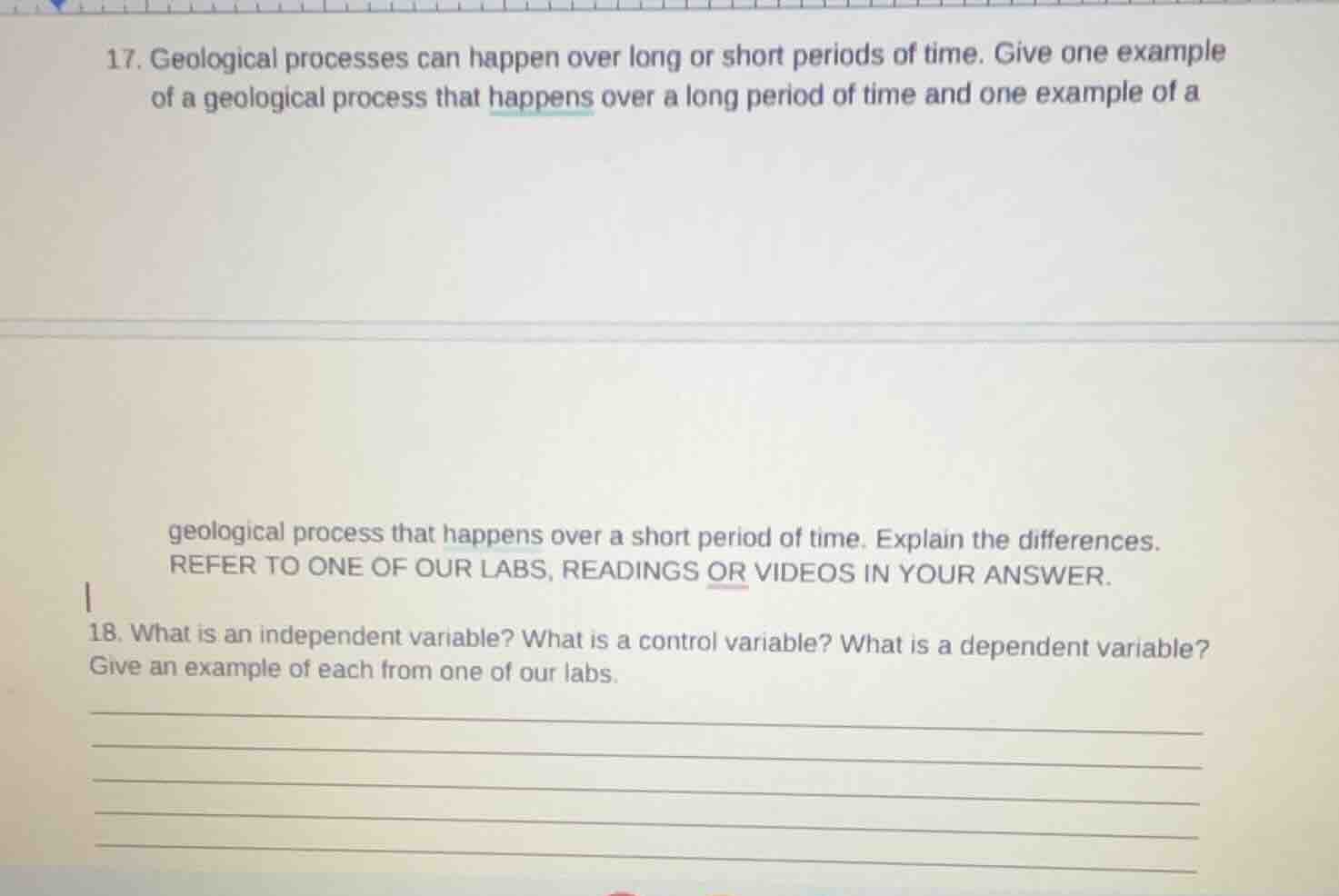
- geological processes can happen over long or short periods of time. give one example of a geological process that happens over a long period of time and one example of a geological process that happens over a short period of time. explain the differences. refer to one of our labs, readings or videos in your answer. 18. what is an independent variable? what is a control variable? what is a dependent variable? give an example of each from one of our labs.
Response
Question 17
Brief Explanations
- Long - term geological process (e.g., Mountain Building): Mountain building, like the formation of the Himalayas due to the collision of the Indian and Eurasian tectonic plates, takes millions of years. This process involves the slow convergence of tectonic plates, leading to the uplift of the Earth's crust. From our geology readings, we learned that tectonic plate movements occur at a rate of a few centimeters per year, and over vast time scales, this accumulates to significant changes in the Earth's surface.
- Short - term geological process (e.g., Volcanic Eruption): A volcanic eruption, such as the 1980 eruption of Mount St. Helens, happens over a relatively short period (hours to days). During an eruption, magma from the Earth's mantle is rapidly expelled to the surface, causing immediate changes like ashfall, lava flows, and the collapse of the volcano's summit. In our lab on volcanic activity, we simulated how quickly volcanic materials can be deposited and how the landscape can be altered in a short time compared to the slow processes of mountain building.
- Differences: The main difference lies in the time scale. Long - term processes act over millions of years, are often related to large - scale tectonic or erosional forces that gradually reshape the Earth's crust. Short - term processes are sudden, driven by events like volcanic activity or earthquakes, and cause immediate but often more localized changes to the landscape.
Brief Explanations
- Independent Variable: This is the variable that is changed or controlled in a scientific experiment to test the effects on the dependent variable. For example, in a lab about plant growth (let's say from our biology lab on photosynthesis), if we were testing the effect of light intensity on plant growth, the light intensity (e.g., low, medium, high light) would be the independent variable.
- Control Variable: These are variables that are kept constant during an experiment to ensure that the experiment is fair and that the change in the dependent variable is only due to the independent variable. In the same plant growth lab, factors like the type of plant (we used the same species of bean plants), the amount of water given (we gave each plant 50 mL of water daily), and the temperature of the growth environment (kept at 25°C) are control variables.
- Dependent Variable: This is the variable that is being measured or tested in an experiment and depends on the independent variable. In the plant growth lab, the height of the plant (measured in centimeters every week) is the dependent variable, as it depends on the light intensity (the independent variable).

Snap & solve any problem in the app
Get step-by-step solutions on Sovi AI
Photo-based solutions with guided steps
Explore more problems and detailed explanations
- Long - term example: Mountain building (e.g., Himalayas formation due to tectonic plate collision).
- Short - term example: Volcanic eruption (e.g., 1980 Mount St. Helens eruption).
- Differences: Mountain building takes millions of years (slow, large - scale tectonic - driven crustal change), while a volcanic eruption occurs over hours/days (sudden, localized, magma - driven surface change). Referenced geology readings (tectonic plate movement rates) and the volcanic activity lab.