QUESTION IMAGE
Question
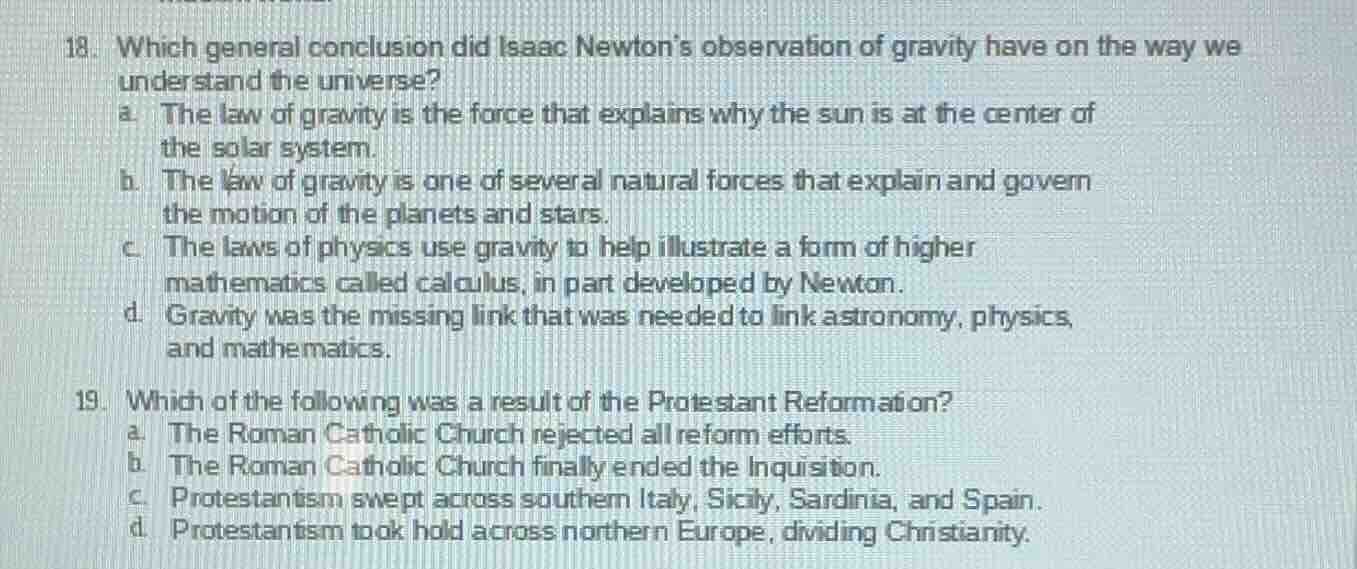
- which general conclusion did isaac newtons observation of gravity have on the way we understand the universe?
a. the law of gravity is the force that explains why the sun is at the center of the solar system.
b. the law of gravity is one of several natural forces that explain and govern the motion of the planets and stars.
c. the laws of physics use gravity to help illustrate a form of higher mathematics called calculus, in part developed by newton.
d. gravity was the missing link that was needed to link astronomy, physics, and mathematics.
- which of the following was a result of the protestant reformation?
a. the roman catholic church rejected all reform efforts.
b. the roman catholic church finally ended the inquisition.
c. protestantism swept across southern italy, sicily, sardinia, and spain.
d. protestantism took hold across northern europe, dividing christianity.
For Question 18:
Newton's law of universal gravitation provided a unifying framework that connected the motion of celestial bodies (astronomy) with terrestrial physics, and he used mathematical principles (including calculus he developed) to formalize this. Option a is incorrect because the heliocentric model was established before Newton. Option b understates the unifying nature of the law, as it was a single, overarching force governing celestial and terrestrial motion, not just one of several. Option c focuses on a mathematical tool rather than the conclusion about understanding the universe. Option d correctly captures the unifying impact across astronomy, physics, and mathematics.
For Question 19:
The Protestant Reformation, starting in the early 16th century, led to the spread of Protestant denominations primarily across northern Europe (e.g., Germany, England, Scandinavia), splitting Western Christianity from the Roman Catholic Church. Option a is incorrect because the Catholic Church did implement some reforms via the Counter-Reformation. Option b is incorrect as the Inquisition continued in some forms after the Reformation. Option c is incorrect because southern Europe remained predominantly Catholic. Option d accurately describes the geographic spread and divisive impact of Protestantism.

Snap & solve any problem in the app
Get step-by-step solutions on Sovi AI
Photo-based solutions with guided steps
Explore more problems and detailed explanations
- d. Gravity was the missing link that was needed to link astronomy, physics, and mathematics.
- d. Protestantism took hold across northern Europe, dividing Christianity.