QUESTION IMAGE
Question
19
read the paragraphs and select the correct answer. * (1 punto)
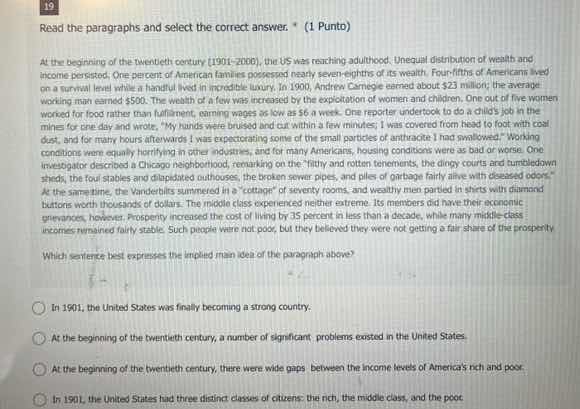
at the beginning of the twentieth century (1901-2000), the us was reaching adulthood. unequal distribution of wealth and income persisted. one percent of american families possessed nearly seven-eighths of its wealth. four-fifths of americans lived on a survival level with a handful in control. in 1900, andrew carnegie earned about $23 million; the average working man earned $500. the wealth of a few was increased by the exploitation of women and children. one out of five women worked for food rather than fulfillment, earning wages as low as $6 a week. one reporter undertook to do a childs job in the mines for a day and wrote this: \my hands were bruised and cut within a few minutes; i was covered from head to foot with coal dust, and for many hours afterwards i was expectorating some of the small particles of anthracite i had swallowed.\ working conditions were equally horrifying in other industries, and for many americans, housing conditions were as bad or worse. one investigator described a chicago neighborhood, remarking on the \filthy and rotting tenements, the foul stench, the loathsome sights, the dreadful sounds.\ a reformer noted that 10 percent of new york citys babies died with diseased organs. at the same time, the vanderbilts could afford a $11 million \summer cottage,\ and wealthy men paraded in shirts with diamond buttons worth three thousand dollars. the middle class experienced mixed fortunes. its members did have their economic generation. in fact, prosperity increased the cost of living by 25 percent in less than a decade, while many middle-class incomes remained fairly stable. such people were not poor, but they believed they were not getting a fair share of the prosperity.
which sentence best expresses the implied main idea of the paragraph above?
○ in 1901, the united states was finally becoming a strong country.
○ at the beginning of the twentieth century, a number of significant problems existed in the united states.
○ at the beginning of the twentieth century, there were wide gaps between the income levels of americas rich and poor.
○ in 1901, the united states had three distinct classes of citizens: the rich, the middle class, and the poor.
The paragraph details extreme inequality in wealth, income, and living conditions between the rich, middle class, and poor in early 1900s US, highlighting significant systemic problems alongside superficial signs of prosperity. Option A is incorrect as the text emphasizes inequality, not a successful strong country. Option C is partially true but focuses only on wealth gaps, while the text also covers working conditions and unshared prosperity. Option D is too narrow, as the core focus is the inequalities and problems, not just categorizing classes. Option B captures the overarching implied idea: alongside 20th-century growth, major problems (inequality, poor conditions) existed.

Snap & solve any problem in the app
Get step-by-step solutions on Sovi AI
Photo-based solutions with guided steps
Explore more problems and detailed explanations
B. At the beginning of the twentieth century, a number of significant problems existed in the United States.