QUESTION IMAGE
Question
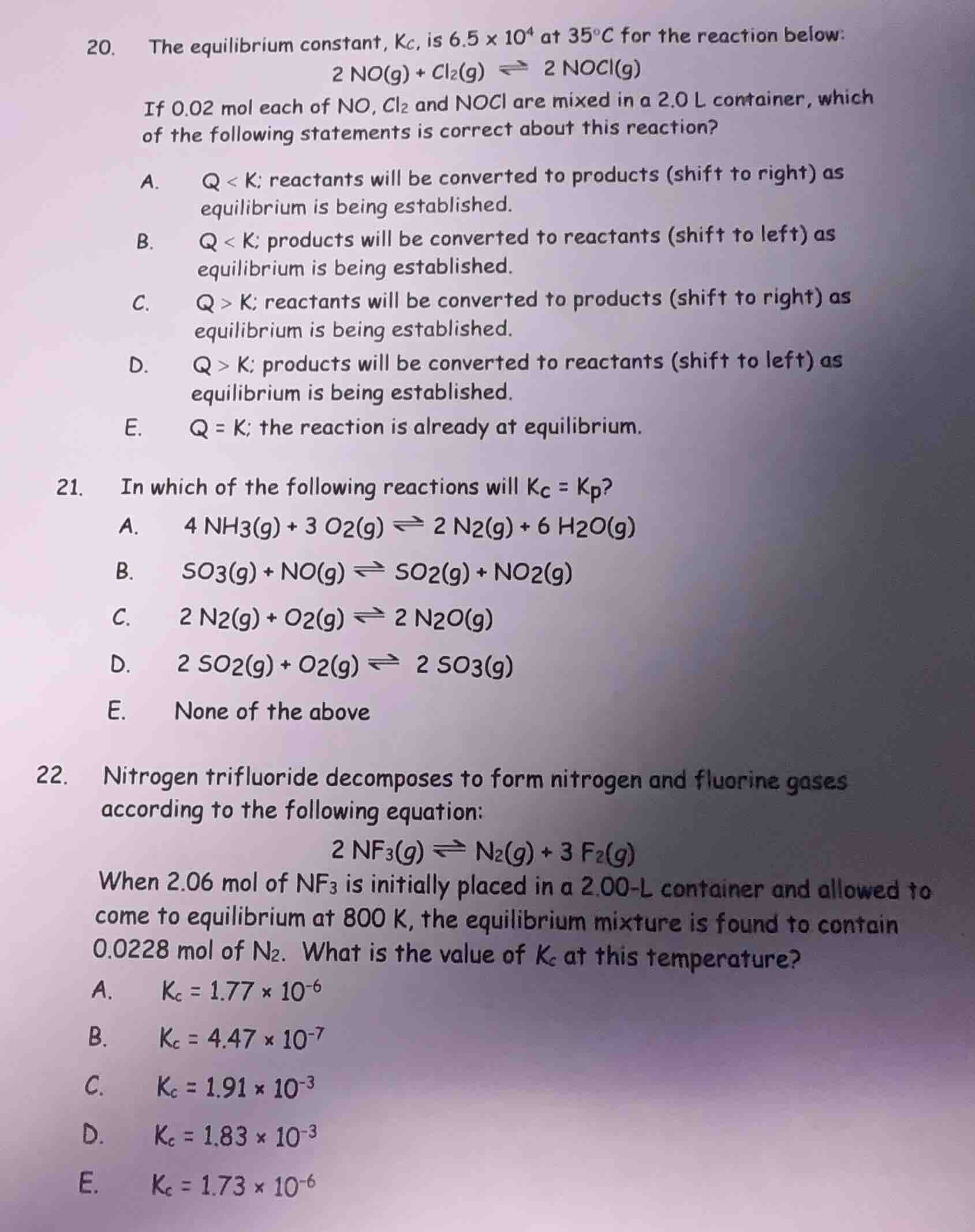
- the equilibrium constant, $k_c$, is $6.5 \times 10^4$ at $35^\circ c$ for the reaction below:
$2\\ no(g) + cl_2(g) \
ightleftharpoons 2\\ nocl(g)$
if 0.02 mol each of no, $cl_2$ and nocl are mixed in a 2.0 l container, which of the following statements is correct about this reaction?
a. $q < k$; reactants will be converted to products (shift to right) as equilibrium is being established.
b. $q < k$; products will be converted to reactants (shift to left) as equilibrium is being established.
c. $q > k$; reactants will be converted to products (shift to right) as equilibrium is being established.
d. $q > k$; products will be converted to reactants (shift to left) as equilibrium is being established.
e. $q = k$; the reaction is already at equilibrium.
- in which of the following reactions will $k_c = k_p$?
a. $4\\ nh_3(g) + 3\\ o_2(g) \
ightleftharpoons 2\\ n_2(g) + 6\\ h_2o(g)$
b. $so_3(g) + no(g) \
ightleftharpoons so_2(g) + no_2(g)$
c. $2\\ n_2(g) + o_2(g) \
ightleftharpoons 2\\ n_2o(g)$
d. $2\\ so_2(g) + o_2(g) \
ightleftharpoons 2\\ so_3(g)$
e. none of the above
- nitrogen trifluoride decomposes to form nitrogen and fluorine gases according to the following equation:
$2\\ nf_3(g) \
ightleftharpoons n_2(g) + 3\\ f_2(g)$
when 2.06 mol of $nf_3$ is initially placed in a 2.00-l container and allowed to come to equilibrium at 800 k, the equilibrium mixture is found to contain 0.0228 mol of $n_2$. what is the value of $k_c$ at this temperature?
a. $k_c = 1.77 \times 10^{-6}$
b. $k_c = 4.47 \times 10^{-7}$
c. $k_c = 1.91 \times 10^{-3}$
d. $k_c = 1.83 \times 10^{-3}$
e. $k_c = 1.73 \times 10^{-6}$
---
Question 20
Step1: Calculate initial concentrations
Concentration = $\frac{\text{moles}}{\text{volume}}$, so for all species:
$\text{[NO]} = \text{[Cl}_2\text{]} = \text{[NOCl]} = \frac{0.02\ \text{mol}}{2.0\ \text{L}} = 0.01\ \text{M}$
Step2: Write reaction quotient expression
For $2\text{NO}(g) + \text{Cl}_2(g)
ightleftharpoons 2\text{NOCl}(g)$:
$Q_c = \frac{[\text{NOCl}]^2}{[\text{NO}]^2[\text{Cl}_2]}$
Step3: Substitute values into $Q_c$
$Q_c = \frac{(0.01)^2}{(0.01)^2(0.01)} = \frac{1\times10^{-4}}{1\times10^{-6}} = 100$
Step4: Compare $Q_c$ and $K_c$
Given $K_c = 6.5\times10^4$, so $Q_c < K_c$. When $Q
Step1: Recall $K_c$ and $K_p$ relationship
The formula is $K_p = K_c(RT)^{\Delta n_g}$, where $\Delta n_g = \text{moles of gaseous products} - \text{moles of gaseous reactants}$. $K_c=K_p$ when $\Delta n_g=0$.
Step2: Calculate $\Delta n_g$ for each reaction
- A: $\Delta n_g = (2+6)-(4+3) = 1$
- B: $\Delta n_g = (1+1)-(1+1) = 0$
- C: $\Delta n_g = 2-(2+1) = -1$
- D: $\Delta n_g = 2-(2+1) = -1$
Step1: Calculate initial $[\text{NF}_3]$
$\text{Initial [NF}_3\text{]} = \frac{2.06\ \text{mol}}{2.00\ \text{L}} = 1.03\ \text{M}$
Equilibrium $[\text{N}_2] = \frac{0.0228\ \text{mol}}{2.00\ \text{L}} = 0.0114\ \text{M}$
Step2: Use ICE table to find equilibrium concentrations
For $2\text{NF}_3(g)
ightleftharpoons \text{N}_2(g) + 3\text{F}_2(g)$:
- Change in $[\text{N}_2] = +0.0114\ \text{M}$, so change in $[\text{NF}_3] = -2\times0.0114 = -0.0228\ \text{M}$, change in $[\text{F}_2] = +3\times0.0114 = 0.0342\ \text{M}$
- Equilibrium $[\text{NF}_3] = 1.03 - 0.0228 = 1.0072\ \text{M}$
- Equilibrium $[\text{F}_2] = 0.0342\ \text{M}$
Step3: Write $K_c$ expression and solve
$K_c = \frac{[\text{N}_2][\text{F}_2]^3}{[\text{NF}_3]^2}$
$K_c = \frac{(0.0114)(0.0342)^3}{(1.0072)^2}$
First calculate $(0.0342)^3 = 4.00\times10^{-5}$, then:
$K_c = \frac{0.0114\times4.00\times10^{-5}}{1.014} \approx 4.47\times10^{-7}$

Snap & solve any problem in the app
Get step-by-step solutions on Sovi AI
Photo-based solutions with guided steps
Explore more problems and detailed explanations
A. Q < K; reactants will be converted to products (shift to right) as equilibrium is being established.
---