QUESTION IMAGE
Question
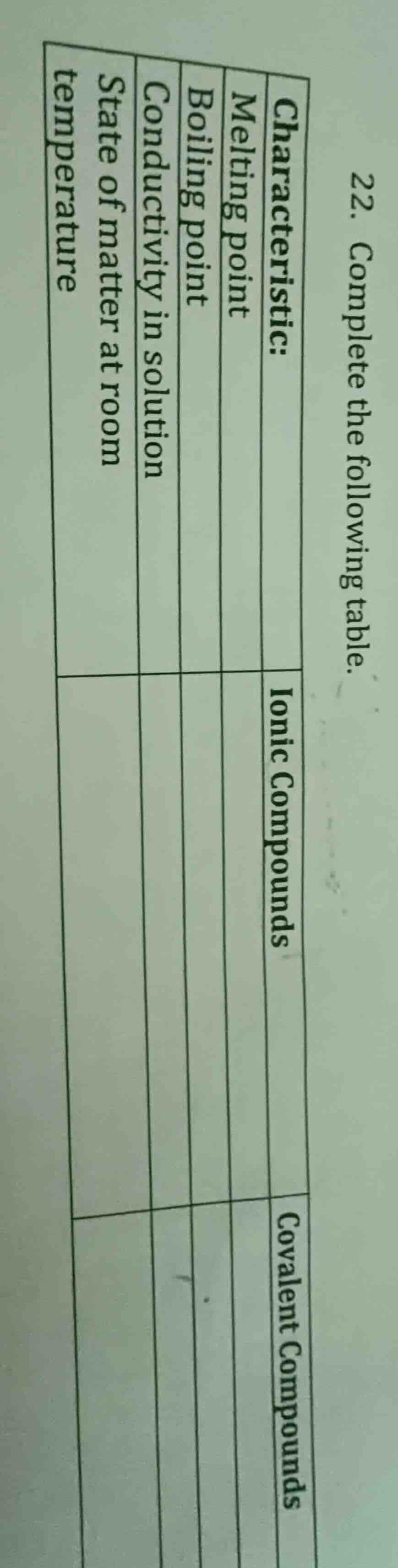
- complete the following table.
characteristic: | ionic compounds | covalent compounds
melting point | |
boiling point | |
conductivity in solution | |
state of matter at room temperature | |
To complete the table, we analyze the properties of ionic and covalent compounds:
Step 1: Melting Point
- Ionic Compounds: Have high melting points (strong ionic bonds require large energy to break).
- Covalent Compounds: Have low melting points (weak intermolecular forces).
Step 2: Boiling Point
- Ionic Compounds: High boiling points (similar to melting point logic, strong bonds).
- Covalent Compounds: Low boiling points (weak intermolecular forces).
Step 3: Conductivity in Solution
- Ionic Compounds: Conduct electricity (dissociate into ions, which carry charge).
- Covalent Compounds: Do not conduct (most do not dissociate into ions).
Step 4: State of Matter at Room Temperature
- Ionic Compounds: Solid (due to strong ionic bonds holding ions in a lattice).
- Covalent Compounds: Usually liquid or gas (weak intermolecular forces; some, like diamond, are solid but non - conducting).
| Characteristic | Ionic Compounds | Covalent Compounds |
|---|---|---|
| Boiling point | High | Low |
| Conductivity in solution | Conducts electricity | Does not conduct |
| State of matter at room temperature | Solid | Liquid or gas (or solid for some exceptions like diamond) |
(Note: For temperature, ionic compounds are solid (room temp ~25°C is below their high melting points), covalent compounds (like H₂O is liquid, CO₂ is gas, etc.) follow their typical states.)

Snap & solve any problem in the app
Get step-by-step solutions on Sovi AI
Photo-based solutions with guided steps
Explore more problems and detailed explanations
To complete the table, we analyze the properties of ionic and covalent compounds:
Step 1: Melting Point
- Ionic Compounds: Have high melting points (strong ionic bonds require large energy to break).
- Covalent Compounds: Have low melting points (weak intermolecular forces).
Step 2: Boiling Point
- Ionic Compounds: High boiling points (similar to melting point logic, strong bonds).
- Covalent Compounds: Low boiling points (weak intermolecular forces).
Step 3: Conductivity in Solution
- Ionic Compounds: Conduct electricity (dissociate into ions, which carry charge).
- Covalent Compounds: Do not conduct (most do not dissociate into ions).
Step 4: State of Matter at Room Temperature
- Ionic Compounds: Solid (due to strong ionic bonds holding ions in a lattice).
- Covalent Compounds: Usually liquid or gas (weak intermolecular forces; some, like diamond, are solid but non - conducting).
| Characteristic | Ionic Compounds | Covalent Compounds |
|---|---|---|
| Boiling point | High | Low |
| Conductivity in solution | Conducts electricity | Does not conduct |
| State of matter at room temperature | Solid | Liquid or gas (or solid for some exceptions like diamond) |
(Note: For temperature, ionic compounds are solid (room temp ~25°C is below their high melting points), covalent compounds (like H₂O is liquid, CO₂ is gas, etc.) follow their typical states.)