QUESTION IMAGE
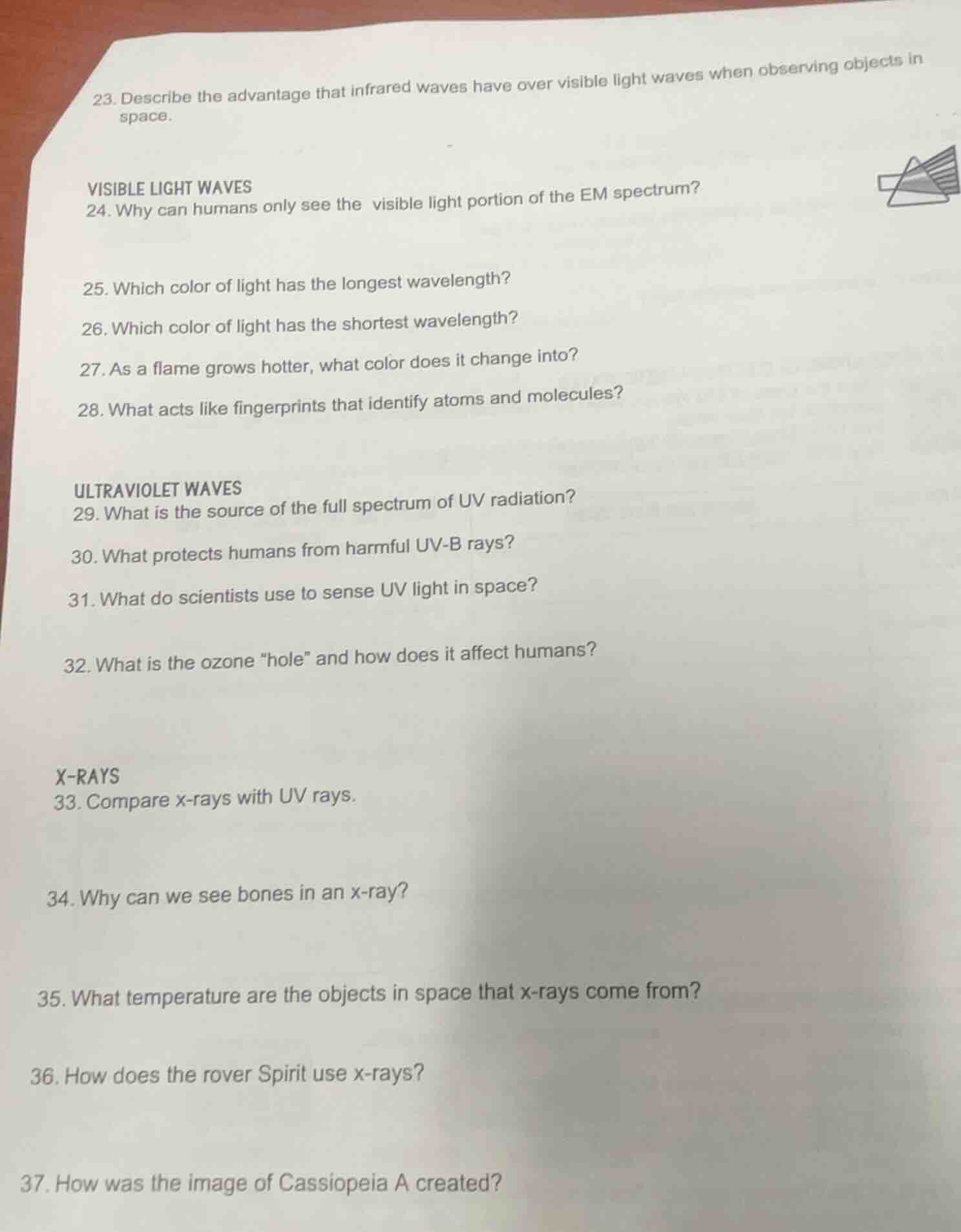
Question
- describe the advantage that infrared waves have over visible light waves when observing objects in space.
visible light waves
- why can humans only see the visible light portion of the em spectrum?
- which color of light has the longest wavelength?
- which color of light has the shortest wavelength?
- as a flame grows hotter, what color does it change into?
- what acts like fingerprints that identify atoms and molecules?
ultraviolet waves
- what is the source of the full spectrum of uv radiation?
- what protects humans from harmful uv - b rays?
- what do scientists use to sense uv light in space?
- what is the ozone \hole\ and how does it affect humans?
x - rays
- compare x - rays with uv rays.
- why can we see bones in an x - ray?
- what temperature are the objects in space that x - rays come from?
- how does the rover spirit use x - rays?
- how was the image of cassiopeia a created?
Question 23
Infrared waves can penetrate dust clouds in space better than visible light. Dust in space absorbs and scatters visible light, but infrared waves (having longer wavelengths) are less affected. So infrared telescopes can observe objects (like star - forming regions or cool stars) that are hidden from visible - light telescopes by interstellar dust. Also, many celestial objects (such as cool stars, brown dwarfs, and dust - enshrouded regions) emit more strongly in the infrared spectrum, allowing us to study their temperature, composition, and dynamics.
Human eyes have photoreceptor cells (rods and cones) that are sensitive to a specific range of electromagnetic radiation (wavelengths of about 400 - 700 nm). Evolution has shaped our eyes to detect visible light because the Sun emits a lot of energy in this range, and it's useful for tasks like seeing in our environment (finding food, avoiding predators). The photoreceptors in our eyes are not sensitive to other parts of the EM spectrum (like infrared or ultraviolet) due to their molecular structure and the way they interact with light.
In the visible light spectrum, the colors are arranged in the order of red, orange, yellow, green, blue, indigo, violet (ROYGBIV) from longest to shortest wavelength. Red light has the longest wavelength among visible colors.

Snap & solve any problem in the app
Get step-by-step solutions on Sovi AI
Photo-based solutions with guided steps
Explore more problems and detailed explanations
Infrared waves can penetrate interstellar dust (which blocks visible light) to observe hidden objects. Many cool celestial objects emit strongly in infrared, enabling study of their properties.