QUESTION IMAGE
Question
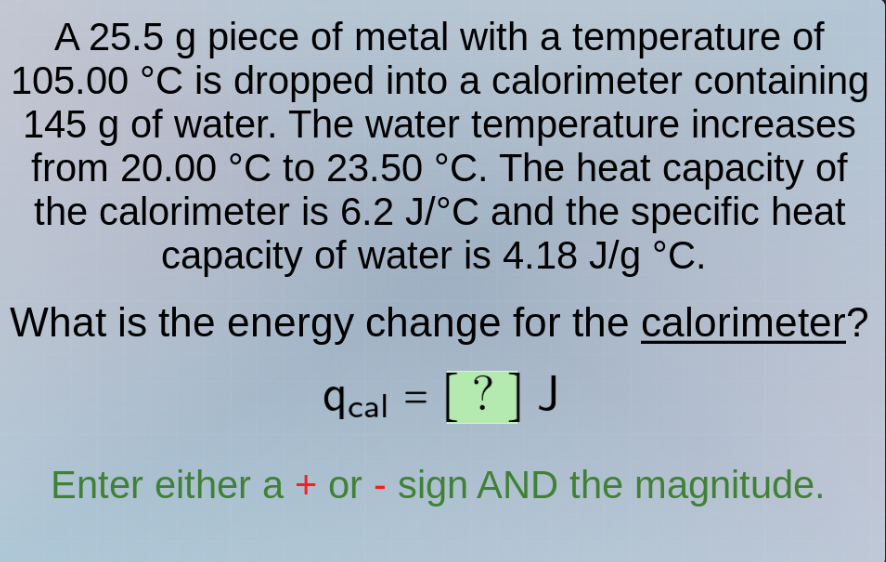
a 25.5 g piece of metal with a temperature of 105.00 °c is dropped into a calorimeter containing 145 g of water. the water temperature increases from 20.00 °c to 23.50 °c. the heat capacity of the calorimeter is 6.2 j/°c and the specific heat capacity of water is 4.18 j/g °c. what is the energy change for the calorimeter? q_{cal} = ? j enter either a + or - sign and the magnitude.
Step1: Recall the formula for heat change of a calorimeter
The heat change for a calorimeter (\(q_{cal}\)) is given by the formula \(q_{cal}=C_{cal}\times\Delta T\), where \(C_{cal}\) is the heat capacity of the calorimeter and \(\Delta T\) is the change in temperature.
Step2: Calculate the change in temperature (\(\Delta T\))
The initial temperature of water (and calorimeter, since they are in thermal equilibrium initially) is \(T_i = 20.00^\circ C\) and the final temperature is \(T_f=23.50^\circ C\). So, \(\Delta T=T_f - T_i=23.50^\circ C - 20.00^\circ C = 3.50^\circ C\).
Step3: Calculate \(q_{cal}\)
We know that \(C_{cal} = 6.2\space J/^\circ C\) and \(\Delta T = 3.50^\circ C\). Substituting these values into the formula \(q_{cal}=C_{cal}\times\Delta T\), we get \(q_{cal}=6.2\space J/^\circ C\times3.50^\circ C\).
Calculating the product: \(6.2\times3.50 = 21.7\). Since the temperature of the calorimeter increases (it absorbs heat from the metal), the sign of \(q_{cal}\) is positive.

Snap & solve any problem in the app
Get step-by-step solutions on Sovi AI
Photo-based solutions with guided steps
Explore more problems and detailed explanations
\(+21.7\)