QUESTION IMAGE
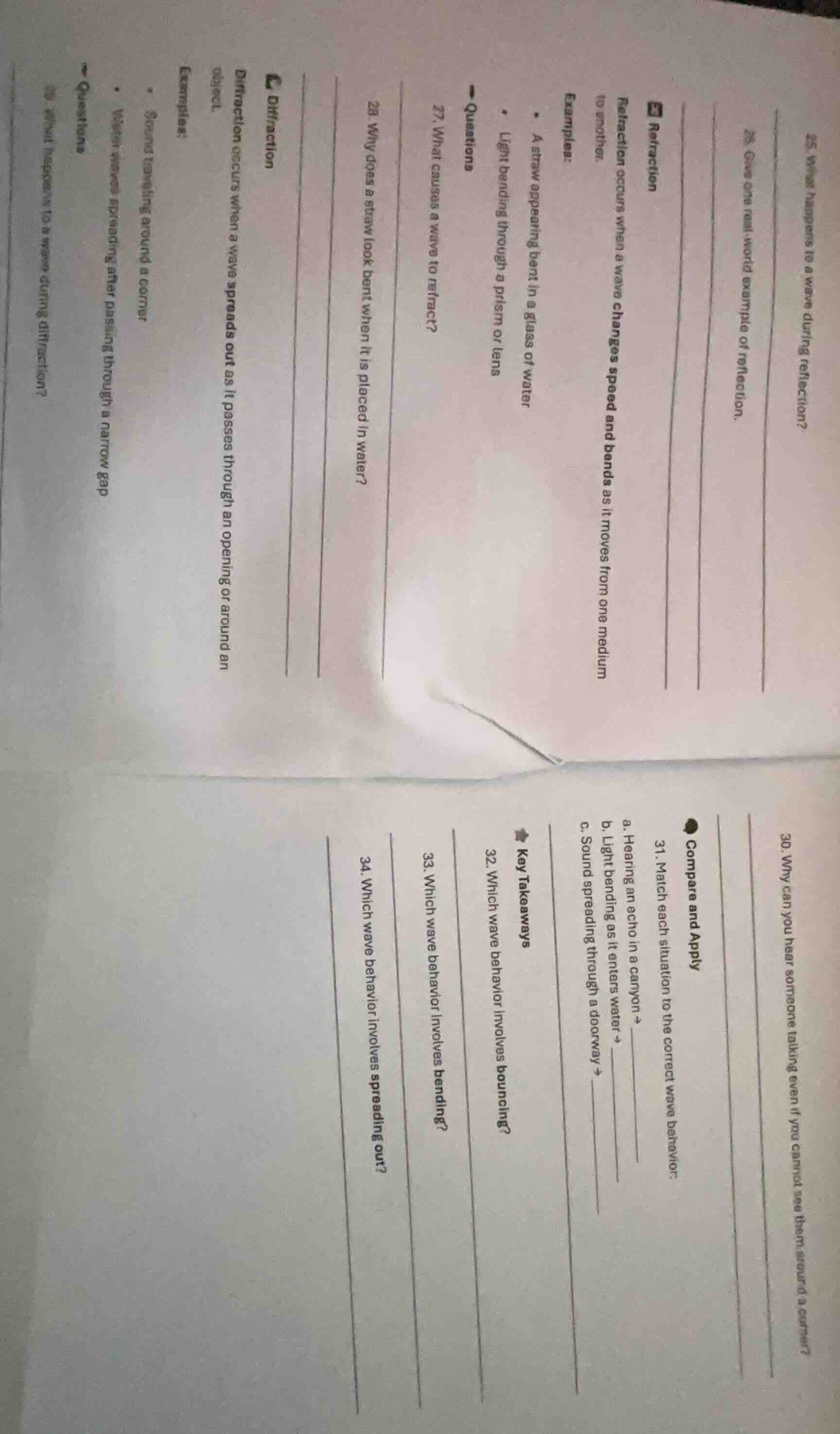
Question
- what happens to a wave during reflection?
- give one real - world example of reflection.
refraction
refraction occurs when a wave changes speed and bends as it moves from one medium to another.
examples:
- a straw appearing bent in a glass of water
- light bending through a prism or lens
questions
- what causes a wave to refract?
- why does a straw look bent when it is placed in water?
diffraction
diffraction occurs when a wave spreads out as it passes through an opening or around an object.
examples:
- sound traveling around a corner
- water waves spreading after passing through a narrow gap
questions
- what happens to a wave during diffraction?
- why can you hear someone talking even if you cannot see them around a corner?
- match each situation to the correct wave behavior.
a. hearing an echo in a canyon→
b. light bending as it enters water→
c. sound spreading through a doorway→
key takeaways
- which wave behavior involves bouncing?
- which wave behavior involves bending?
- which wave behavior involves spreading out?
Brief Explanations
- Reflection is the bouncing of a wave off a surface, so the wave rebounds from the boundary, maintaining its frequency but changing direction.
- A common real-world example is seeing your reflection in a flat mirror, where light waves bounce off the mirror surface to form an image.
- Refraction is caused by a wave changing its speed as it moves from one medium to another with a different optical density.
- Light travels slower in water than in air. When light from the straw exits water into air, it refracts (bends), making the straw appear bent at the water's surface.
- During diffraction, a wave spreads out as it passes through an opening or around an obstacle, rather than traveling in a straight line.
- Sound waves diffract around the corner: they spread out after passing the obstacle (the corner), allowing the sound to reach your ears even when the source is out of sight.
- a. An echo is a reflected sound wave, so it matches reflection. b. Light bending when entering water is refraction, as the wave changes speed in a new medium. c. Sound spreading through a doorway is diffraction, as the wave spreads out through an opening.
- Bouncing of a wave is the defining behavior of reflection.
- Bending of a wave (due to speed change between media) is refraction.
- Spreading out of a wave through an opening or around an obstacle is diffraction.

Snap & solve any problem in the app
Get step-by-step solutions on Sovi AI
Photo-based solutions with guided steps
Explore more problems and detailed explanations
- The wave bounces off a surface, changing direction while keeping its original frequency and wavelength (in the same medium).
- Seeing your reflection in a flat bathroom mirror.
- A wave refracts when it changes speed as it moves from one medium to another (with different optical or mechanical density).
- Light travels slower in water than in air. When light from the straw leaves the water and enters air, it refracts (bends), creating the illusion that the straw is bent.
- The wave spreads out as it passes through an opening or around an obstacle.
- Sound waves diffract around the corner: they spread out after passing the obstacle, allowing the sound to reach your ears even when the source is not visible.
- a. Reflection; b. Refraction; c. Diffraction
- Reflection
- Refraction
- Diffraction