QUESTION IMAGE
Question
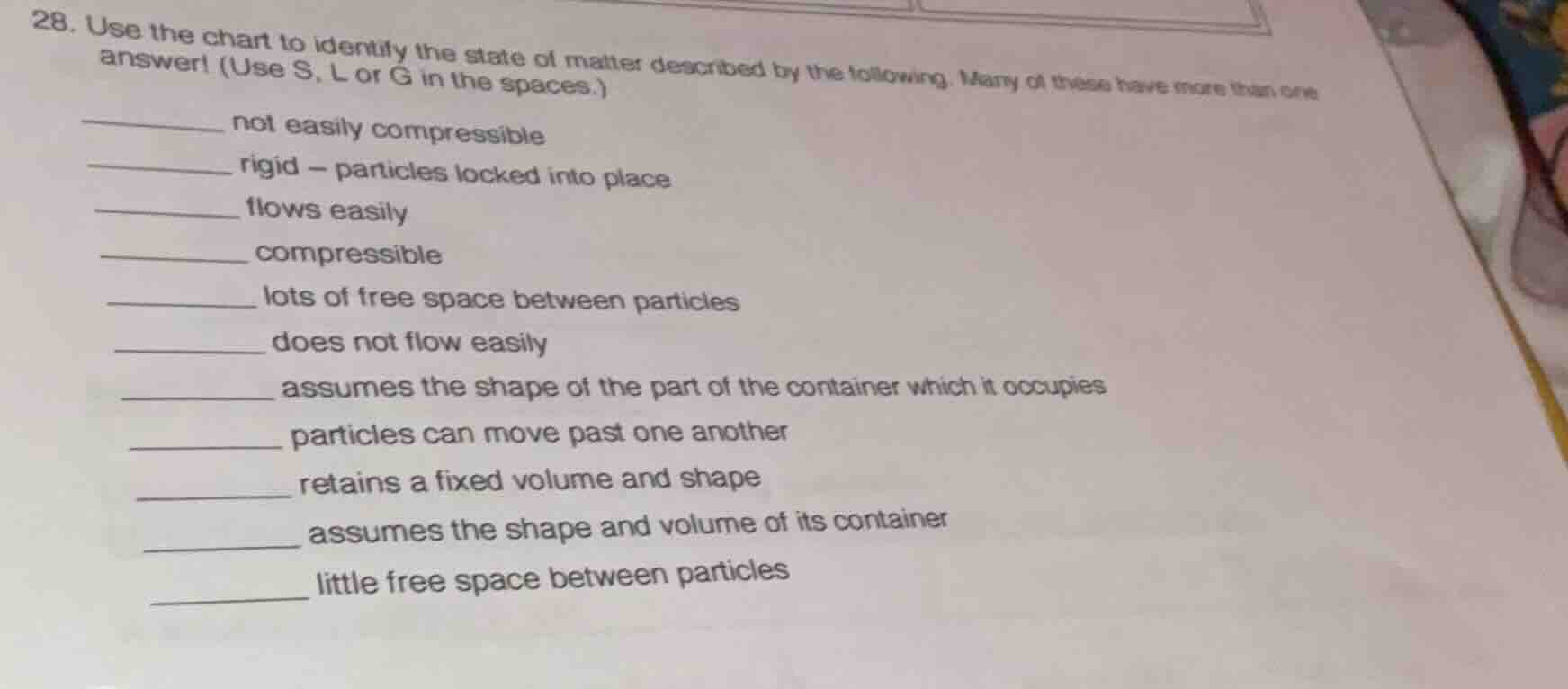
- use the chart to identify the state of matter described by the following. many of these have more than one answer! (use s, l or g in the spaces.)
_______ not easily compressible
_______ rigid – particles locked into place
_______ flows easily
_______ compressible
_______ lots of free space between particles
_______ does not flow easily
_______ assumes the shape of the part of the container which it occupies
_______ particles can move past one another
_______ retains a fixed volume and shape
_______ assumes the shape and volume of its container
_______ little free space between particles
Brief Explanations
- not easily compressible: Solids and liquids have tightly packed particles with little space to be squeezed together.
- rigid – particles locked into place: Only solids have particles fixed in a rigid, ordered structure that doesn't move freely.
- flows easily: Liquids and gases have particles that can move past each other, allowing them to flow.
- compressible: Gases have large amounts of empty space between particles, so they can be compressed.
- lots of free space between particles: Gas particles are spread far apart, creating significant free space.
- does not flow easily: Solid particles are locked in position, so they cannot flow.
- assumes the shape of the part of the container which it occupies: Liquids take the shape of the container's bottom/occupied portion but keep a fixed volume.
- particles can move past one another: Liquid and gas particles are not fixed in place, so they can slide or move past each other.
- retains a fixed volume and shape: Solids have fixed particle positions, so their volume and shape do not change.
- assumes the shape and volume of its container: Gases expand to fill the entire container they are placed in.
- little free space between particles: Solid and liquid particles are closely packed with minimal empty space between them.

Snap & solve any problem in the app
Get step-by-step solutions on Sovi AI
Photo-based solutions with guided steps
Explore more problems and detailed explanations
- S, L
- S
- L, G
- G
- G
- S
- L
- L, G
- S
- G
- S, L