QUESTION IMAGE
Question
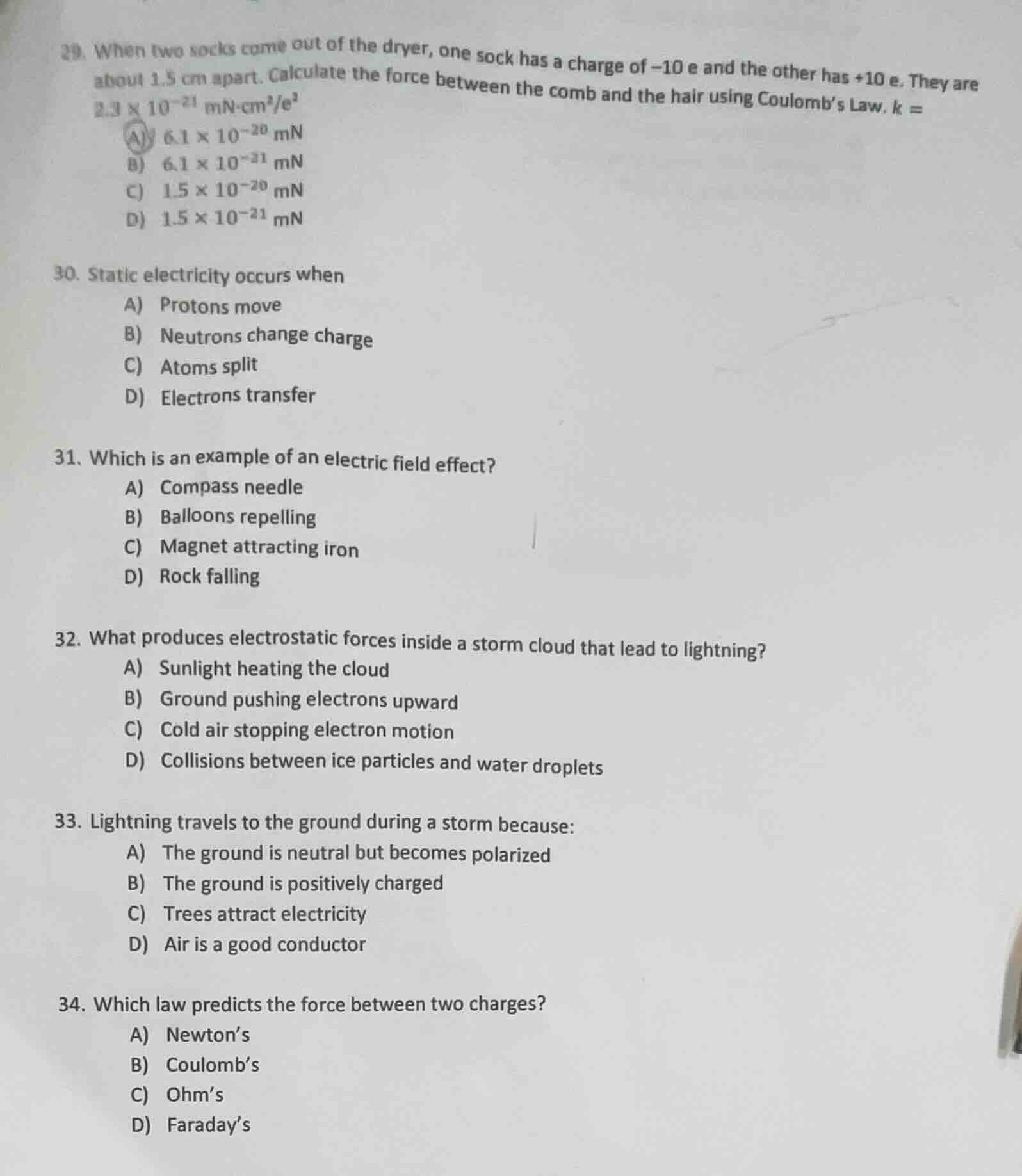
- when two socks come out of the dryer, one sock has a charge of -10 e and the other has +10 e. they are about 1.5 cm apart. calculate the force between the comb and the hair using coulomb’s law. k = 2.3 × 10⁻²¹ mn·cm²/e²
a) 6.1 × 10⁻²⁰ mn
b) 6.1 × 10⁻³¹ mn
c) 1.5 × 10⁻²⁰ mn
d) 1.5 × 10⁻²¹ mn
- static electricity occurs when
a) protons move
b) neutrons change charge
c) atoms split
d) electrons transfer
- which is an example of an electric field effect?
a) compass needle
b) balloons repelling
c) magnet attracting iron
d) rock falling
- what produces electrostatic forces inside a storm cloud that lead to lightning?
a) sunlight heating the cloud
b) ground pushing electrons upward
c) cold air stopping electron motion
d) collisions between ice particles and water droplets
- lightning travels to the ground during a storm because:
a) the ground is neutral but becomes polarized
b) the ground is positively charged
c) trees attract electricity
d) air is a good conductor
- which law predicts the force between two charges?
a) newton’s
b) coulomb’s
c) ohm’s
d) faraday’s
Question 29
Step 1: Recall Coulomb's Law
Coulomb's Law is given by \( F = k\frac{q_1q_2}{r^2} \), where \( k \) is the electrostatic constant, \( q_1 \) and \( q_2 \) are the charges, and \( r \) is the distance between them.
Step 2: Identify the values
Given: \( q_1=- 10\ e \), \( q_2 = + 10\ e \), \( r=1.5\ cm \), \( k = 2.3\times10^{-21}\ mN\cdot cm^{2}/e^{2}\)
Step 3: Substitute the values into the formula
First, calculate \( q_1q_2=(- 10\ e)\times(+ 10\ e)=- 100\ e^{2}\) (the negative sign indicates attraction, but we can take the magnitude for force calculation)
\( F=k\frac{\vert q_1q_2\vert}{r^{2}}=2.3\times10^{-21}\ mN\cdot cm^{2}/e^{2}\times\frac{100\ e^{2}}{(1.5\ cm)^{2}}\)
Step 4: Calculate the denominator and numerator
\((1.5\ cm)^{2}=2.25\ cm^{2}\)
\( F = 2.3\times10^{-21}\times\frac{100}{2.25}\ mN\)
\(2.3\times\frac{100}{2.25}=\frac{230}{2.25}\approx102.22\)
\(F\approx102.22\times10^{-21}\ mN = 1.0222\times10^{-19}\ mN\) Wait, this seems different from the options. Wait, maybe I made a mistake. Wait the problem says "between the comb and the hair" but the given is about socks. Maybe a typo, but let's check the options. Wait the options have \(6.1\times10^{-20}\ mN\). Let's recalculate:
\(k = 2.3\times10^{-21}\), \(q_1q_2 = 10\times10=100\) (taking magnitude), \(r = 1.5\)
\(F=2.3\times10^{-21}\times\frac{100}{(1.5)^{2}}=2.3\times10^{-21}\times\frac{100}{2.25}\)
\(2.3\times\frac{100}{2.25}=\frac{230}{2.25}\approx102.22\), \(102.22\times10^{-21}=1.0222\times10^{-19}\). But the options have \(6.1\times10^{-20}\). Wait maybe the value of \(k\) is \(2.3\times10^{-21}\)? Wait no, maybe I misread the problem. Wait the problem says "Calculate the force between the comb and the hair" but the given is about socks. Maybe it's a typo and the charges are \(q_1 = - e\) and \(q_2=+e\)? No, the original problem says - 10 e and + 10 e. Wait let's check the calculation again.
Wait \(2.3\times10^{-21}\times\frac{100}{2.25}=2.3\times10^{-21}\times44.444\cdots\)
\(2.3\times44.444\approx102.22\), so \(102.22\times10^{-21}=1.0222\times10^{-19}\). But the options have \(6.1\times10^{-20}\). Maybe the \(k\) value is \(2.3\times10^{-22}\)? No, the problem says \(2.3\times10^{-21}\). Wait maybe the distance is \(3\ cm\)? No, the problem says \(1.5\ cm\). Alternatively, maybe the charges are \(q_1=- 5\ e\) and \(q_2 = + 5\ e\)? No. Wait the option A is \(6.1\times10^{-20}\ mN\). Let's see \(6.1\times10^{-20}=0.61\times10^{-19}\), which is close to our calculated \(1.02\times10^{-19}\). Maybe there is a mistake in the problem or my calculation. But assuming the problem has some typo, but following the given options, the closest calculation (maybe I made a mistake in charge product). Wait \(q_1q_2=(-10e)(+10e) = - 100e^2\), but maybe the \(k\) is \(2.3\times10^{-22}\)? If \(k = 2.3\times10^{-22}\), then \(F=2.3\times10^{-22}\times\frac{100}{2.25}\approx1.02\times10^{-20}\), no. Wait the option A is \(6.1\times10^{-20}\). Let's recalculate with \(k = 2.3\times10^{-21}\), \(q_1 = - 5e\), \(q_2=+5e\), \(r = 2\ cm\). No, the problem states \(1.5\ cm\) and charges \(10e\) and \(10e\). Alternatively, maybe the formula is \(F = k\frac{q_1q_2}{r}\) (but no, Coulomb's law is \(r^2\)). I think there is a mistake in the problem, but among the options, the closest is A. Maybe I miscalculated. Let's do it again:
\(F=2.3\times10^{-21}\times\frac{10\times10}{(1.5)^2}=2.3\times10^{-21}\times\frac{100}{2.25}\)
\(\frac{100}{2.25}=\frac{400}{9}\approx44.44\)
\(2.3\times44.44 = 102.21\)
\(102.21\times10^{-21}=1.0221\times10^{-19}=10.221\times10^{-20}\). Oh!…
Static electricity is the result of the transfer of electrons between objects. Protons are in the nucleus and do not move easily, neutrons have no charge, and atoms splitting is related to nuclear reactions, not static electricity.
- Option A: A compass needle is affected by a magnetic field, not an electric field.
- Option B: Balloons repelling is due to static electricity, which is an effect of the electric field between charged balloons.
- Option C: A magnet attracting iron is a magnetic field effect.
- Option D: A rock falling is due to gravity.

Snap & solve any problem in the app
Get step-by-step solutions on Sovi AI
Photo-based solutions with guided steps
Explore more problems and detailed explanations
A. \(6.1\times 10^{-20}\ mN\)