QUESTION IMAGE
Question
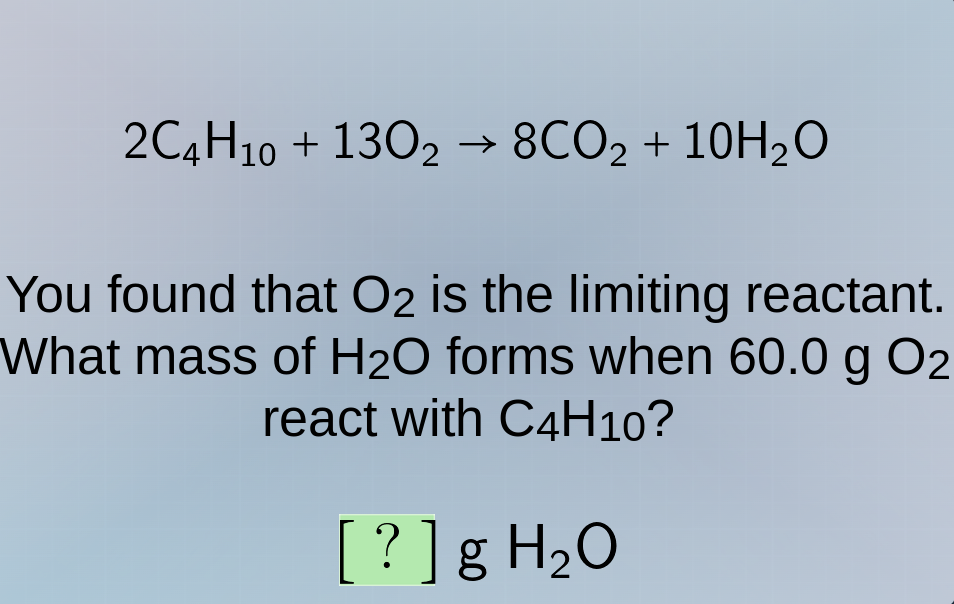
2c₄h₁₀ + 13o₂ → 8co₂ + 10h₂o
you found that o₂ is the limiting reactant.
what mass of h₂o forms when 60.0 g o₂
react with c₄h₁₀?
? g h₂o
Step1: Calculate moles of \( O_2 \)
Molar mass of \( O_2 \) is \( 32.00 \, \text{g/mol} \). Moles of \( O_2 = \frac{\text{mass}}{\text{molar mass}} = \frac{60.0 \, \text{g}}{32.00 \, \text{g/mol}} = 1.875 \, \text{mol} \).
Step2: Relate moles of \( O_2 \) to \( H_2O \)
From the balanced equation, \( 13 \, \text{mol} \, O_2 \) produces \( 10 \, \text{mol} \, H_2O \). So, moles of \( H_2O = 1.875 \, \text{mol} \, O_2 \times \frac{10 \, \text{mol} \, H_2O}{13 \, \text{mol} \, O_2} \approx 1.4423 \, \text{mol} \).
Step3: Calculate mass of \( H_2O \)
Molar mass of \( H_2O \) is \( 18.02 \, \text{g/mol} \). Mass of \( H_2O = \text{moles} \times \text{molar mass} = 1.4423 \, \text{mol} \times 18.02 \, \text{g/mol} \approx 25.99 \, \text{g} \approx 26.0 \, \text{g} \).

Snap & solve any problem in the app
Get step-by-step solutions on Sovi AI
Photo-based solutions with guided steps
Explore more problems and detailed explanations
\( 26.0 \) (or approximately \( 25.9 \) - \( 26.0 \) depending on rounding steps)