QUESTION IMAGE
Question
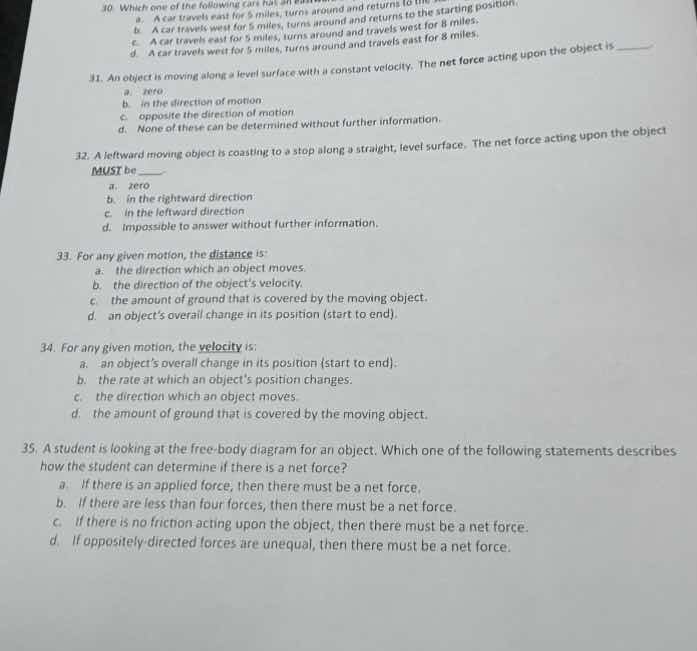
- which one of the following cars a. a car travels east for 5 miles, turns around and returns to the starting position. b. a car travels east for 5 miles, turns around and travels west for 8 miles. c. a car travels west for 5 miles, turns around and travels east for 8 miles. d. a car travels west for 5 miles, turns around and travels west for 8 miles. 31. an object is moving along a level surface with a constant velocity. the net force acting upon the object is ____. a. zero b. in the direction of motion c. opposite the direction of motion d. none of these can be determined without further information. 32. a rightward moving object is coasting to a stop along a straight, level surface. the net force acting upon the object must be ____. a. zero b. in the rightward direction c. in the leftward direction d. impossible to answer without further information. 33. for any given motion, the distance is: a. the direction which an object moves. b. the direction of the objects velocity. c. the amount of ground that is covered by the moving object. d. an objects overall change in its position (start to end). 34. for any given motion, the velocity is: a. an objects overall change in its position (start to end). b. the rate at which an objects position changes. c. the direction which an object moves. d. the amount of ground that is covered by the moving object. 35. a student is looking at the free - body diagram for an object. which one of the following statements describes how the student can determine if there is a net force? a. if there are less than four forces, then there must be a net force. b. if there is an applied force, then there must be a net force. c. if there is no friction acting upon the object, then there must be a net force. d. if oppositely - directed forces are unequal, then there must be a net force.
Brief Explanations
- Newton's first law states that an object in constant velocity has zero net force, as balanced forces act on it.
- To slow a leftward moving object, a force opposite to its motion (rightward) is needed to create deceleration.
- Distance is the total ground covered by a moving object, regardless of direction.
- Velocity is the rate of change of an object's position, including direction.
- A net force exists when opposing forces are unequal, as they do not cancel each other out.

Snap & solve any problem in the app
Get step-by-step solutions on Sovi AI
Photo-based solutions with guided steps
Explore more problems and detailed explanations
- a. zero
- b. in the rightward direction
- c. the amount of ground that is covered by the moving object.
- b. the rate at which an object's position changes.
- d. If oppositely-directed forces are unequal, then there must be a net force.