QUESTION IMAGE
Question
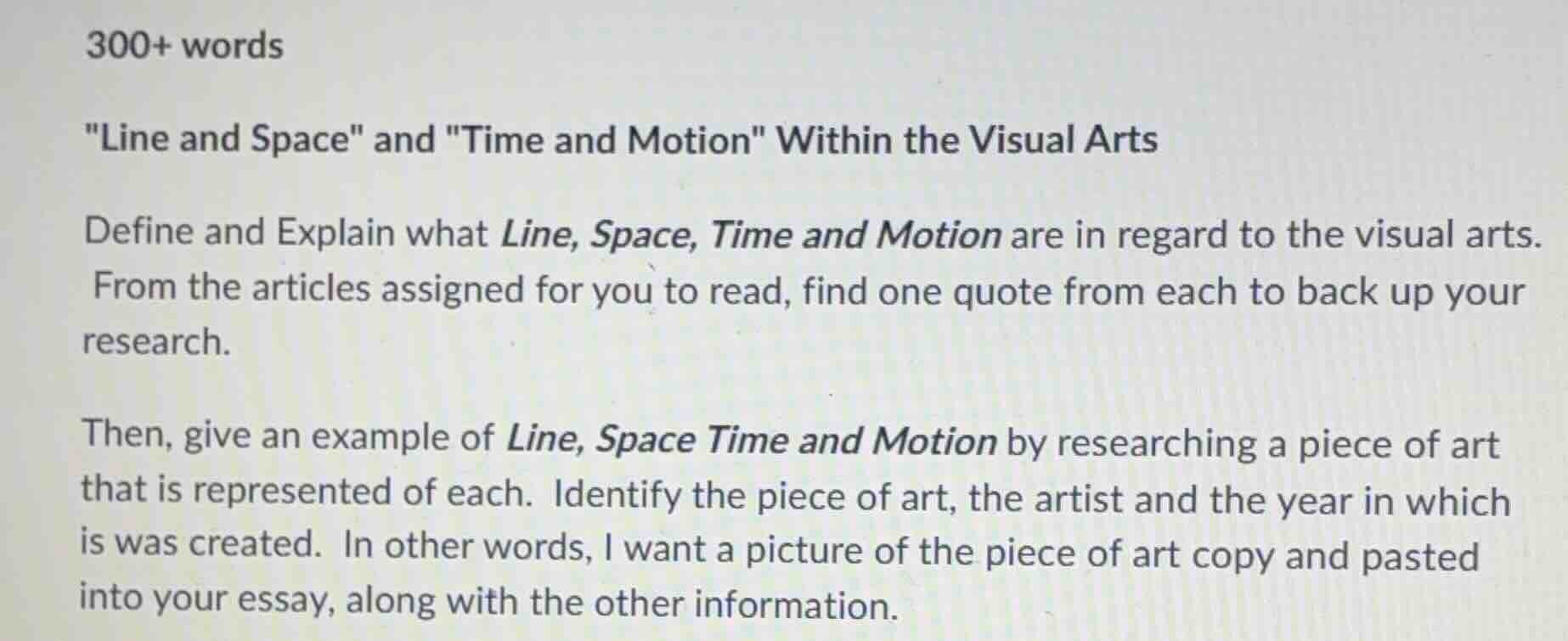
300+ words
\line and space\ and \time and motion\ within the visual arts
define and explain what line, space, time and motion are in regard to the visual arts. from the articles assigned for you to read, find one quote from each to back up your research.
then, give an example of line, space time and motion by researching a piece of art that is represented of each. identify the piece of art, the artist and the year in which is was created. in other words, i want a picture of the piece of art copy and pasted into your essay, along with the other information.
To address this, we analyze each element in visual arts:
1. Defining the Elements
- Line: A fundamental visual art element, a mark with length and direction (e.g., curved, straight, thick/thin), used to create shapes, guide the eye, or express emotion. Quote (example from art theory): “Line is the path of a point moving through space” (from basic art principles texts).
- Space: Encompasses positive (occupied by subjects) and negative (empty areas) space, creating depth, perspective, or balance. Quote: “Space in art is not just empty; it is an active component shaping the viewer’s experience” (from a visual arts analysis).
- Time: In visual art, time can be implied (e.g., a still life suggesting a moment) or represented through sequential works (e.g., a series of paintings showing a narrative over time). Quote: “Time in art is a silent storyteller, freezing or unfolding moments” (from a text on art history).
- Motion: Implied (e.g., a blurred figure in a painting) or actual (e.g., kinetic art with moving parts). Quote: “Motion in art breaks the stillness, inviting the viewer to perceive change” (from a modern art theory source).
2. Examples of Each Element
- Line: “The Starry Night” (Vincent van Gogh, 1889). The swirling, curved lines of the sky express movement and emotion, defining the turbulent atmosphere.
- Space: “The Last Supper” (Leonardo da Vinci, 1498). Uses linear perspective to create depth, with the room’s architecture guiding the eye to the central figure (Jesus), balancing positive (figures) and negative (background) space.
- Time: “The Persistence of Memory” (Salvador Dalí, 1931). Implies the passage of time through melting clocks, suggesting a dreamlike, timeless moment.
- Motion: “Bicycle Wheel” (Marcel Duchamp, 1913, kinetic art precursor). The spinning wheel (when activated) introduces actual motion, challenging traditional still art.

Snap & solve any problem in the app
Get step-by-step solutions on Sovi AI
Photo-based solutions with guided steps
Explore more problems and detailed explanations
To complete the essay:
- Define Each Element with quotes from assigned articles (replace example quotes with your readings).
- Include Examples with images, artist, year, and analysis (e.g., The Starry Night for Line, The Last Supper for Space, The Persistence of Memory for Time, Bicycle Wheel for Motion).
Structure your essay with an introduction, sections for each element (definition + quote + example), and a conclusion. Ensure quotes are properly cited, and images are labeled with artist, title, year, and a brief explanation of how they exemplify the element.