QUESTION IMAGE
Question
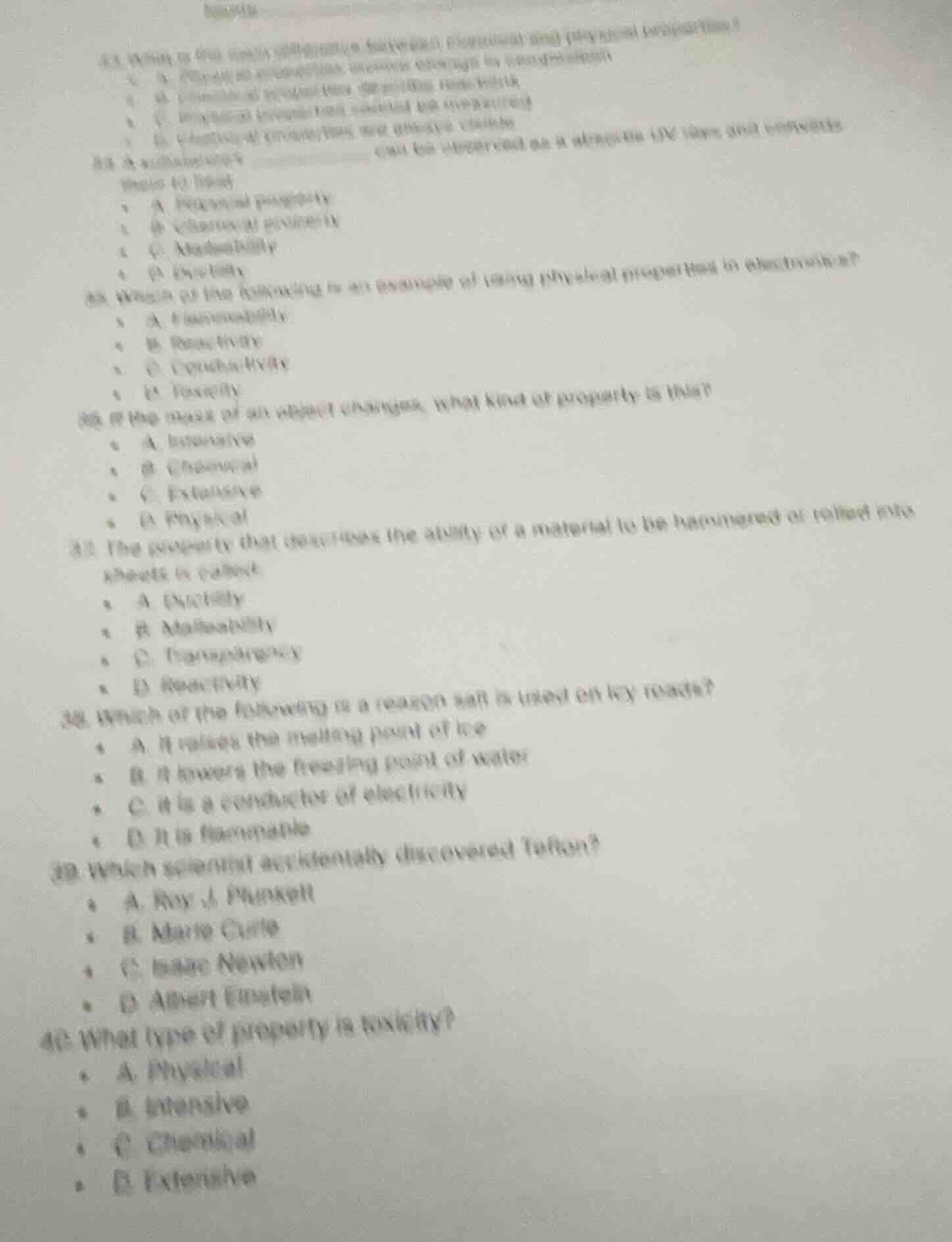
- question text unclear a. option a text unclear b. option b text unclear c. option c text unclear d. option d text unclear 34. a substances ______ can be observed as it changes to uv light and invisible means to hand a. fragmental property b. option b text unclear c. malleability d. toxicity 35. which of the following is an example of using physical property in electronics? a. flammability b. reactivity c. conductivity d. toxicity 36. if the mass of an object changes, what kind of property is this? a. intensive b. chemical c. extensive d. physical 37. the property that describes the ability of a material to be hammered or rolled into sheets is called a. toxicity b. malleability c. option c text unclear d. reactivity 38. which of the following is a reason salt is used on icy roads? a. it raises the melting point of ice b. it lowers the freezing point of water c. it is a conductor of electricity d. it is flammable 39. which scientist accidentally discovered teflon? a. roy j. plunkett b. marie curie c. isaac newton d. albert einstein 40. what type of property is toxicity? a. physical b. intensive c. chemical d. extensive
Brief Explanations
- (The question is cut off, but based on typical content about physical/chemical properties: Physical properties are observable without changing substance identity, chemical require reaction. Assuming the question asks which is a physical property measurement, the correct choice would be the one that doesn't involve a chemical change. However, as the full question is missing, this is a note. For the visible questions below:)
- Sunscreen's ability to absorb UV rays is a chemical property because it involves a chemical interaction with UV radiation.
- Conductivity is a physical property used in electronics to transfer electrical current.
- Extensive properties depend on the amount of matter; mass changing with amount makes it extensive.
- Malleability is the ability of a material to be hammered/rolled into sheets.
- Salt lowers the freezing point of water, melting ice on roads via freezing point depression.
- Roy J. Plunkett accidentally discovered Teflon (polytetrafluoroethylene).
- Toxicity involves how a substance reacts with living organisms, so it is a chemical property.

Snap & solve any problem in the app
Get step-by-step solutions on Sovi AI
Photo-based solutions with guided steps
Explore more problems and detailed explanations
- B. Chemical property
- C. Conductivity
- C. Extensive
- B. Malleability
- B. It lowers the freezing point of water
- A. Roy J. Plunkett
- C. Chemical