QUESTION IMAGE
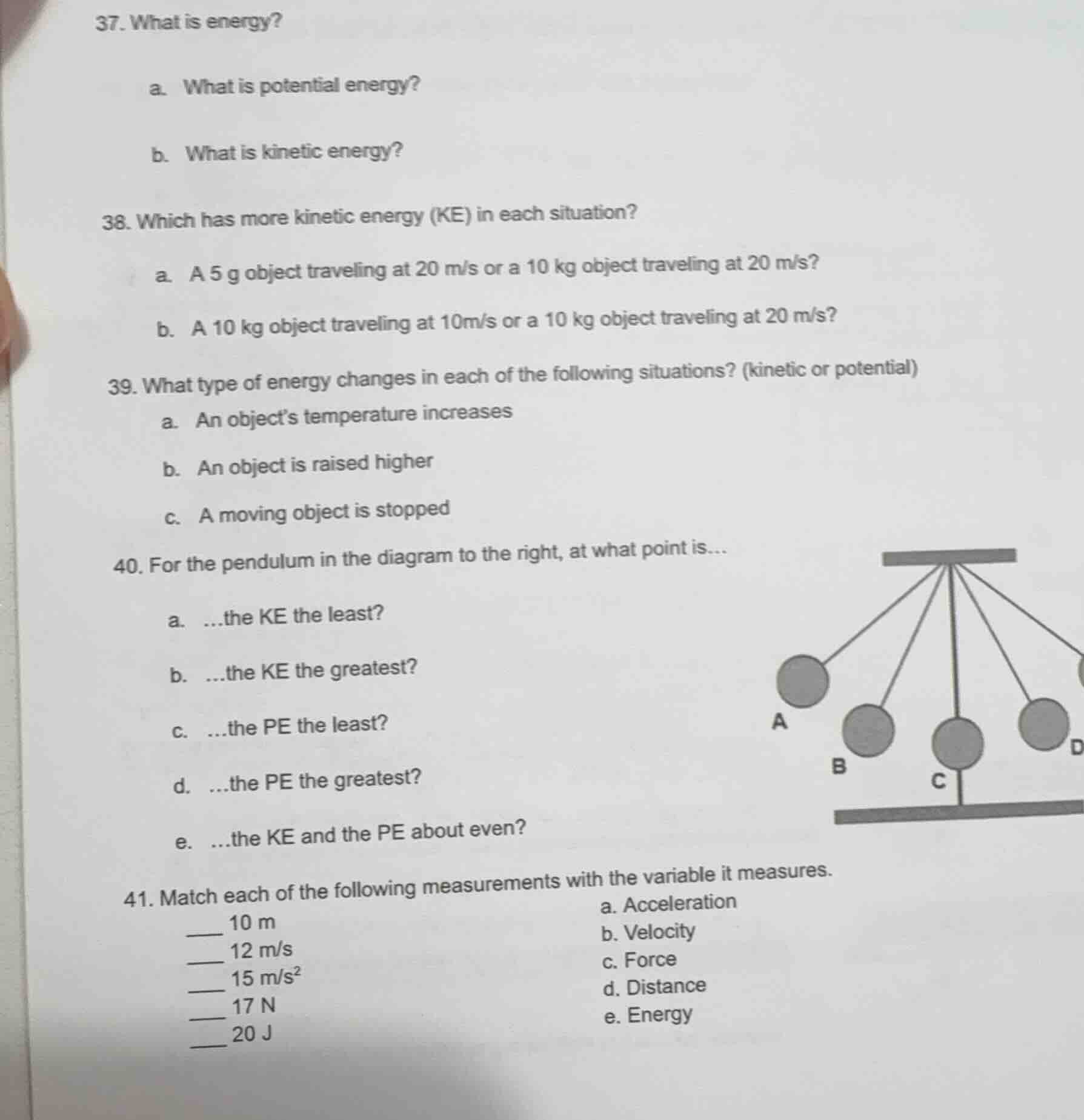
Question
- what is energy?
a. what is potential energy?
b. what is kinetic energy?
- which has more kinetic energy (ke) in each situation?
a. a 5 g object traveling at 20 m/s or a 10 kg object traveling at 20 m/s?
b. a 10 kg object traveling at 10m/s or a 10 kg object traveling at 20 m/s?
- what type of energy changes in each of the following situations? (kinetic or potential)
a. an object’s temperature increases
b. an object is raised higher
c. a moving object is stopped
- for the pendulum in the diagram to the right, at what point is…
a. …the ke the least?
b. …the ke the greatest?
c. …the pe the least?
d. …the pe the greatest?
- match each of the following measurements with the variable it measures.
___ 10 m \t\ta. acceleration
___ 12 m/s \t\tb. velocity
___ 15 m/s² \t\tc. force
___ 17 n \t\td. distance
___ 20 j \t\te. energy
Question 37
a. What is potential energy?
Potential energy (PE) is the stored energy an object has due to its position, shape, or state. For example, gravitational potential energy depends on an object's height ($PE = mgh$, where $m$ is mass, $g$ is acceleration due to gravity, and $h$ is height) or elastic potential energy in a stretched spring.
Kinetic energy (KE) is the energy an object possesses due to its motion. The formula is $KE=\frac{1}{2}mv^{2}$, where $m$ is mass and $v$ is velocity. It depends on both mass and speed of the moving object.
Step 1: Recall KE formula
The formula for kinetic energy is $KE=\frac{1}{2}mv^{2}$.
Step 2: Convert units (5 g to kg)
$5\ g = 0.005\ kg$.
Step 3: Calculate KE for 5 g object
For $m = 0.005\ kg$ and $v = 20\ m/s$:
$KE_1=\frac{1}{2}(0.005)(20)^{2}=\frac{1}{2}(0.005)(400)= 1\ J$.
Step 4: Calculate KE for 10 kg object
For $m = 10\ kg$ and $v = 20\ m/s$:
$KE_2=\frac{1}{2}(10)(20)^{2}=\frac{1}{2}(10)(400)= 2000\ J$.
Step 5: Compare KE values
Since $2000\ J>1\ J$, the 10 kg object has more KE.

Snap & solve any problem in the app
Get step-by-step solutions on Sovi AI
Photo-based solutions with guided steps
Explore more problems and detailed explanations
Potential energy is the stored energy an object has due to its position, shape, or state (e.g., gravitational PE from height, elastic PE from deformation).