QUESTION IMAGE
Question
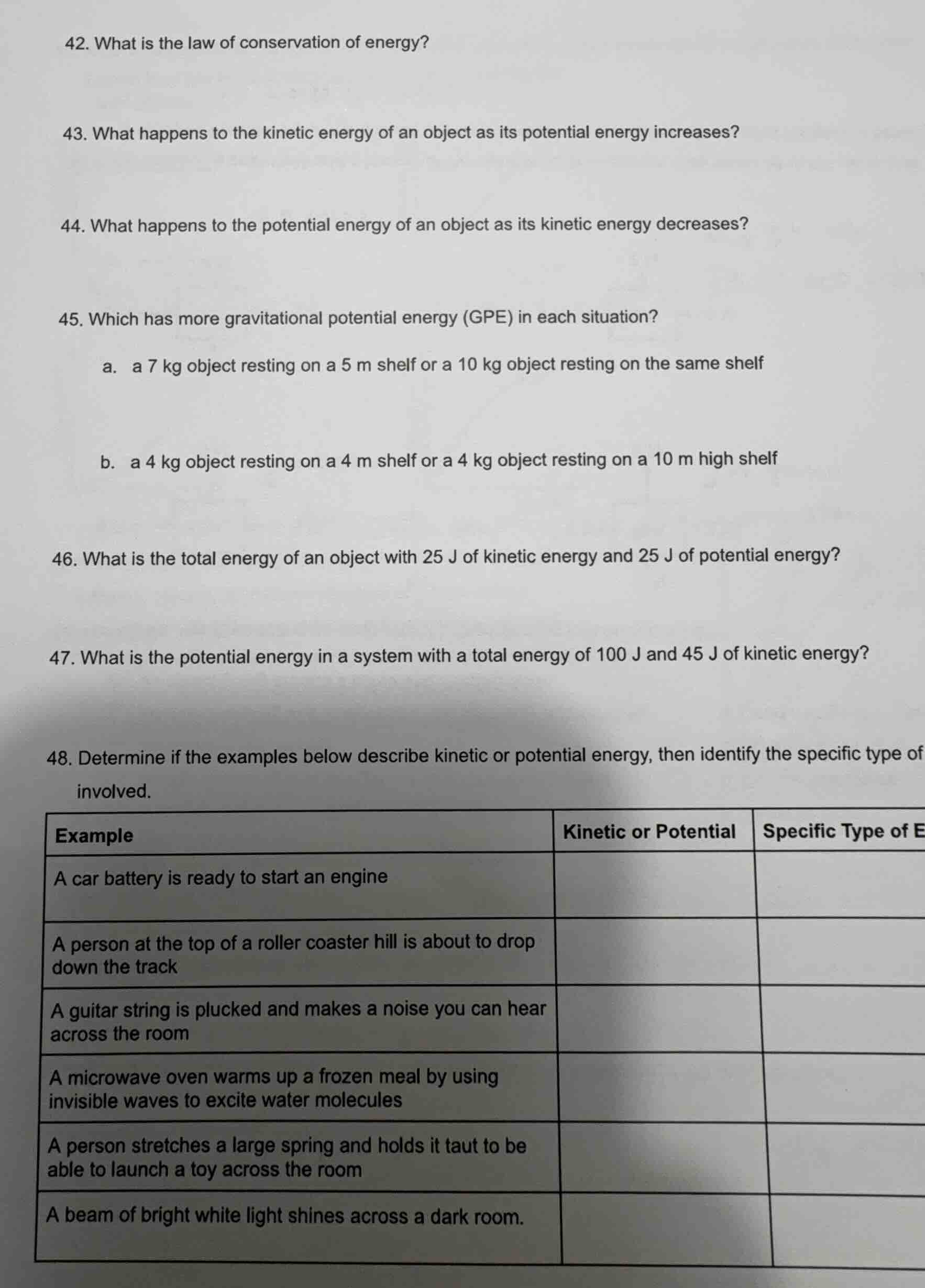
- what is the law of conservation of energy?
- what happens to the kinetic energy of an object as its potential energy increases?
- what happens to the potential energy of an object as its kinetic energy decreases?
- which has more gravitational potential energy (gpe) in each situation?
a. a 7 kg object resting on a 5 m shelf or a 10 kg object resting on the same shelf
b. a 4 kg object resting on a 4 m shelf or a 4 kg object resting on a 10 m high shelf
- what is the total energy of an object with 25 j of kinetic energy and 25 j of potential energy?
- what is the potential energy in a system with a total energy of 100 j and 45 j of kinetic energy?
- determine if the examples below describe kinetic or potential energy, then identify the specific type of involved.
| example | kinetic or potential | specific type of e |
|---|---|---|
| a person at the top of a roller coaster hill is about to drop down the track | ||
| a guitar string is plucked and makes a noise you can hear across the room | ||
| a microwave oven warms up a frozen meal by using invisible waves to excite water molecules | ||
| a person stretches a large spring and holds it taut to be able to launch a toy across the room | ||
| a beam of bright white light shines across a dark room. |
Question 42
The law of conservation of energy states that energy cannot be created or destroyed, only transformed from one form to another, and the total energy of an isolated system remains constant.
By the law of conservation of energy (assuming no non - conservative forces like friction), as potential energy (PE) of an object increases, kinetic energy (KE) decreases because the total mechanical energy \(E = KE+PE\) remains constant (or changes in a way that an increase in PE is balanced by a decrease in KE).
Using the law of conservation of mechanical energy (\(E = KE + PE\)), when kinetic energy (KE) of an object decreases, potential energy (PE) increases (assuming no non - conservative forces and total mechanical energy is conserved).

Snap & solve any problem in the app
Get step-by-step solutions on Sovi AI
Photo-based solutions with guided steps
Explore more problems and detailed explanations
Energy cannot be created or destroyed, only transformed, and total energy in an isolated system is constant.