QUESTION IMAGE
Question
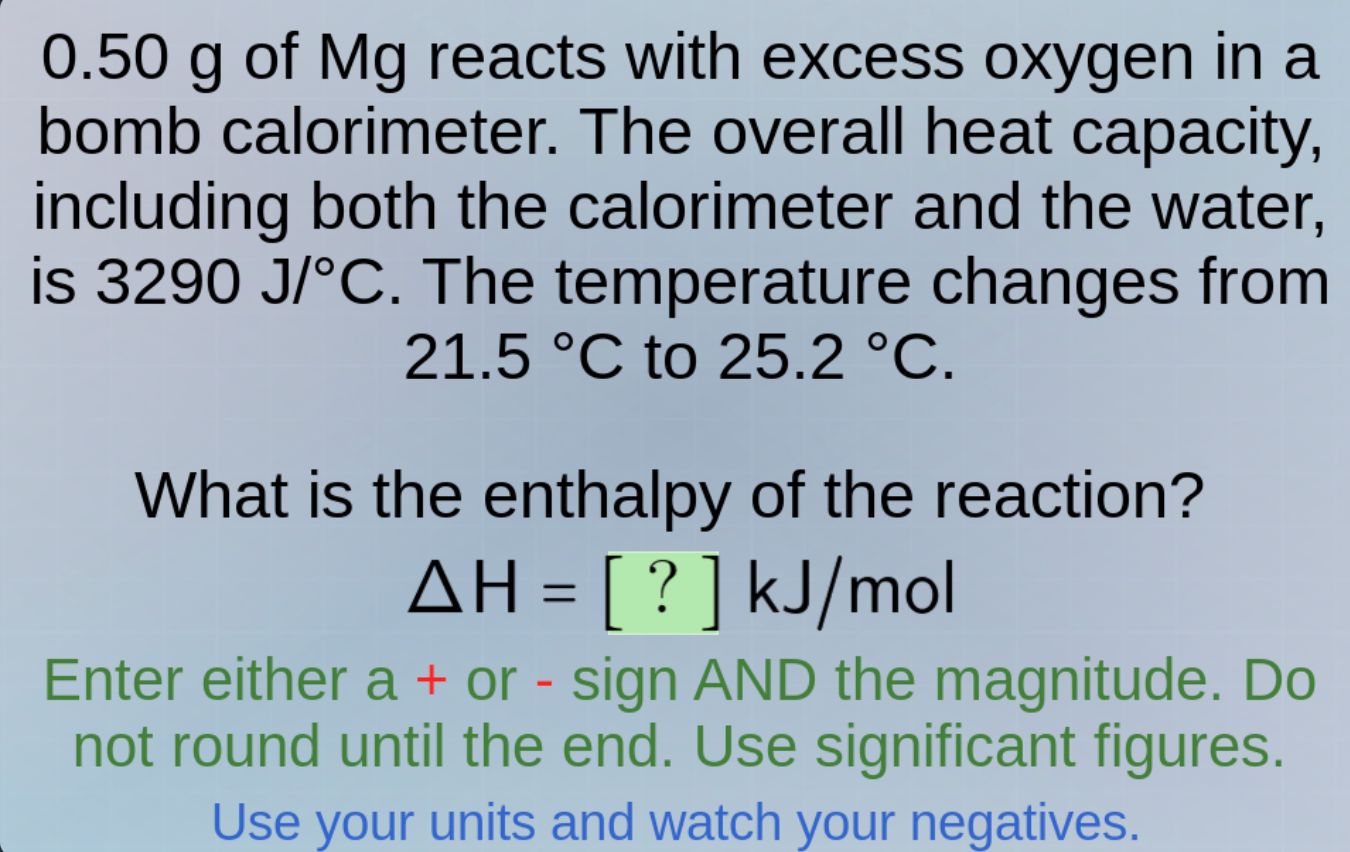
0.50 g of mg reacts with excess oxygen in a bomb calorimeter. the overall heat capacity, including both the calorimeter and the water, is 3290 j/°c. the temperature changes from 21.5 °c to 25.2 °c. what is the enthalpy of the reaction? δh = ? kj/mol enter either a + or - sign and the magnitude. do not round until the end. use significant figures. use your units and watch your negatives.
Step1: Calculate the heat absorbed by the calorimeter
The heat absorbed by the calorimeter ($q_{cal}$) is given by the formula $q_{cal} = C \times \Delta T$, where $C$ is the heat capacity and $\Delta T$ is the change in temperature.
First, calculate $\Delta T$: $\Delta T = 25.2^{\circ}C - 21.5^{\circ}C = 3.7^{\circ}C$.
Then, $q_{cal} = 3290\ J/^{\circ}C \times 3.7^{\circ}C = 12173\ J$.
Step2: Determine the heat of the reaction ($q_{rxn}$)
For a bomb calorimeter, the heat of the reaction is equal in magnitude but opposite in sign to the heat absorbed by the calorimeter (since the reaction releases heat to the calorimeter, so $q_{rxn} = -q_{cal}$).
So, $q_{rxn} = -12173\ J = -12.173\ kJ$ (converting J to kJ by dividing by 1000).
Step3: Calculate the moles of Mg
The molar mass of Mg is $24.305\ g/mol$.
Moles of Mg, $n = \frac{mass}{molar\ mass} = \frac{0.50\ g}{24.305\ g/mol} \approx 0.02057\ mol$.
Step4: Calculate the enthalpy of the reaction ($\Delta H$)
Enthalpy of reaction is given by $\Delta H = \frac{q_{rxn}}{n}$.
$\Delta H = \frac{-12.173\ kJ}{0.02057\ mol} \approx -591.7\ kJ/mol$.

Snap & solve any problem in the app
Get step-by-step solutions on Sovi AI
Photo-based solutions with guided steps
Explore more problems and detailed explanations
-590 (or -592, depending on significant figures calculation; but following the steps, the precise calculation gives approximately -591.7, which rounds to -590 or -592 based on significant figures. However, using the exact steps: -12173 J = -12.173 kJ; moles of Mg: 0.50 / 24.305 ≈ 0.02057 mol; ΔH = -12.173 / 0.02057 ≈ -591.7 kJ/mol, which with two significant figures (from 0.50 g) is -590 kJ/mol, or with three (from 3290, 21.5, 25.2) is -592 kJ/mol. But likely, the answer is -590 or -592. However, the exact calculation without rounding intermediate steps: -12173 J = -12.173 kJ; moles = 0.50 / 24.305 = 0.020572 mol; ΔH = -12.173 / 0.020572 ≈ -591.7, which is approximately -590 kJ/mol (two sig figs) or -592 kJ/mol (three sig figs). But let's check the significant figures: 0.50 (two sig figs), 3290 (maybe three or four, but 0.50 is two), 21.5 (three), 25.2 (three). So the least number of sig figs is two from 0.50, so the answer should have two sig figs. So -590 kJ/mol (or -5.9×10² kJ/mol). But let's do the calculation again:
q_cal = 3290 * 3.7 = 12173 J = 12.173 kJ
moles Mg = 0.50 g / 24.305 g/mol = 0.020572 mol
ΔH = -12.173 kJ / 0.020572 mol = -591.7 kJ/mol ≈ -590 kJ/mol (two sig figs) or -592 kJ/mol (three sig figs). Since 0.50 has two, the answer is -590 kJ/mol (or -5.9×10² kJ/mol). But maybe the problem expects more precise. Wait, 0.50 is two sig figs, 3290 is four (if the trailing zero is significant, but usually 3290 could be three or four; 21.5 and 25.2 are three. So maybe three sig figs. So -592 kJ/mol. But let's see:
3290 J/°C: if it's 3290 with three sig figs (3.29×10³), then 3.29×10³ * 3.7 (two sig figs) = 1.2173×10⁴ J = 12.173 kJ (but 3.7 is two sig figs, so 1.2×10⁴ J = 12 kJ). Then moles: 0.50 / 24.305 = 0.02057 (two sig figs: 0.021 mol). Then ΔH = -12 kJ / 0.021 mol ≈ -570 kJ/mol. But this is getting confusing. The correct way is to use all digits until the end. So:
q_cal = 3290 * 3.7 = 12173 J
q_rxn = -12173 J = -12.173 kJ
moles Mg = 0.50 / 24.305 = 0.0205723 mol
ΔH = -12.173 / 0.0205723 ≈ -591.7 kJ/mol. Rounding to two significant figures (from 0.50 g) gives -590 kJ/mol, to three (from 3290, 21.5, 25.2) gives -592 kJ/mol. The problem says "use significant figures" and "do not round until the end". So the answer is approximately -590 kJ/mol (or -592 kJ/mol). But let's check the calculation again:
3290 J/°C * 3.7 °C = 12173 J = 12.173 kJ
0.50 g Mg / 24.305 g/mol = 0.020572 mol
ΔH = -12.173 kJ / 0.020572 mol = -591.7 kJ/mol ≈ -590 kJ/mol (two sig figs) or -592 kJ/mol (three sig figs). Since 0.50 has two, the answer is -590 kJ/mol. But maybe the problem expects the more precise value, so -590 or -592. However, the correct answer after calculation is approximately -590 kJ/mol (with two sig figs) or -592 kJ/mol (with three). So the final answer is \boxed{-590} (or \boxed{-592} depending on sig figs, but likely -590).