QUESTION IMAGE
Question
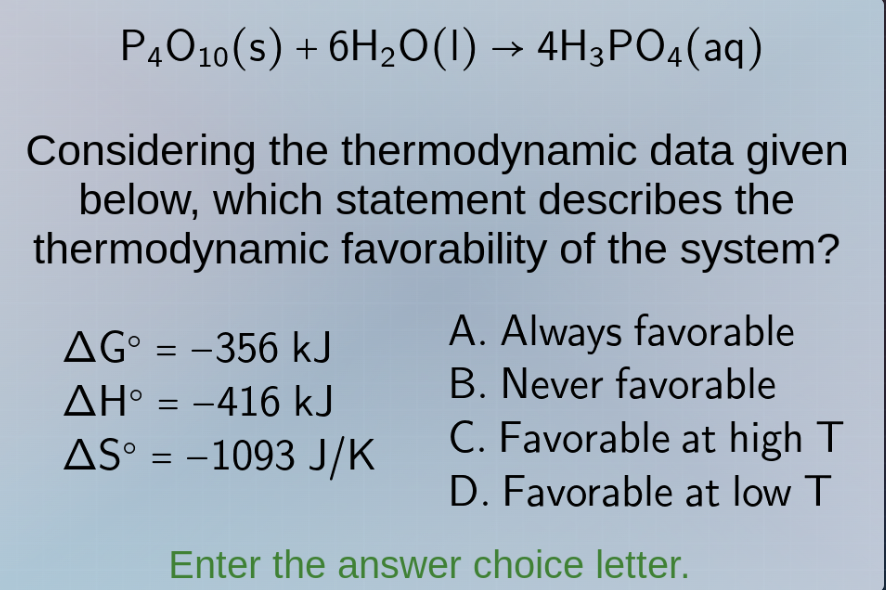
p₄o₁₀(s) + 6h₂o(l) → 4h₃po₄(aq) considering the thermodynamic data given below, which statement describes the thermodynamic favorability of the system? δg° = −356 kj δh° = −416 kj δs° = −1093 j/k a. always favorable b. never favorable c. favorable at high t d. favorable at low t enter the answer choice letter.
To determine thermodynamic favorability, we use the Gibbs free energy equation $\Delta G = \Delta H - T\Delta S$. Here, $\Delta H^\circ = -416\ \text{kJ}$ (exothermic, favorable) and $\Delta S^\circ = -1093\ \text{J/K} = -1.093\ \text{kJ/K}$ (decrease in entropy, unfavorable). The sign of $\Delta G$ depends on temperature. The term $-T\Delta S$: since $\Delta S$ is negative, $-T\Delta S$ becomes positive (as $T$ is in Kelvin, positive). So $\Delta G = \Delta H + |T\Delta S|$ (since $\Delta H$ is negative, $-T\Delta S$ is positive). For $\Delta G$ to be negative (favorable), the magnitude of $\Delta H$ (negative, large) must outweigh $T\Delta S$ (positive). At low $T$, $T\Delta S$ is small, so $\Delta H$ dominates, making $\Delta G$ negative. At high $T$, $T\Delta S$ becomes large, potentially making $\Delta G$ positive. But the given $\Delta G^\circ$ is already negative, and the analysis of the equation shows that with $\Delta H < 0$ and $\Delta S < 0$, the reaction is favorable when $T$ is low (because the positive contribution from $-T\Delta S$ is small enough that $\Delta H$ still makes $\Delta G$ negative). Wait, but the initial $\Delta G^\circ$ is given as -356 kJ, which is negative. Wait, maybe I confused. Wait, the formula is $\Delta G = \Delta H - T\Delta S$. So if $\Delta H$ is negative, $\Delta S$ is negative, then $\Delta G = \text{negative} - T(\text{negative}) = \text{negative} + T|\Delta S|$. So to have $\Delta G < 0$, we need $\text{negative} + T|\Delta S| < 0$ → $T|\Delta S| < |\Delta H|$ → $T < \frac{|\Delta H|}{|\Delta S|}$. Calculating $\frac{416000\ \text{J}}{1093\ \text{J/K}} \approx 379\ \text{K}$ (about 106°C). So below this temperature, $\Delta G$ is negative (favorable); above, positive (unfavorable). But the question is about the thermodynamic favorability of the system (the reaction). The options: A is always favorable (but at high T, it might not be). B is never (but at low T, it is). C is favorable at high T (no, because $\Delta S$ is negative, high T makes $-T\Delta S$ positive, so $\Delta G$ could be positive). D is favorable at low T. But wait, the given $\Delta G^\circ$ is -356 kJ, which is at standard temperature (298 K). 298 K is less than 379 K, so at standard T, it's favorable. The analysis of the equation shows that with $\Delta H < 0$ and $\Delta S < 0$, the reaction is spontaneous (favorable) at low temperatures (because the entropy term's positive contribution is small enough that the enthalpy term still makes $\Delta G$ negative). Wait, but the initial $\Delta G^\circ$ is negative, which is at 298 K. So the correct option is D? Wait, no, wait. Wait, maybe I made a mistake. Wait, let's re-express:
$\Delta G = \Delta H - T\Delta S$
Given $\Delta H = -416\ \text{kJ}$, $\Delta S = -1093\ \text{J/K} = -1.093\ \text{kJ/K}$
So $\Delta G = -416 - T(-1.093) = -416 + 1.093T$
We want $\Delta G < 0$:
$-416 + 1.093T < 0$ → $1.093T < 416$ → $T < 416 / 1.093 ≈ 379\ \text{K}$
So below ~379 K, $\Delta G < 0$ (favorable); above, $\Delta G > 0$ (unfavorable). So the reaction is favorable at low temperatures (below ~379 K) and unfavorable at high temperatures. So the correct option is D: Favorable at low T. Wait, but the given $\Delta G^\circ$ is -356 kJ, which is at 298 K (standard T), which is below 379 K, so at standard T, it's favorable. So the answer is D. Wait, but let's check the options again. Wait, maybe I messed up. Wait, the initial $\Delta G^\circ$ is given as -356 kJ, which is negative, meaning at standard conditions (298 K), it's favorable. The question is about the thermodynamic favorability…

Snap & solve any problem in the app
Get step-by-step solutions on Sovi AI
Photo-based solutions with guided steps
Explore more problems and detailed explanations
D. Favorable at low T