QUESTION IMAGE
Question
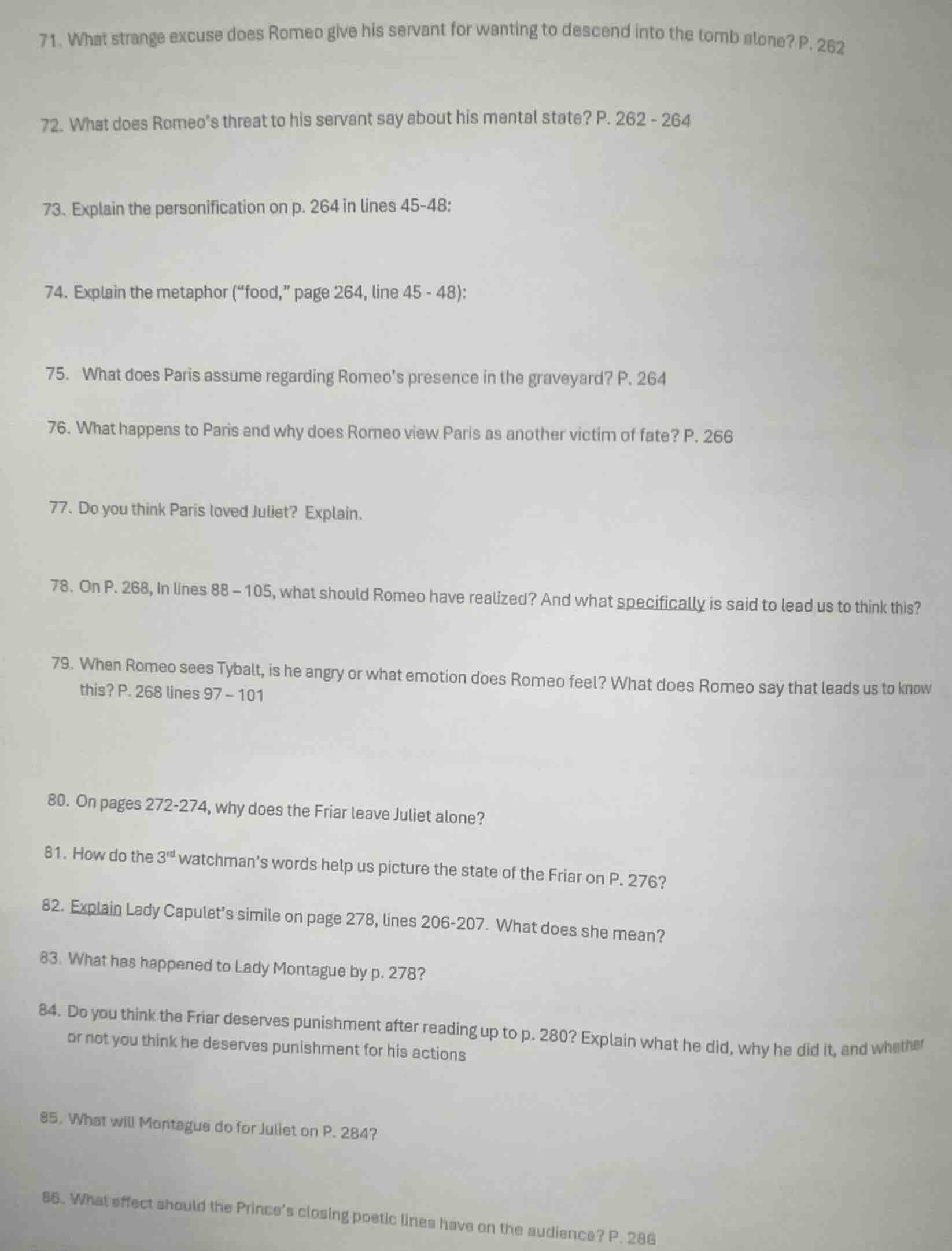
- what strange excuse does romeo give his servant for wanting to descend into the tomb alone? p. 262
- what does romeo’s threat to his servant say about his mental state? p. 262 - 264
- explain the personification on p. 264 in lines 45 - 48:
- explain the metaphor (\food,\ page 264, line 45 - 48):
- what does paris assume regarding romeo’s presence in the graveyard? p. 264
- what happens to paris and why does romeo view paris as another victim of fate? p. 266
- do you think paris loved juliet? explain.
- on p. 268, in lines 88 – 105, what should romeo have realized? and what specifically is said to lead us to think this?
- when romeo sees tybalt, is he angry or what emotion does romeo feel? what does romeo say that leads us to know this? p. 268 lines 97 – 101
- on pages 272 - 274, why does the friar leave juliet alone?
- how do the 3rd watchman’s words help us picture the state of the friar on p. 276?
- explain lady capulet’s simile on page 278, lines 206 - 207. what does she mean?
- what has happened to lady montague by p. 278?
- do you think the friar deserves punishment after reading up to p. 280? explain what he did, why he did it, and whether or not you think he deserves punishment for his actions
- what will montague do for juliet on p. 284?
- what effect should the prince’s closing poetic lines have on the audience? p. 286
71.
Romeo tells his servant he wants to retrieve a valuable ring he had given to Juliet, claiming it would be dishonorable to leave it buried with her.
72.
Romeo threatens to kill his servant if he does not leave, which shows he is in an unstable, desperate, and irrational mental state, consumed by grief and impulsivity.
73.
(Assuming the lines reference the tomb) Romeo personifies the tomb as a "womb" and a "hungry monster" that has "swallowed" Juliet, giving the inanimate tomb human/animal-like traits of consuming and holding Juliet.
74.
Romeo uses "food" as a metaphor for Juliet's beauty; he refers to the tomb as a creature that is keeping Juliet's beauty (the "food") for itself, framing her allure as something to be "eaten" or hoarded by the tomb.
75.
Paris assumes Romeo has come to the graveyard to desecrate the Capulet tombs out of spite for the Montague-Capuulet feud, to vandalize the bodies or monuments.
76.
Romeo kills Paris in a fight. Romeo views Paris as a victim of fate because Paris, like Romeo, was caught up in the feud and the tragic circumstances surrounding Juliet; he loved Juliet and was doomed by the same family hatred that destroyed Romeo and Juliet.
77.
This is a subjective question, but a common analysis: Paris likely did not love Juliet deeply. He saw her as a suitable, high-status match, focused on the social and familial benefits of the marriage rather than genuine affection, as he barely knew her and only interacted with her formally.
78.
Romeo should have realized Juliet was not actually dead—her cheeks were still pink, and her body showed no signs of decay. The text states "Thy drugs are quick. Thus with a kiss I die" but before that, Romeo notes "Beauty's ensign yet is crimson in thy lips and in thy cheeks, and death's pale flag is not advanced there."
79.
Romeo feels guilt and compassion, not anger. He says "Tybalt, liest thou there in thy bloody sheet? O, what more favor can I do to thee than with that hand that cut thy youth in twain to sunder his that was thine enemy? Forgive me, cousin." This shows he mourns Tybalt and feels responsible for his death.
80.
The Friar leaves Juliet alone because he hears the watchmen approaching, and he panics, fearing he will be caught and punished for his role in the secret marriage and fake death plan.
81.
The 3rd watchman says the Friar was "trembling, sighing, sobbing, and looking wildly," which paints the Friar as distraught, anxious, and clearly guilty or overwhelmed by the tragic events unfolding.
82.
Lady Capulet uses a simile comparing Juliet's death to a "frost upon the sweetest flower of all the field." She means Juliet was the most beautiful and beloved person in their lives, and her death is a sudden, cruel destruction of something precious.
83.
Lady Montague has died of grief over Romeo's exile from Verona; her sorrow over being separated from her son was too much to bear.
84.
This is subjective: The Friar married Romeo and Juliet in secret to end the feud, created the fake death plan to reunite them, but abandoned Juliet in the tomb. Some argue he deserves punishment for acting recklessly and abandoning Juliet at the end, while others argue his motives were noble, but his poor judgment led to tragedy.
85.
Montague says he will erect a golden statue of Juliet in Verona, to stand alongside a statue of Romeo, as a permanent tribute to their love and to end the feud between the families.
86.
The Prince's closing lines ("A glooming peace this morning with it brings; The sun, for sorrow, will not…

Snap & solve any problem in the app
Get step-by-step solutions on Sovi AI
Photo-based solutions with guided steps
Explore more problems and detailed explanations
- He claims he needs to retrieve a ring from Juliet's body.
- It shows he is unstable, desperate, and irrational.
- He personifies the tomb as a hungry monster that swallowed Juliet.
- "Food" is Juliet's beauty, hoarded by the tomb.
- He thinks Romeo came to desecrate Capulet tombs out of spite.
- Romeo kills Paris; Paris is a victim of the feud/fate like Romeo and Juliet.
- Likely not—he saw her as a formal, high-status match, not a loved one.
- He should have realized Juliet was alive; her cheeks were still pink (no decay signs).
- He feels guilt/compassion; he apologizes to Tybalt and mourns him.
- He panics when he hears the watchmen approaching.
- They show the Friar is distraught, anxious, and overwhelmed.
- She compares Juliet's death to frost killing a sweet flower, meaning Juliet was a precious, destroyed treasure.
- She died of grief over Romeo's exile.
- Subjective: He may deserve punishment for reckless planning and abandoning Juliet, or be pardoned for noble motives (ending the feud).
- He will build a golden statue of Juliet next to Romeo's.
- It leaves the audience somber, reflective of the feud's tragic cost.