QUESTION IMAGE
Question
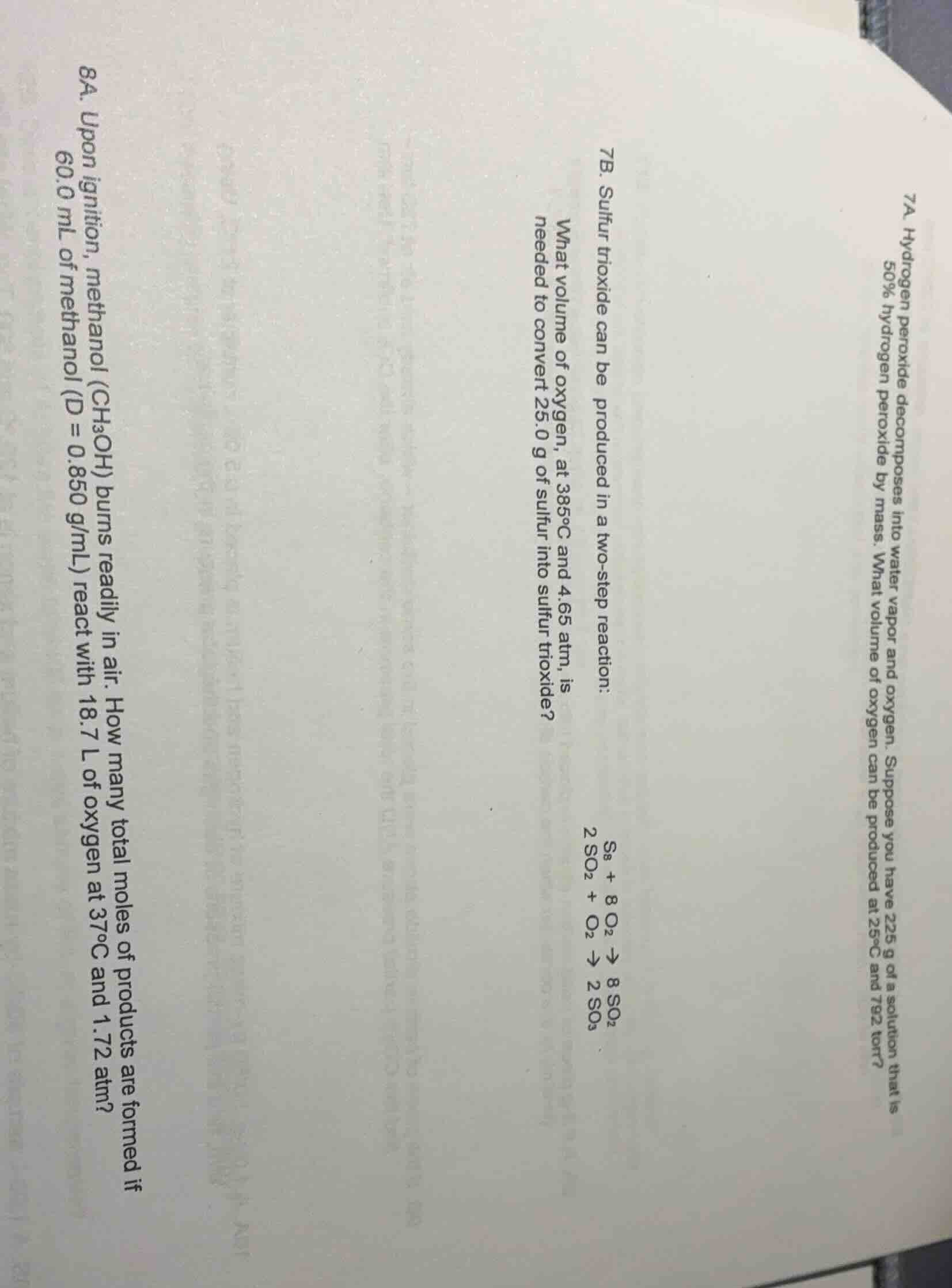
7a. hydrogen peroxide decomposes into water vapor and oxygen. suppose you have 225 g of a solution that is 50% hydrogen peroxide by mass. what volume of oxygen can be produced at 25°c and 792 torr?
7b. sulfur trioxide can be produced in a two - step reaction:
\ce{s8 + 8o2 -> 8so2}
\ce{2so2 + o2 -> 2so3}
what volume of oxygen, at 385°c and 4.65 atm, is needed to convert 25.0 g of sulfur into sulfur trioxide?
8a. upon ignition, methanol (\ce{ch3oh}) burns readily in air. how many total moles of products are formed if 60.0 ml of methanol (d = 0.850 g/ml) react with 18.7 l of oxygen at 37°c and 1.72 atm?
7B Solution:
Step 1: Find moles of \( S_8 \)
Molar mass of \( S_8 \) is \( 8\times32.07 = 256.56 \, \text{g/mol} \). Moles of \( S_8 \): \( n_{S_8}=\frac{25.0 \, \text{g}}{256.56 \, \text{g/mol}} \approx 0.0974 \, \text{mol} \).
Step 2: Moles of \( O_2 \) from first reaction
From \( S_8 + 8O_2
ightarrow 8SO_2 \), \( n_{O_2(1)} = 8\times n_{S_8} = 8\times0.0974 \approx 0.779 \, \text{mol} \). Moles of \( SO_2 = 8\times0.0974 \approx 0.779 \, \text{mol} \).
Step 3: Moles of \( O_2 \) from second reaction
From \( 2SO_2 + O_2
ightarrow 2SO_3 \), \( n_{O_2(2)}=\frac{1}{2}\times n_{SO_2}=\frac{1}{2}\times0.779 \approx 0.3895 \, \text{mol} \).
Step 4: Total moles of \( O_2 \)
\( n_{O_2(\text{total})}=n_{O_2(1)} + n_{O_2(2)} = 0.779 + 0.3895 \approx 1.1685 \, \text{mol} \).
Step 5: Use ideal gas law (\( PV = nRT \))
\( T = 385 + 273.15 = 658.15 \, \text{K} \), \( P = 4.65 \, \text{atm} \), \( R = 0.0821 \, \text{L·atm/(mol·K)} \).
\( V=\frac{nRT}{P}=\frac{1.1685 \, \text{mol} \times 0.0821 \, \text{L·atm/(mol·K)} \times 658.15 \, \text{K}}{4.65 \, \text{atm}} \approx \frac{1.1685\times0.0821\times658.15}{4.65} \approx 13.2 \, \text{L} \).
Step 1: Moles of \( CH_3OH \)
Mass of \( CH_3OH \): \( m = 60.0 \, \text{mL} \times 0.850 \, \text{g/mL} = 51.0 \, \text{g} \). Molar mass of \( CH_3OH = 32.04 \, \text{g/mol} \). \( n_{CH_3OH}=\frac{51.0 \, \text{g}}{32.04 \, \text{g/mol}} \approx 1.592 \, \text{mol} \).
Step 2: Moles of \( O_2 \) (gas)
\( T = 37 + 273.15 = 310.15 \, \text{K} \), \( P = 1.72 \, \text{atm} \), \( V = 18.7 \, \text{L} \). Using \( PV = nRT \), \( n_{O_2}=\frac{PV}{RT}=\frac{1.72 \times 18.7}{0.0821 \times 310.15} \approx \frac{32.164}{25.46} \approx 1.263 \, \text{mol} \).
Step 3: Balanced reaction of \( CH_3OH \) combustion
\( 2CH_3OH + 3O_2
ightarrow 2CO_2 + 4H_2O \). Moles of \( O_2 \) required for \( CH_3OH \): \( n_{O_2(\text{req})}=\frac{3}{2}\times n_{CH_3OH}=\frac{3}{2}\times1.592 \approx 2.388 \, \text{mol} \). But available \( O_2 = 1.263 \, \text{mol} \) (limiting reactant is \( O_2 \)).
Step 4: Moles of products from \( O_2 \)
From reaction, \( n_{CO_2}=\frac{2}{3}\times n_{O_2}=\frac{2}{3}\times1.263 \approx 0.842 \, \text{mol} \), \( n_{H_2O}=\frac{4}{3}\times n_{O_2}=\frac{4}{3}\times1.263 \approx 1.684 \, \text{mol} \).
Step 5: Total moles of products
\( n_{\text{products}} = n_{CO_2} + n_{H_2O} = 0.842 + 1.684 \approx 2.526 \, \text{mol} \).

Snap & solve any problem in the app
Get step-by-step solutions on Sovi AI
Photo-based solutions with guided steps
Explore more problems and detailed explanations
\(\approx 13.2 \, \text{L}\)