QUESTION IMAGE
Question
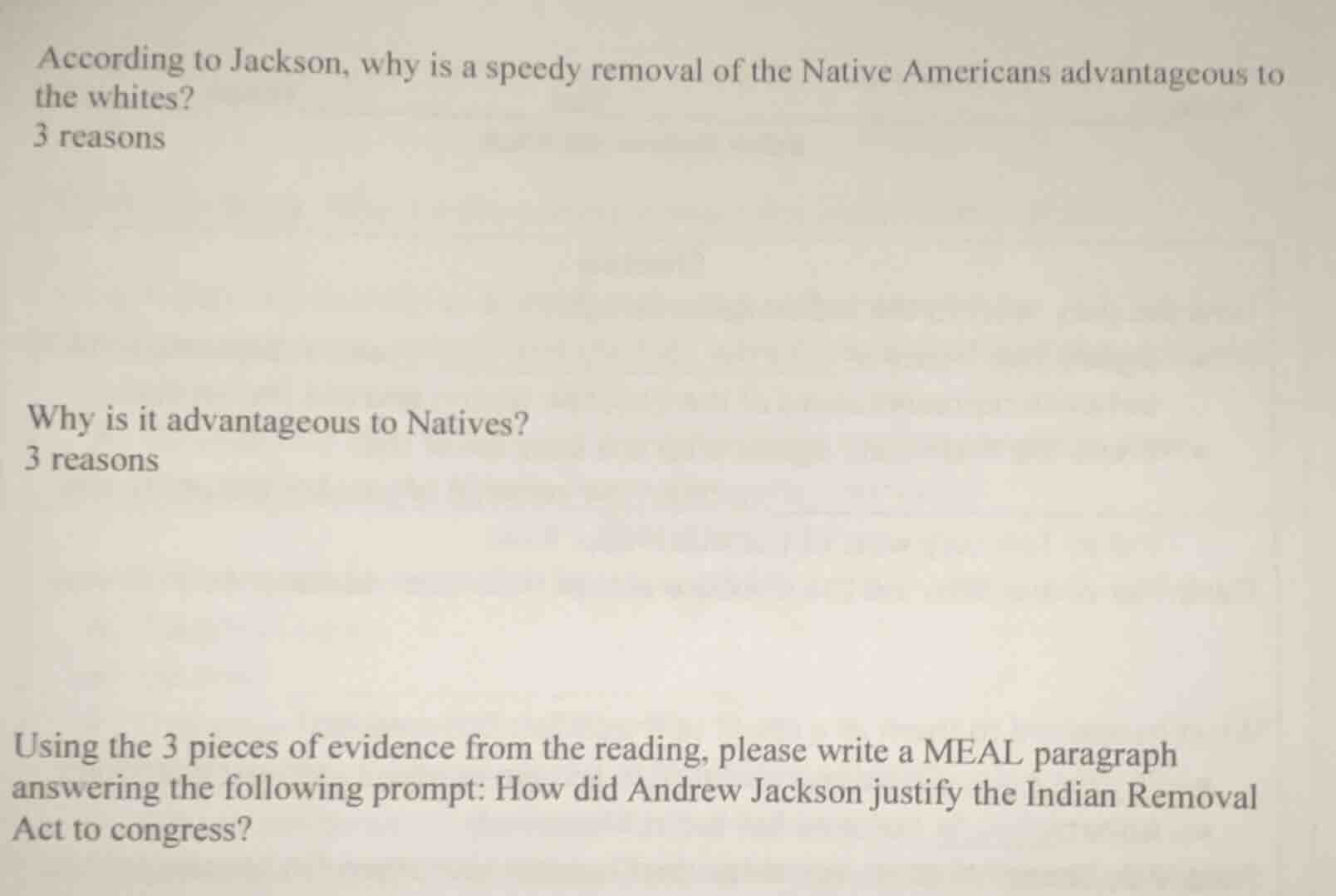
according to jackson, why is a speedy removal of the native americans advantageous to the whites?
3 reasons
why is it advantageous to natives?
3 reasons
using the 3 pieces of evidence from the reading, please write a meal paragraph answering the following prompt: how did andrew jackson justify the indian removal act to congress?
Part 1: Why speedy removal is advantageous to whites (3 reasons)
- Land Access: Jackson argued that removing Native Americans would open up their lands (often fertile or resource - rich) for white settlers to farm, build, and develop, which would boost white economic opportunities and territorial expansion.
- Safety and Conflict Reduction: He claimed that removing Natives would reduce conflicts between white settlers and Native Americans. As white settlement expanded, clashes over land and resources were common, and removal was seen as a way to ensure the safety of white communities.
- Economic Development (Broader): The lands acquired from Native Americans could be used for various economic activities like mining, logging, and agriculture on a larger scale, which would contribute to the overall economic growth of the white - dominated society.
- Avoiding Assimilation/Protecting Culture: Jackson suggested that removal would allow Native Americans to preserve their own cultures, traditions, and ways of life away from the influence of white settlers who were trying to assimilate them.
- Avoiding Violence/Conflict: By relocating, Native Americans could avoid the violent conflicts that were occurring with white settlers on their original lands, thus protecting their lives and communities.
- New Start/Autonomy: He argued that in their new territories (like the Indian Territory), Native Americans could have more autonomy to govern themselves and develop their societies without the interference of white settlers.
- Main Idea (M): Andrew Jackson justified the Indian Removal Act to Congress by framing it as beneficial for both white Americans and Native Americans, using claims about land, safety, and cultural preservation.
- Evidence (E) 1: For whites, Jackson argued that removal would provide access to Native American lands, which could be used for farming, resource extraction, and economic growth, stating that “the vacant lands … will afford ample space for the settlement of our citizens.” This land access was presented as a way to expand white economic opportunities and territorial control.
- Evidence (E) 2: He also claimed that removal would reduce conflicts between whites and Natives, asserting that “collisions between the races would be avoided” as white settlement expanded. This was meant to assure Congress of the safety of white communities.
- Evidence (E) 3: For Native Americans, Jackson posited that removal would allow them to “preserve [their] own institutions” and avoid assimilation, as they could govern themselves in a new territory, free from white interference.
- Analysis (A): Jackson’s justifications relied on a paternalistic and self - serving view, prioritizing white economic and territorial goals while framing Native American removal as a “benevolent” act for their cultural preservation and safety, ignoring the forced displacement and harm it caused.
- Link (L): By presenting removal as mutually beneficial, Jackson aimed to gain congressional support for the Indian Removal Act, leveraging concerns about economic growth, safety, and (a flawed view of) Native American well - being.
MEAL Paragraph:
Andrew Jackson justified the Indian Removal Act to Congress by framing it as a measure beneficial to both white Americans and Native Americans. Jackson argued that for white Americans, the removal of Native Americans would provide access to “vacant lands … [that] will afford ample space for the settlement of our citizens,” enabling economic growth through farming, resource extraction, and territorial expansion. Additionally, he claimed that removal would reduce “collisions between the races,” ensuring the safety of white communities as they expanded into new areas. For Native Americans, Jackson posited that removal would allow them to “preserve [their] own institutions” and avoid assimilation, as they could govern themselves in a new territory free from white interference. Jackson’s justifications, however, were rooted in a paternalistic and self - serving perspective: while prioritizing white economic and territorial goals, he framed Native American removal as a “benevolent” act, ignoring the forced displacement and harm it caused. By presenting removal as mutually beneficial, Jackson aimed to gain congressional support for the act, leveraging concerns about economic growth, safety, and a flawed view of Native American well - being.

Snap & solve any problem in the app
Get step-by-step solutions on Sovi AI
Photo-based solutions with guided steps
Explore more problems and detailed explanations
- Land access for white settlement and economic development (farming, resource extraction).
- Reduction of conflicts between white settlers and Native Americans.
- Promotion of overall white - dominated economic growth through utilization of acquired lands.