QUESTION IMAGE
Question
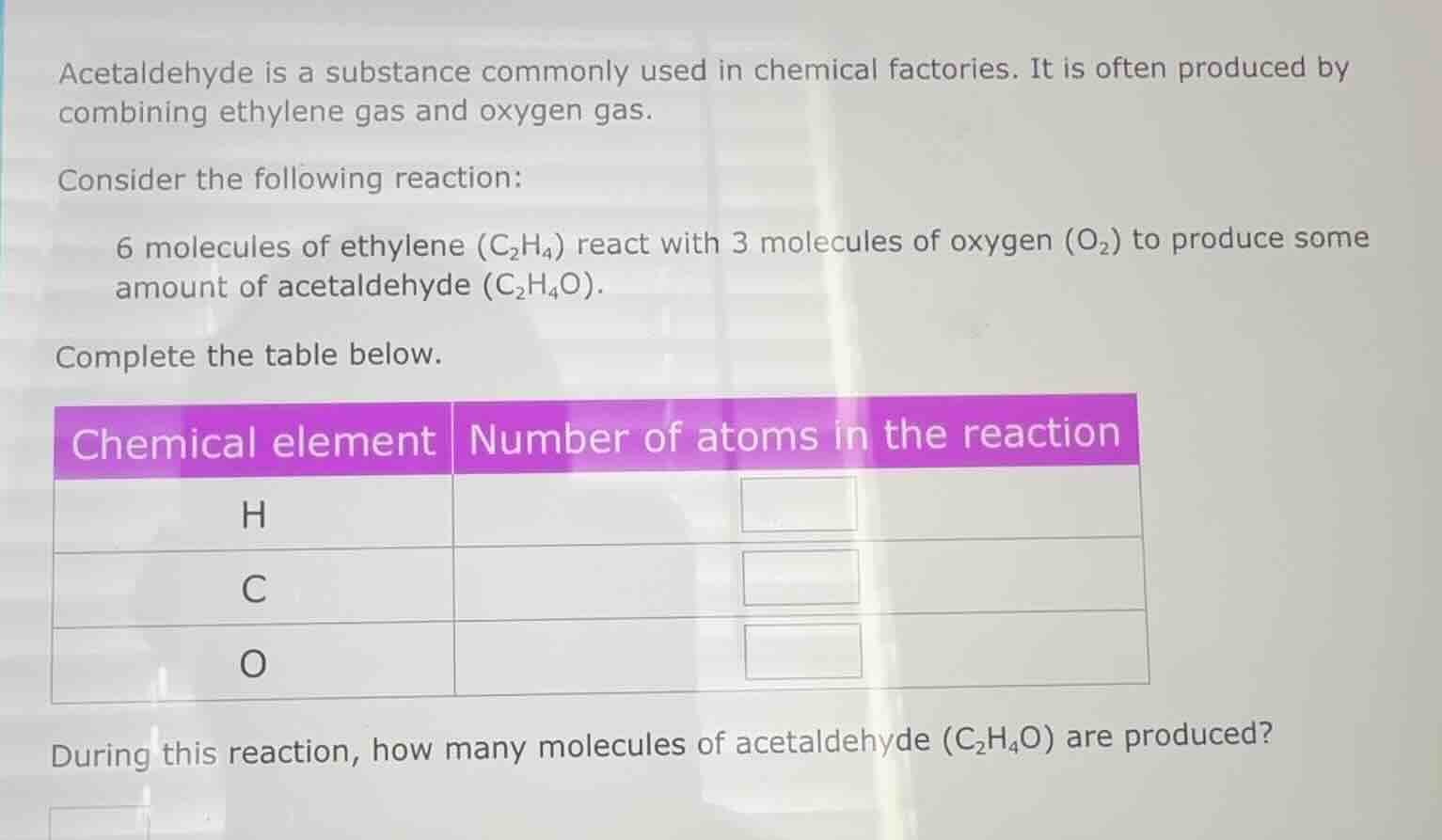
acetaldehyde is a substance commonly used in chemical factories. it is often produced by combining ethylene gas and oxygen gas. consider the following reaction: 6 molecules of ethylene (c₂h₄) react with 3 molecules of oxygen (o₂) to produce some amount of acetaldehyde (c₂h₄o). complete the table below. chemical element | number of atoms in the reaction h | c | o | during this reaction, how many molecules of acetaldehyde (c₂h₄o) are produced?
Part 1: Completing the table (number of atoms)
For Hydrogen (H):
Step1: Calculate H from $C_2H_4$
Each $C_2H_4$ has 4 H atoms. 6 molecules of $C_2H_4$: $6\times4 = 24$ H atoms.
Step2: No H from $O_2$ or $C_2H_4O$ (since we count reactants, but conservation: same as products, but here reactants: $C_2H_4$ has H, $O_2$ has none. So total H atoms: 24.
For Carbon (C):
Step1: Calculate C from $C_2H_4$
Each $C_2H_4$ has 2 C atoms. 6 molecules: $6\times2 = 12$ C atoms.
Step2: No C from $O_2$, so total C atoms: 12.
For Oxygen (O):
Step1: Calculate O from $O_2$
Each $O_2$ has 2 O atoms. 3 molecules: $3\times2 = 6$ O atoms.
Step2: No O from $C_2H_4$, so total O atoms: 6.
Part 2: Molecules of acetaldehyde ($C_2H_4O$)
Step1: Use conservation of atoms. Let $x$ be molecules of $C_2H_4O$.
- For C: Each $C_2H_4O$ has 2 C. So $2x = 12$ (from C atoms in reactants).
Step2: Solve for $x$
$x=\frac{12}{2}=6$.
- Check O: Each $C_2H_4O$ has 1 O. $6\times1 = 6$, which matches O atoms from reactants (3 $O_2$: 6 O).
- Check H: Each $C_2H_4O$ has 4 H. $6\times4 = 24$, which matches H atoms from reactants (6 $C_2H_4$: 24 H).
Table Completion:
| Chemical element | Number of atoms in the reaction |
|---|---|
| C | 12 |
| O | 6 |
Molecules of acetaldehyde: 6
Final Answers:
Table: H: 24, C: 12, O: 6; Acetaldehyde molecules: 6

Snap & solve any problem in the app
Get step-by-step solutions on Sovi AI
Photo-based solutions with guided steps
Explore more problems and detailed explanations
Part 1: Completing the table (number of atoms)
For Hydrogen (H):
Step1: Calculate H from $C_2H_4$
Each $C_2H_4$ has 4 H atoms. 6 molecules of $C_2H_4$: $6\times4 = 24$ H atoms.
Step2: No H from $O_2$ or $C_2H_4O$ (since we count reactants, but conservation: same as products, but here reactants: $C_2H_4$ has H, $O_2$ has none. So total H atoms: 24.
For Carbon (C):
Step1: Calculate C from $C_2H_4$
Each $C_2H_4$ has 2 C atoms. 6 molecules: $6\times2 = 12$ C atoms.
Step2: No C from $O_2$, so total C atoms: 12.
For Oxygen (O):
Step1: Calculate O from $O_2$
Each $O_2$ has 2 O atoms. 3 molecules: $3\times2 = 6$ O atoms.
Step2: No O from $C_2H_4$, so total O atoms: 6.
Part 2: Molecules of acetaldehyde ($C_2H_4O$)
Step1: Use conservation of atoms. Let $x$ be molecules of $C_2H_4O$.
- For C: Each $C_2H_4O$ has 2 C. So $2x = 12$ (from C atoms in reactants).
Step2: Solve for $x$
$x=\frac{12}{2}=6$.
- Check O: Each $C_2H_4O$ has 1 O. $6\times1 = 6$, which matches O atoms from reactants (3 $O_2$: 6 O).
- Check H: Each $C_2H_4O$ has 4 H. $6\times4 = 24$, which matches H atoms from reactants (6 $C_2H_4$: 24 H).
Table Completion:
| Chemical element | Number of atoms in the reaction |
|---|---|
| C | 12 |
| O | 6 |
Molecules of acetaldehyde: 6
Final Answers:
Table: H: 24, C: 12, O: 6; Acetaldehyde molecules: 6