QUESTION IMAGE
Question
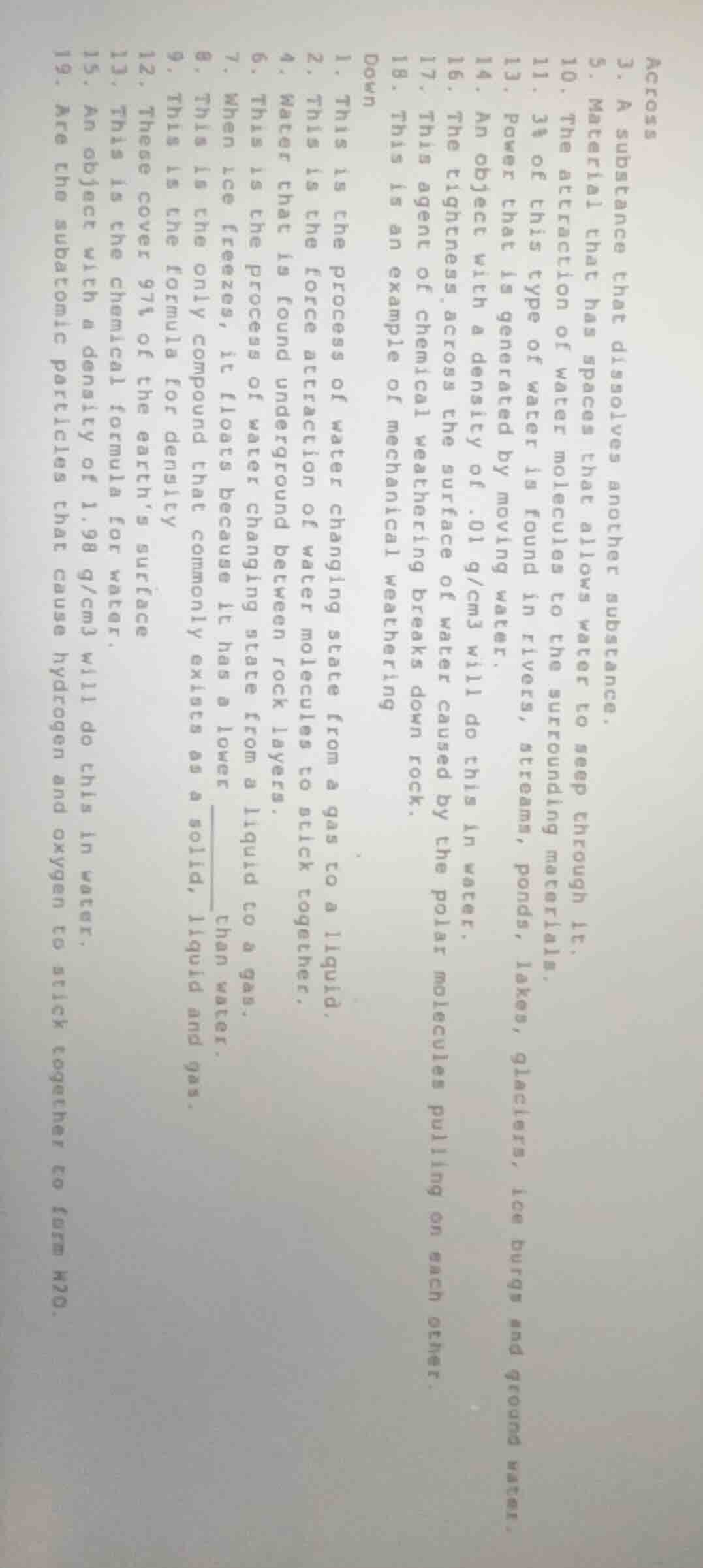
across
- a substance that dissolves another substance.
- material that has spaces that allows water to seep through it.
- the attraction of water molecules to the surrounding materials.
- 3% of this type of water is found in rivers, streams, ponds, lakes, glaciers, ice burgs and ground water.
- power that is generated by moving water.
- an object with a density of.01 g/cm3 will do this in water.
- the tightness across the surface of water caused by the polar molecules pulling on each other.
- this agent of chemical weathering breaks down rock.
- this is an example of mechanical weathering
down
- this is the process of water changing state from a gas to a liquid.
- this is the force attraction of water molecules to stick together.
- water that is found underground between rock layers.
- this is the process of water changing state from a liquid to a gas.
- when ice freezes, it floats because it has a lower ______ than water.
- this is the only compound that commonly exists as a solid, liquid and gas.
- this is the formula for density
- these cover 97% of the earth’s surface
- this is the chemical formula for water.
- an object with a density of 1.98 g/cm3 will do this in water.
- are the subatomic particles that cause hydrogen and oxygen to stick together to form h2o.
Response
This appears to be a crossword puzzle related to properties of water in the context of Natural Science (specifically Chemistry or Earth Science). Here are some answers for the clues:
Across
- Solute - A substance that dissolves another substance.
- Permeable - Material that has spaces allowing water to seep through.
- Cohesion - Attraction of water molecules to surrounding materials (Wait, actually, cohesion is water to water, adhesion is water to other. Maybe "Adhesion"? Wait, the clue says "attraction of water molecules to the surrounding materials" – that's adhesion.
- 3% – Wait, the clue is "3% of this type of water is found in rivers...", that's "Freshwater" (but length? Maybe "Fresh" but no. Wait, maybe "Surface" no. Wait, the clue is "3% of this type of water is found in rivers, streams, ponds, lakes, glaciers, icebergs and ground water" – that's "Fresh" (but 3% of freshwater? No, 3% of total water is freshwater. So maybe "Fresh".
- Energy – Power generated by moving water (hydroelectric power, so energy).
- Float – An object with density 0.01 g/cm³ (wait, no, water density is 1 g/cm³. An object less dense than water (like density <1) will float. So "Float".
- Surface Tension – Tightness across water surface from polar molecules pulling.
- Acid – Agent of chemical weathering breaking rock (acids in chemical weathering).
- Abrasion – Example of mechanical weathering (like rocks rubbing, abrasion).
Down
- Condensation – Process of water changing from gas to liquid.
- Cohesion – Force of water molecules sticking together.
- Groundwater – Water found underground between rock layers.
- Evaporation – Process of water changing from liquid to gas.
- Density – When ice freezes, it floats because lower density than water.
- Water – Only compound existing as solid, liquid, gas (commonly).
- Density Formula – Formula for density is mass/volume, but the clue is "formula for density" – maybe "ρ = m/V" but as a word? No, maybe "Density" (the formula is density = mass/volume, so the term is density. Wait, the clue is "This is the formula for density" – the formula is ρ = m/V, but as a word, maybe "Density" (the concept).
- Water – Covers 71% of Earth’s surface (wait, 71% water, 29% land. So "Water".
- H₂O – Chemical formula for water.
- Atoms – Subatomic particles (hydrogen and oxygen atoms) that form H₂O.
But since the user didn't specify a particular clue, maybe they want help with a specific one. Let's pick a clue, say Down 1: "This is the process of water changing state from a gas to a liquid." The answer is Condensation.
Brief Explanations
The process of water changing from gas (water vapor) to liquid (like forming dew or clouds) is called condensation.

Snap & solve any problem in the app
Get step-by-step solutions on Sovi AI
Photo-based solutions with guided steps
Explore more problems and detailed explanations
Down 1: Condensation