QUESTION IMAGE
Question
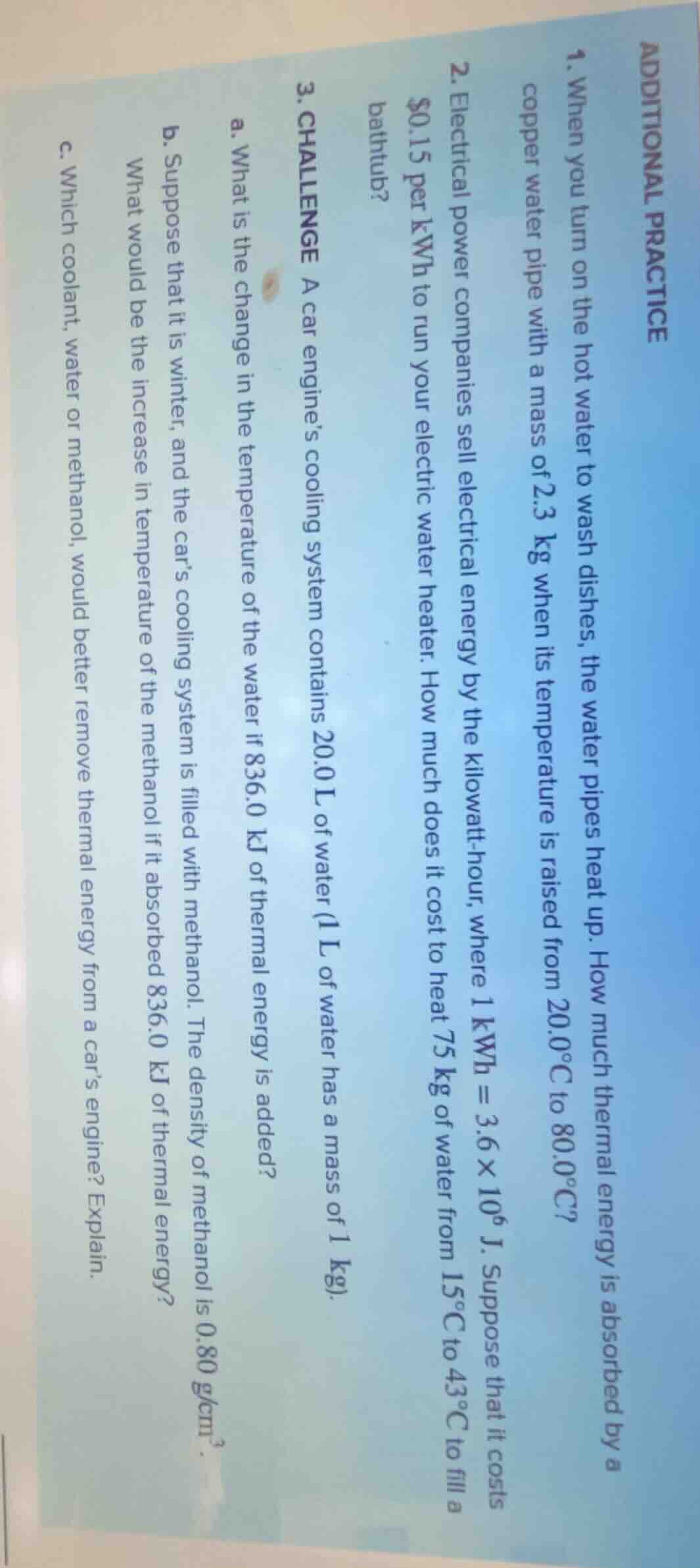
additional practice 1. when you turn on the hot water to wash dishes, the water pipes heat up. how much thermal energy is absorbed by a copper water pipe with a mass of 2.3 kg when its temperature is raised from 20.0°c to 80.0°c? 2. electrical power companies sell electrical energy by the kilowatt - hour, where 1 kwh = 3.6×10^6 j. suppose that it costs $0.15 per kwh to run your electric water heater. how much does it cost to heat 75 kg of water from 15°c to 43°c to fill a bathtub? 3. challenge a car engine’s cooling system contains 20.0 l of water (1 l of water has a mass of 1 kg). a. what is the change in the temperature of the water if 836.0 kj of thermal energy is added? b. suppose that it is winter, and the car’s cooling system is filled with methanol. the density of methanol is 0.80 g/cm³. what would be the increase in temperature of the methanol if it absorbed 836.0 kj of thermal energy? c. which coolant, water or methanol, would better remove thermal energy from a car’s engine? explain.
Problem 1
Step1: Recall the specific heat formula
The formula for thermal energy absorbed \( Q \) is \( Q = mc\Delta T \), where \( m \) is mass, \( c \) is specific heat capacity, and \( \Delta T \) is temperature change. For copper, \( c_{copper}=387\ J/(kg\cdot^\circ C) \), \( m = 2.3\ kg \), \( \Delta T=80.0^\circ C - 20.0^\circ C = 60.0^\circ C \).
Step2: Substitute values into the formula
\( Q = 2.3\ kg\times387\ J/(kg\cdot^\circ C)\times60.0^\circ C \)
\( Q = 2.3\times387\times60\ J \)
\( Q = 2.3\times23220\ J \)
\( Q = 53406\ J = 53.4\ kJ \) (approx)
Step1: Calculate thermal energy needed
First, find \( Q \) for water: \( c_{water}=4186\ J/(kg\cdot^\circ C) \), \( m = 75\ kg \), \( \Delta T = 43^\circ C - 15^\circ C = 28^\circ C \).
\( Q = mc\Delta T = 75\ kg\times4186\ J/(kg\cdot^\circ C)\times28^\circ C \)
\( Q = 75\times4186\times28\ J \)
\( Q = 75\times117208\ J = 8790600\ J \)
Step2: Convert energy to kWh
Since \( 1\ kWh = 3.6\times10^{6}\ J \), number of kWh \( n=\frac{8790600\ J}{3.6\times10^{6}\ J/kWh}\approx2.4418\ kWh \)
Step3: Calculate cost
Cost = \( n\times0.15\ \$/\text{kWh} = 2.4418\times0.15\ \$ \approx 0.366\ \$ \) (approx \( \$0.37 \))
Step1: Find mass of water
Volume \( V = 20.0\ L = 20.0\ dm^{3}=0.02\ m^{3} \), density of water \(
ho = 1000\ kg/m^{3} \), so \( m=
ho V = 1000\ kg/m^{3}\times0.02\ m^{3}=20\ kg \).
Step2: Use \( Q = mc\Delta T \) to find \( \Delta T \)
\( c_{water}=4186\ J/(kg\cdot^\circ C) \), \( Q = 836000\ J \) (since \( 836.0\ kJ = 836000\ J \))
\( \Delta T=\frac{Q}{mc}=\frac{836000\ J}{20\ kg\times4186\ J/(kg\cdot^\circ C)} \)
\( \Delta T=\frac{836000}{83720}\approx10.0^\circ C \)

Snap & solve any problem in the app
Get step-by-step solutions on Sovi AI
Photo-based solutions with guided steps
Explore more problems and detailed explanations
The thermal energy absorbed is \( \boldsymbol{5.34\times10^{4}\ J} \) (or \( 53.4\ kJ \))