QUESTION IMAGE
Question
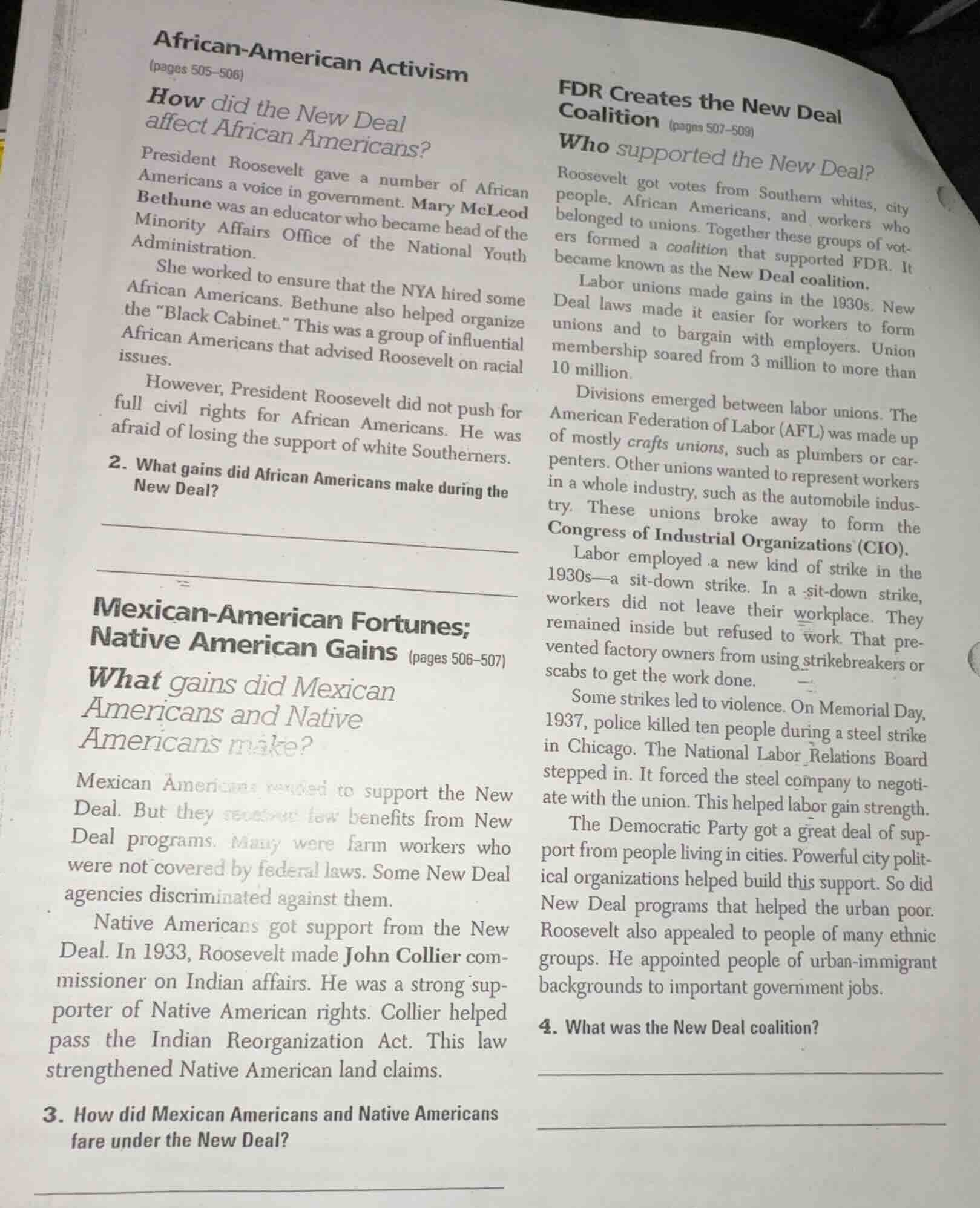
african - american activism (pages 505 - 506)
how did the new deal affect african americans?
president roosevelt gave a number of african americans a voice in government. mary mcleod bethune was an educator who became head of the minority affairs office of the national youth administration.
she worked to ensure that the nya hired some african americans. bethune also helped organize the \black cabinet.\ this was a group of influential african americans that advised roosevelt on racial issues.
however, president roosevelt did not push for full civil rights for african americans. he was afraid of losing the support of white southerners.
- what gains did african americans make during the new deal?
mexican - american fortunes; native american gains (pages 506 - 507)
what gains did mexican americans and native americans make?
mexican americans tended to support the new deal. but they received few benefits from new deal programs. many were farm workers who were not covered by federal laws. some new deal agencies discriminated against them.
native americans got support from the new deal. in 1933, roosevelt made john collier commissioner on indian affairs. he was a strong supporter of native american rights. collier helped pass the indian reorganization act. this law strengthened native american land claims.
- how did mexican americans and native americans fare under the new deal?
fdr creates the new deal coalition (pages 507 - 509)
who supported the new deal?
roosevelt got votes from southern whites, city people, african americans, and workers who belonged to unions. together these groups of voters formed a coalition that supported fdr. it became known as the new deal coalition.
labor unions made gains in the 1930s. new deal laws made it easier for workers to form unions and to bargain with employers. union membership soared from 3 million to more than 10 million.
divisions emerged between labor unions. the american federation of labor (afl) was made up of mostly crafts unions, such as plumbers or carpenters. other unions wanted to represent workers in a whole industry, such as the automobile industry. these unions broke away to form the congress of industrial organizations (cio).
labor employed a new kind of strike in the 1930s — a sit - down strike. in a sit - down strike, workers did not leave their workplace. they remained inside but refused to work. that prevented factory owners from using strikebreakers or scabs to get the work done.
some strikes led to violence. on memorial day, 1937, police killed ten people during a steel strike in chicago. the national labor relations board stepped in. it forced the steel company to negotiate with the union. this helped labor gain strength.
the democratic party got a great deal of support from people living in cities. powerful city political organizations helped build this support. so did new deal programs that helped the urban poor. roosevelt also appealed to people of many ethnic groups. he appointed people of urban - immigrant backgrounds to important government jobs.
- what was the new deal coalition?
Question 2: What gains did African Americans make during the New Deal?
- African Americans got a voice in government. For example, Mary McLeod Bethune became head of the Minority Affairs Office of the National Youth Administration.
- Mary McLeod Bethune helped organize the "Black Cabinet", a group of influential African Americans that advised Roosevelt on racial issues.
- The NYA (National Youth Administration) hired some African Americans due to Bethune's efforts.
- Mexican Americans: They tended to support the New Deal but received few benefits from its programs. Many were farm workers not covered by federal laws, and some New Deal agencies discriminated against them.
- Native Americans: They received support from the New Deal. In 1933, Roosevelt appointed John Collier as commissioner on Indian affairs (a strong supporter of Native American rights), and Collier helped pass the Indian Reorganization Act, which strengthened Native American land claims.
Roosevelt got votes from Southern whites, city people, African Americans, and workers who belonged to unions. These groups of voters together formed the New Deal coalition.

Snap & solve any problem in the app
Get step-by-step solutions on Sovi AI
Photo-based solutions with guided steps
Explore more problems and detailed explanations
- African Americans gained a voice in government (e.g., Mary McLeod Bethune became head of the Minority Affairs Office of the National Youth Administration).
- The "Black Cabinet" was organized to advise Roosevelt on racial issues.
- Some African Americans were hired by the NYA.