QUESTION IMAGE
Question
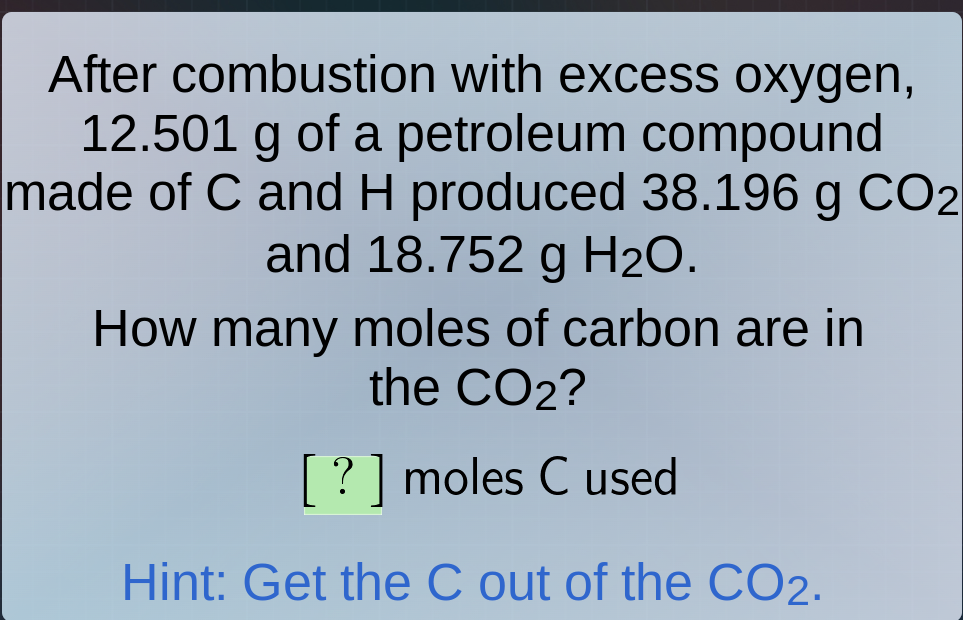
after combustion with excess oxygen, 12.501 g of a petroleum compound made of c and h produced 38.196 g co₂ and 18.752 g h₂o. how many moles of carbon are in the co₂? ? moles c used hint: get the c out of the co₂.
Step1: Find molar mass of \(CO_2\)
Molar mass of \(C\) is \(12.01\space g/mol\), molar mass of \(O\) is \(16.00\space g/mol\). So molar mass of \(CO_2\) is \(12.01 + 2\times16.00 = 44.01\space g/mol\).
Step2: Calculate moles of \(CO_2\)
Moles of \(CO_2=\frac{mass\ of\ CO_2}{molar\ mass\ of\ CO_2}=\frac{38.196\space g}{44.01\space g/mol}\).
Step3: Determine moles of \(C\)
In \(CO_2\), each mole of \(CO_2\) contains 1 mole of \(C\). So moles of \(C\) = moles of \(CO_2\).
Calculating moles of \(CO_2\): \(\frac{38.196}{44.01}= 0.868\space mol\) (approx). So moles of \(C\) is also \(0.868\space mol\) (more precisely, \(\frac{38.196}{44.01}=0.86789\approx0.868\)).

Snap & solve any problem in the app
Get step-by-step solutions on Sovi AI
Photo-based solutions with guided steps
Explore more problems and detailed explanations
\(0.868\) (or more precisely, the value from \(\frac{38.196}{44.01}\) which is approximately \(0.868\) moles)