QUESTION IMAGE
Question
the age of imperialism
across
- a people of modern south africa whom king shaka united in 1818.
- a dutch colonist in south africa.
- the indian term for the british rule)
- loyalty to a nation and promotion of its interests above all others
- the ___ war between great britain and china over restrictions to foreign trade
- a country whose affairs are partially controlled by a stronger power.
- ___ conference was where the major european powers negotiated and claimed territory in africa
- a soldier in south asia, especially in the service of the british
- the british _ _ company set up large, profitable trading posts in india.
down
- rudyard kipling wrote a poem, the white mans ___ which became a motto for imperialism.
- discriminatory behavior towards members of another ethnic group.
- unprocessed natural products used in production
- policy of extending a countrys power and influence through diplomacy or military force.
- group in china who rebelled against foreign influence in the country.
- a territory that is legally tied to a sovereign state rather than completely independent.
- a canal in egypt linking the red sea with the mediterranean sea
- a nickname for india under british control was the \___ in the crown\
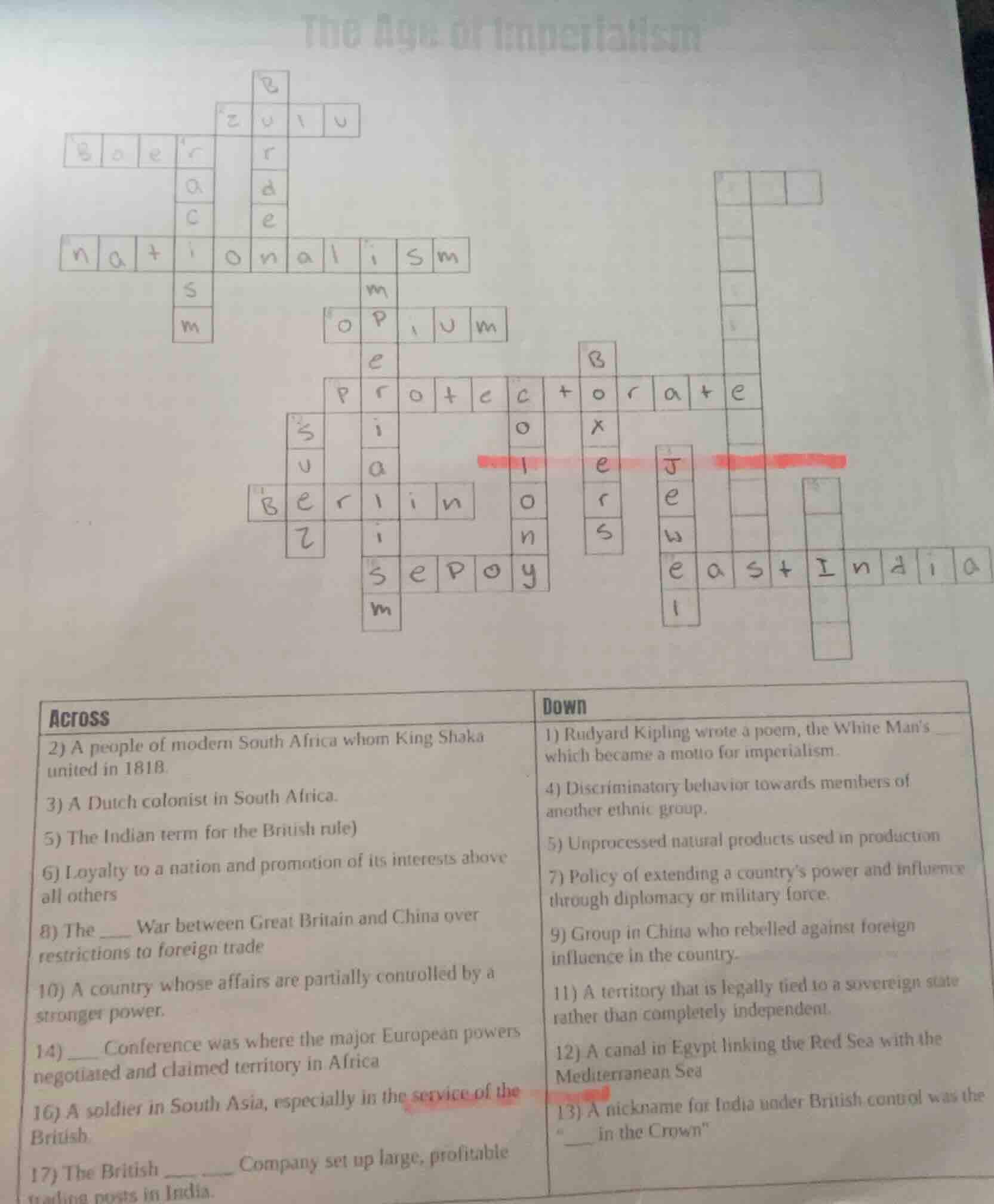
To solve the crossword, we analyze each clue:
Across Clues:
- Zulu: King Shaka united the Zulu people in 1818 (South Africa).
- Boer: Dutch colonists in South Africa.
- Raj: Indian term for British rule.
- Nationalism: Loyalty to a nation, prioritizing its interests.
- Opium: War between Britain and China over trade restrictions (Opium War).
- Protectorate: A country partially controlled by a stronger power.
- Berlin: Conference where European powers divided Africa.
- Sepoy: South Asian soldier (especially British - employed).
- East India: British East India Company had Indian trading posts.
Down Clues:
- Burden: Kipling’s “White Man’s Burden” (imperialism motto).
- Racism: Discrimination against other ethnic groups.
- Raw: Unprocessed natural production materials.
- Imperialism: Policy of extending power via diplomacy/military.
- Boxers: Chinese group (Boxer Rebellion) against foreign influence.
- Colony: Territory tied to a sovereign state (not fully independent).
- Suez: Canal linking Red and Mediterranean Seas.
- Jewel: India was the “Jewel in the Crown” under Britain.
Filled Answers (Key Entries):
- Across 2: Zulu
- Across 3: Boer
- Across 5: Raj
- Across 6: Nationalism
- Across 8: Opium
- Across 10: Protectorate
- Across 14: Berlin
- Across 16: Sepoy
- Across 17: East India
- Down 1: Burden
- Down 4: Racism
- Down 5: Raw
- Down 7: Imperialism
- Down 9: Boxers
- Down 11: Colony
- Down 12: Suez
- Down 13: Jewel
(Note: The grid’s pre - filled letters (e.g., “nationalism”, “opium”, “protectorate”, “berlin”, “sepoys”, “east india”) align with these answers, confirming accuracy.)
For example, the “nationalism” (Across 6) and “opium” (Across 8) match the grid’s visible letters. The “sepoy” (Across 16) and “east india” (Across 17) also fit the grid structure.

Snap & solve any problem in the app
Get step-by-step solutions on Sovi AI
Photo-based solutions with guided steps
Explore more problems and detailed explanations
To solve the crossword, we analyze each clue:
Across Clues:
- Zulu: King Shaka united the Zulu people in 1818 (South Africa).
- Boer: Dutch colonists in South Africa.
- Raj: Indian term for British rule.
- Nationalism: Loyalty to a nation, prioritizing its interests.
- Opium: War between Britain and China over trade restrictions (Opium War).
- Protectorate: A country partially controlled by a stronger power.
- Berlin: Conference where European powers divided Africa.
- Sepoy: South Asian soldier (especially British - employed).
- East India: British East India Company had Indian trading posts.
Down Clues:
- Burden: Kipling’s “White Man’s Burden” (imperialism motto).
- Racism: Discrimination against other ethnic groups.
- Raw: Unprocessed natural production materials.
- Imperialism: Policy of extending power via diplomacy/military.
- Boxers: Chinese group (Boxer Rebellion) against foreign influence.
- Colony: Territory tied to a sovereign state (not fully independent).
- Suez: Canal linking Red and Mediterranean Seas.
- Jewel: India was the “Jewel in the Crown” under Britain.
Filled Answers (Key Entries):
- Across 2: Zulu
- Across 3: Boer
- Across 5: Raj
- Across 6: Nationalism
- Across 8: Opium
- Across 10: Protectorate
- Across 14: Berlin
- Across 16: Sepoy
- Across 17: East India
- Down 1: Burden
- Down 4: Racism
- Down 5: Raw
- Down 7: Imperialism
- Down 9: Boxers
- Down 11: Colony
- Down 12: Suez
- Down 13: Jewel
(Note: The grid’s pre - filled letters (e.g., “nationalism”, “opium”, “protectorate”, “berlin”, “sepoys”, “east india”) align with these answers, confirming accuracy.)
For example, the “nationalism” (Across 6) and “opium” (Across 8) match the grid’s visible letters. The “sepoy” (Across 16) and “east india” (Across 17) also fit the grid structure.