QUESTION IMAGE
Question
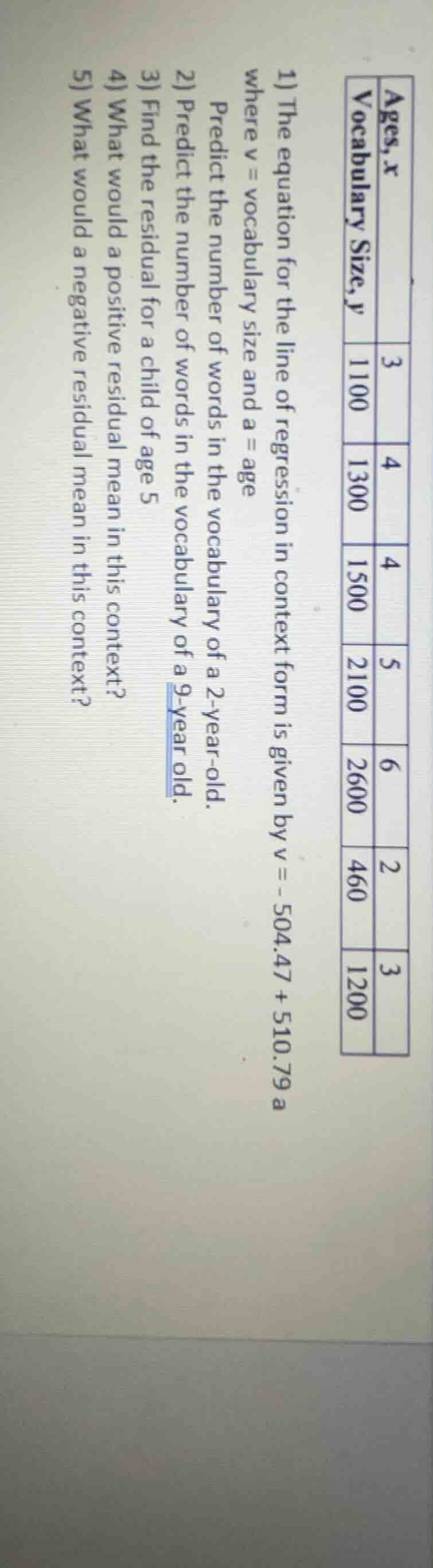
ages, x | vocabulary size, y
3 | 1100
4 | 1300
4 | 1500
5 | 2100
6 | 2600
2 | 460
3 | 1200
- the equation for the line of regression in context is given by v = -504.47 + 510.79 a where v = vocabulary size and a = age
predict the number of words in the vocabulary of a 2-year-old.
- predict the number of words in the vocabulary of a 9-year old.
- find the residual for a child of age 5
- what would a positive residual mean in this context?
- what would a negative residual mean in this context?
Sub - question 2: Predict the number of words in the vocabulary of a 9 - year - old.
Step 1: Identify the regression equation
The given regression equation is \(v=- 504.47 + 510.79a\), where \(v\) is the vocabulary size and \(a\) is the age.
Step 2: Substitute \(a = 9\) into the equation
Substitute \(a = 9\) into \(v=-504.47+510.79a\).
\(v=-504.47 + 510.79\times9\)
First, calculate \(510.79\times9=4597.11\)
Then, \(v=-504.47 + 4597.11=4092.64\)
Step 1: Find the predicted vocabulary size for \(a = 5\)
Using the regression equation \(v=-504.47+510.79a\), substitute \(a = 5\).
\(v=-504.47+510.79\times5\)
Calculate \(510.79\times5 = 2553.95\)
Then \(v=-504.47+2553.95 = 2049.48\)
Step 2: Find the actual vocabulary size for \(a = 5\)
From the table, when \(a = 5\), the actual vocabulary size \(y = 2100\)
Step 3: Calculate the residual
Residual \(= \text{Actual}-\text{Predicted}\)
Residual \(=2100 - 2049.48=50.52\)
A residual is calculated as \(\text{Residual}=\text{Actual Vocabulary Size}-\text{Predicted Vocabulary Size}\). A positive residual means that the actual vocabulary size of the child (at a given age) is greater than the vocabulary size that was predicted by the regression equation for that age.

Snap & solve any problem in the app
Get step-by-step solutions on Sovi AI
Photo-based solutions with guided steps
Explore more problems and detailed explanations
The predicted number of words in the vocabulary of a 9 - year - old is \(4092.64\)