QUESTION IMAGE
Question
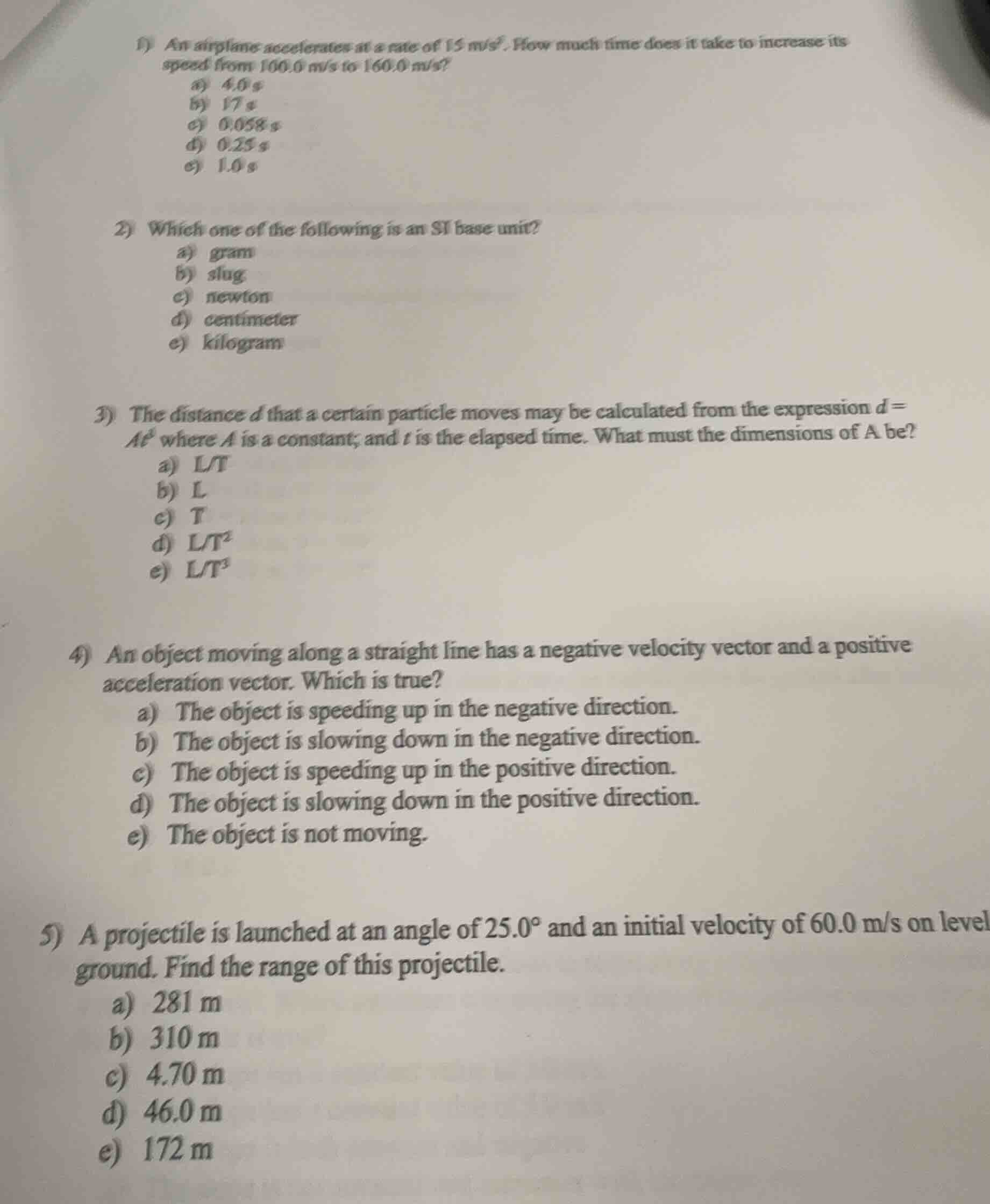
- an airplane accelerates at a rate of $15\\ \text{m/s}^2$. how much time does it take to increase its speed from 100.0 m/s to 160.0 m/s?
a) 4.0 s
b) 17 s
c) 0.058 s
d) 0.25 s
e) 1.0 s
- which one of the following is an si base unit?
a) gram
b) slug
c) newton
d) centimeter
e) kilogram
- the distance $d$ that a certain particle moves may be calculated from the expression $d = at^3$ where $a$ is a constant; and $t$ is the elapsed time. what must the dimensions of $a$ be?
a) l/t
b) l
c) t
d) $l/t^2$
e) $l/t^3$
- an object moving along a straight line has a negative velocity vector and a positive acceleration vector. which is true?
a) the object is speeding up in the negative direction.
b) the object is slowing down in the negative direction.
c) the object is speeding up in the positive direction.
d) the object is slowing down in the positive direction.
e) the object is not moving.
- a projectile is launched at an angle of $25.0^\circ$ and an initial velocity of 60.0 m/s on level ground. find the range of this projectile.
a) 281 m
b) 310 m
c) 4.70 m
d) 46.0 m
e) 172 m
Problem 1:
Step1: Recall acceleration formula
Acceleration $a = \frac{v_f - v_i}{t}$, rearrange to $t = \frac{v_f - v_i}{a}$
Step2: Substitute given values
$v_f=160.0\ \text{m/s}$, $v_i=100.0\ \text{m/s}$, $a=15\ \text{m/s}^2$
$t = \frac{160.0 - 100.0}{15} = \frac{60}{15} = 4.0\ \text{s}$
Problem 2:
Step1: Identify SI base units
SI base units include kilogram, meter, second, etc. Eliminate non-base units: gram (derived, metric prefix), slug (imperial), newton (derived force unit), centimeter (derived, metric prefix). Only kilogram is an SI base unit.
Problem 3:
Step1: Write dimension equation
$[d] = [A][t^3]$, $[d]=L$, $[t]=T$, so $L = [A]T^3$
Step2: Solve for $[A]$
$[A] = \frac{L}{T^3}$
Problem 4:
Step1: Analyze velocity-acceleration sign
Negative velocity means motion in negative direction; positive acceleration means acceleration in positive direction (opposite to velocity). Opposite signs mean the object slows down in its current direction (negative direction).
Problem 5:
Step1: Recall projectile range formula
$R = \frac{v_0^2 \sin(2\theta)}{g}$, where $g=9.81\ \text{m/s}^2$
Step2: Substitute given values
$v_0=60.0\ \text{m/s}$, $\theta=25.0^\circ$
$2\theta=50.0^\circ$, $\sin(50.0^\circ)\approx0.7660$
$R = \frac{(60.0)^2 \times 0.7660}{9.81} = \frac{3600 \times 0.7660}{9.81} = \frac{2757.6}{9.81} \approx 281\ \text{m}$

Snap & solve any problem in the app
Get step-by-step solutions on Sovi AI
Photo-based solutions with guided steps
Explore more problems and detailed explanations
- a) 4.0 s
- e) kilogram
- e) $L/T^3$
- b) The object is slowing down in the negative direction.
- a) 281 m