QUESTION IMAGE
Question
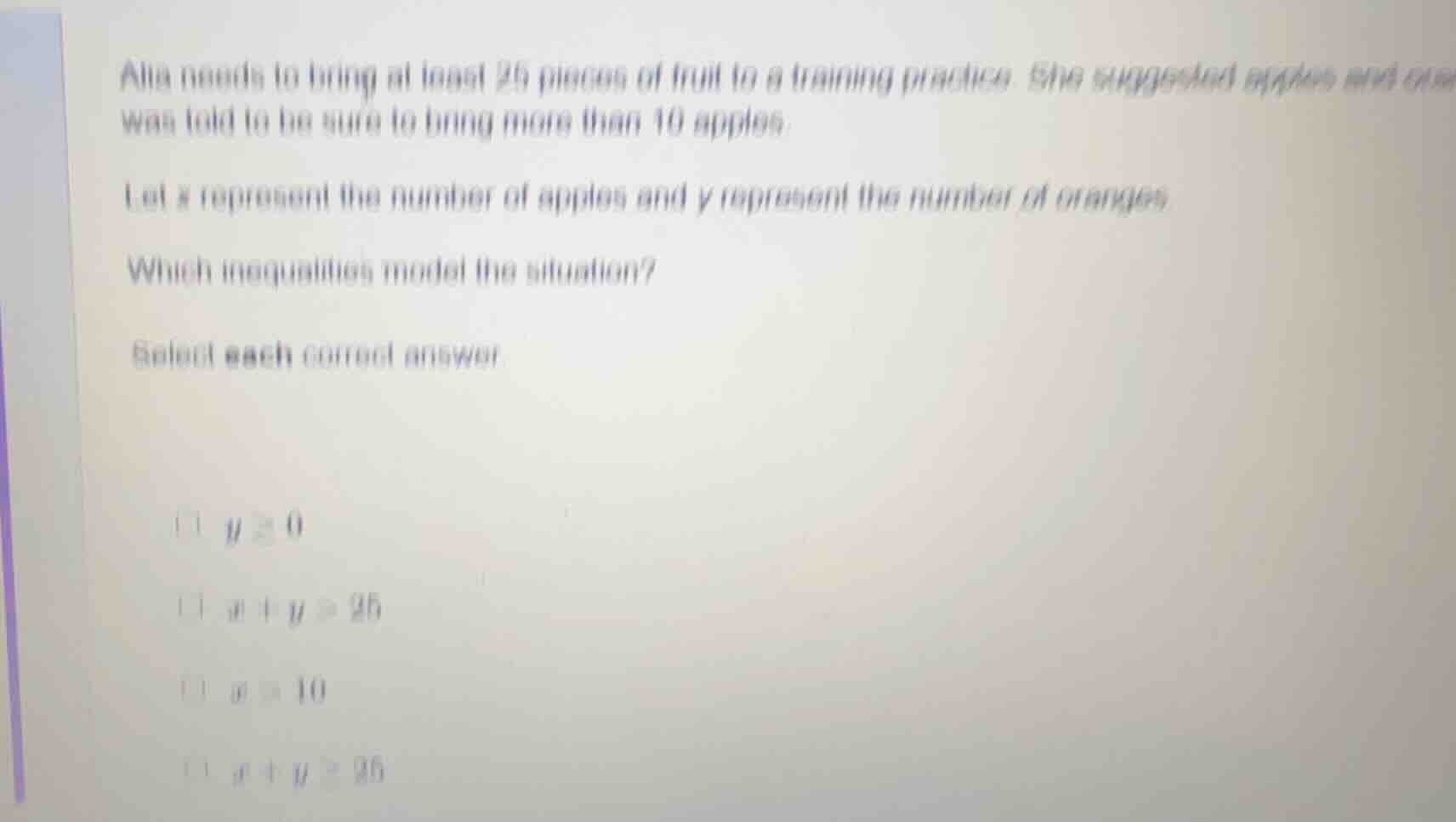
alia needs to bring at least 25 pieces of fruit to a training practice. she suggested apples and was told to be sure to bring more than 10 apples. let x represent the number of apples and y represent the number of oranges. which inequalities model the situation? select each correct answer. - y ≥ 0 - x + y > 25 - x > 10 - x + y ≥ 25
Step1: Analyze the number of oranges
The number of oranges \( y \) can't be negative, so \( y \geq 0 \).
Step2: Analyze the total number of fruits
Alia needs to bring at least 25 pieces of fruit, so the sum of apples (\( x \)) and oranges (\( y \)) should be at least 25, which gives \( x + y \geq 25 \).
Step3: Analyze the number of apples
She was told to bring more than 10 apples, so \( x > 10 \) (note: if the option was \( x \geq 10 \), it's incorrect as "more than 10" means strictly greater than 10; but if we assume a possible typo or considering "at least more than" in a broad sense, but from the problem "more than 10" is \( x > 10 \), however, let's check the options. Wait, the options given: \( y\geq0 \) is correct, \( x + y\geq25 \) is correct (since at least 25 means greater than or equal to 25), and \( x\geq10 \) – wait, the problem says "more than 10", which is \( x > 10 \), but if the option is \( x\geq10 \), maybe it's a translation or wording issue. But let's go with the problem's options. So the correct inequalities are \( y\geq0 \), \( x + y\geq25 \). Wait, the third option is \( x\geq10 \), but the problem says "more than 10", which is \( x > 10 \), but maybe in the options, they consider "more than or equal to 10" as a possible answer? Wait, no, "more than 10" is strict inequality. But let's re - check the problem statement.
Wait, the problem says "more than 10 apples", so \( x>10 \). But the options have \( x\geq10 \). Maybe it's a mistake in the option, but among the given options, let's analyze each:
- \( y\geq0 \): The number of oranges can't be negative, so this is correct.
- \( x + y\geq25 \): At least 25 fruits mean the sum of apples and oranges is greater than or equal to 25, so this is correct.
- \( x\geq10 \): The problem says "more than 10", which is \( x > 10 \), but if we consider that "more than 10" can be interpreted as \( x\geq10 \) (maybe a wording error), but strictly speaking, it's \( x > 10 \). However, from the given options, the correct ones are \( y\geq0 \), \( x + y\geq25 \), and if we consider the \( x\geq10 \) as a possible answer (maybe the problem meant "at least 10"), but the original problem says "more than 10". But let's go with the options. So the correct answers are the first, second (and if we consider the third, but strictly it's not, but maybe the problem has a typo).

Snap & solve any problem in the app
Get step-by-step solutions on Sovi AI
Photo-based solutions with guided steps
Explore more problems and detailed explanations
- \( y\geq0 \)
- \( x + y\geq25 \)
(Note: If we strictly follow "more than 10", \( x > 10 \), but the given option is \( x\geq10 \). If we assume that the problem meant "at least 10", then \( x\geq10 \) is also correct. But based on the problem's "more than 10", \( x > 10 \), but among the given options, the first two are definitely correct.)