QUESTION IMAGE
Question
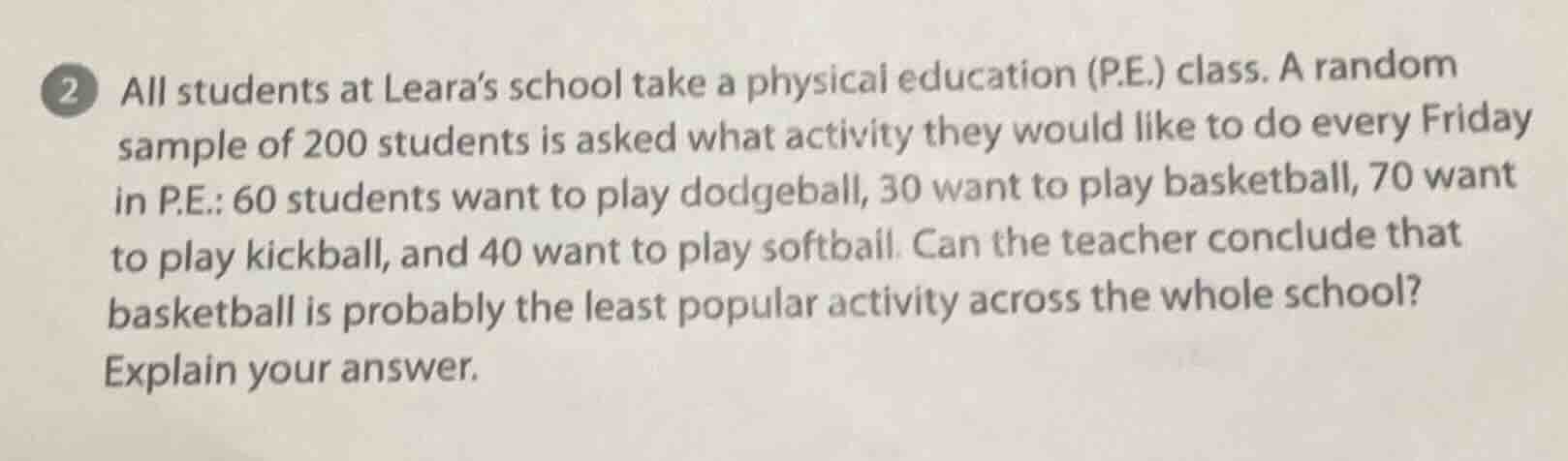
2 all students at leara’s school take a physical education (p.e.) class. a random sample of 200 students is asked what activity they would like to do every friday in p.e.: 60 students want to play dodgeball, 30 want to play basketball, 70 want to play kickball, and 40 want to play softball. can the teacher conclude that basketball is probably the least popular activity across the whole school? explain your answer.
- First, analyze the sample data: In the sample of 200 students, the number of students who want to play each sport is: dodgeball (60), basketball (30), kickball (70), softball (40).
- Compare the numbers: 30 (basketball) is the smallest among 60, 30, 70, and 40 in the sample.
- Consider the nature of random sampling: A random sample is intended to be representative of the whole population (all students in the school). If the sample is random and properly selected, the proportions in the sample can be used to make inferences about the population. Since basketball has the lowest number of students who want to play it in the random sample, it is reasonable to infer that basketball is likely the least popular activity in the whole school, although there is still some uncertainty (e.g., sampling error), but based on the sample data, this conclusion is probable.

Snap & solve any problem in the app
Get step-by-step solutions on Sovi AI
Photo-based solutions with guided steps
Explore more problems and detailed explanations
Yes, the teacher can conclude that basketball is probably the least popular activity across the whole school. In the random sample of 200 students, the number of students who want to play basketball (30) is less than the number of students who want to play dodgeball (60), kickball (70), and softball (40). A random sample is meant to represent the whole population, so the lower count for basketball in the sample suggests it is likely the least popular in the entire school (while acknowledging some sampling uncertainty).