QUESTION IMAGE
Question
4
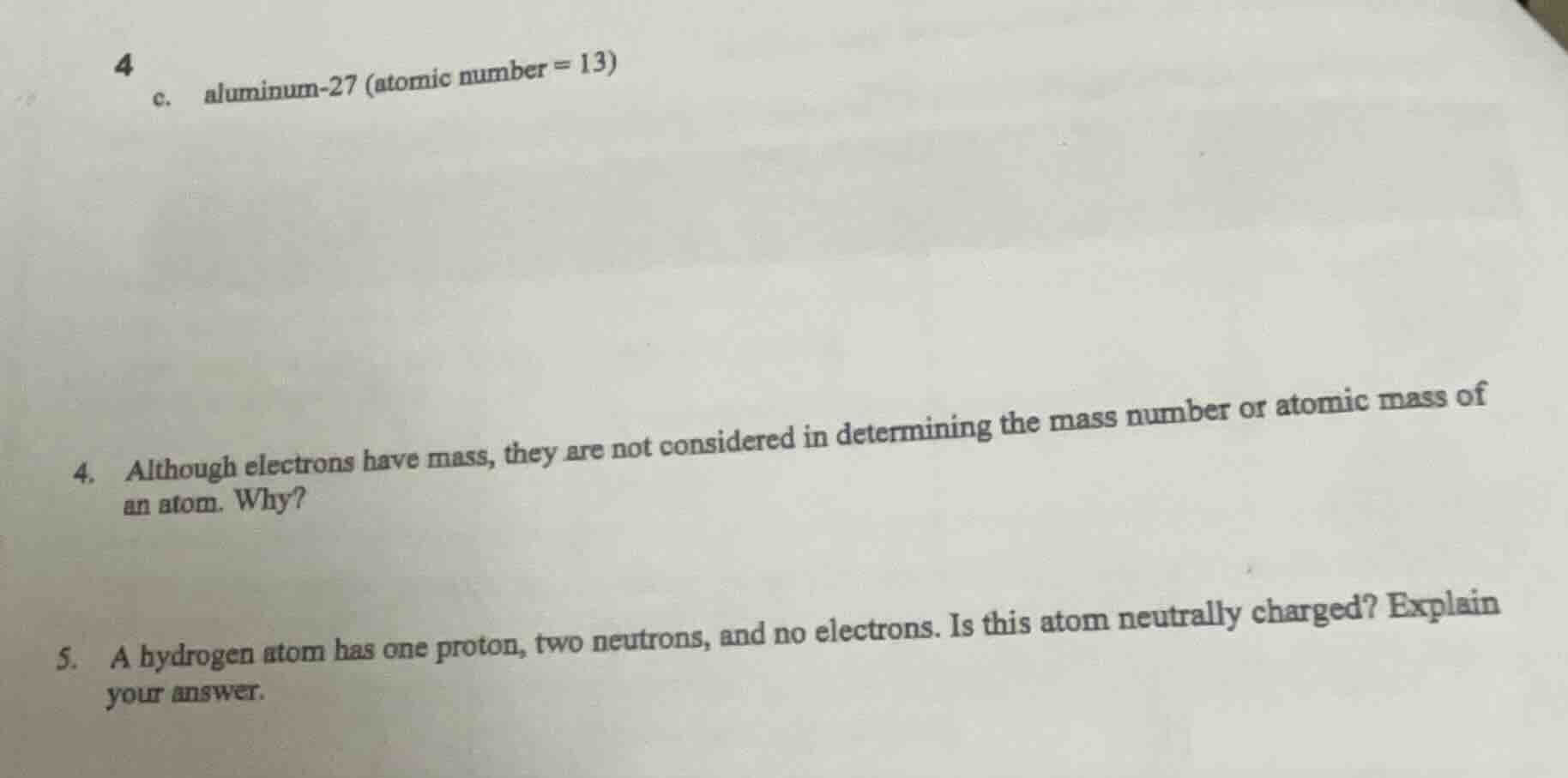
c. aluminum-27 (atomic number = 13)
- although electrons have mass, they are not considered in determining the mass number or atomic mass of an atom. why?
- a hydrogen atom has one proton, two neutrons, and no electrons. is this atom neutrally charged? explain your answer.
Brief Explanations
- (For question 4) The mass of an electron is approximately $\frac{1}{1836}$ the mass of a proton. This tiny mass is so insignificant that it does not meaningfully affect the total mass number or atomic mass of an atom, so it is ignored in these calculations.
- (For question 5) A neutral atom has an equal number of positively charged protons and negatively charged electrons. This hydrogen atom has 1 positively charged proton and 0 negatively charged electrons, resulting in a net positive charge of +1, so it is not neutral. Neutrons have no charge and do not affect the overall electrical charge of the atom.

Snap & solve any problem in the app
Get step-by-step solutions on Sovi AI
Photo-based solutions with guided steps
Explore more problems and detailed explanations
- (For question 4) Electrons are excluded because their mass is negligible compared to protons and neutrons.
- (For question 5) No, the atom is not neutrally charged; it has a +1 charge.